
• Recipes
    • Beef and Red Meat
    • Chicken and Poultry
    • Pork
    • Fish and Seafood
    • Eggs
    • Soups
    • Salads
    • Sides, Veggies and Appetizers
    • Sauces, Dips & Vinaigrettes
    • Drinks
    • Sweets and Snacks
    • Cooking Tips
  • Learn
  • Your Starting Point
    • Topic Index
    • Paleo 101
    • Paleo Meal Plan
    • Paleo Food List
    • Transitioning to Paleo
    • Am I Doing it Right? - Checklist
    • Mini-Course for Beginners
  • Popular Topics
    • Recipes for Beginners
    • Breakfast Ideas
    • Homemade Condiments
    • Legumes
    • Wheat & Gluten
    • Dairy
    • Nightshades
  • More
    • Compilations
    • Foods
menu icon
go to homepage
  • Recipes
  • Chicken
  • Pork
  • Snacks
  • Salads
  • Learn Paleo
  • Paleo Cooking Tips
  • Paleo Diet Foods
  • Paleo Recipe Compilations
  • Keto Diet Recipes
  • Paleo Beef and Red Meat Recipes
  • Paleo Drink Recipes
  • Paleo Egg Recipes
  • Paleo Fish and Seafood Recipes
  • Paleo Sauces and Dips
  • Paleo Sides, Veggies and Appetizers
  • Paleo Soup Recipes
  • Paleo Tips & Tricks
  • Paleo Topic Index
    • Facebook
    • Instagram
    • Pinterest
    • Twitter
    • YouTube
  • search icon
    Homepage link
    • Recipes
    • Chicken
    • Pork
    • Snacks
    • Salads
    • Learn Paleo
    • Paleo Cooking Tips
    • Paleo Diet Foods
    • Paleo Recipe Compilations
    • Keto Diet Recipes
    • Paleo Beef and Red Meat Recipes
    • Paleo Drink Recipes
    • Paleo Egg Recipes
    • Paleo Fish and Seafood Recipes
    • Paleo Sauces and Dips
    • Paleo Sides, Veggies and Appetizers
    • Paleo Soup Recipes
    • Paleo Tips & Tricks
    • Paleo Topic Index
    • Facebook
    • Instagram
    • Pinterest
    • Twitter
    • YouTube
  • ×
    Home » You searched for salad

    Search Results for: salad

    Infographic: Intro to Ketosis & the Keto Diet

    July 5, 2018 by Paleo Leaper Leave a Comment

    Jump to infographic

    What is Ketosis?

    Ketosis is when your body primarily runs on fat, not carbohydrates, for energy. You don’t have to be in ketosis to be Paleo, but it’s useful for some people as an optional tweak for weight loss, mental health, or other benefits.

    Just the Basics:

    • Keep net carbs very low. 30-50 grams is a good rule of thumb. You will have to exclude all grains, all legumes, and all starchy vegetables, but it’s OK to eat low-carb vegetables (there’s a list below)
    • Keep protein moderate. Too much protein will throw you out of ketosis.
    • Focus on fat. Fat should be your primary calorie source, around 80-85% of calories.

    On the plate

    Fatty Meat.

    Forget chicken breast; think bacon and ribs.

    Non-starchy vegetables.

    Vegetables make your meals more interesting, and also provide electrolytes (potassium, and magnesium), which prevent cramping.

    Fruit.

    Watch your fruit intake; it can easily bump up your carb count.

    Lean meats.

    Too much protein will kick you out of ketosis. If you eat a chicken breast, smother it in butter or wrap it in bacon.

    No grains, legumes, potatoes, and starchy vegetables. These have too many carbs; they’re not good for ketosis.


    What vegetables can I eat?

    For ketosis purposes, vegetables are all about net carbs. Fiber doesn’t count as a “carb,” so the total carb count on the Nutrition Facts panel may be misleading. Here’s a quick guide:

    Eat Up!

    Endive, bok chook, broccoli raab, celery, asparagus, eggplant, jicama, bell peppers, cabbage, cauliflower, cucumber, mushrooms, zucchini, radishes, lettuce (and other salad greens), broccoli, and leafy green vegetables (spinach, Swiss chard, collards, kale).

    Once a day or small serving

    Turnips, Brussels sprouts, pumpkin, beets, carrots, okra, tomatoes, onions.

    Limit or avoid

    Butternut squash (and most other winter squash), parsnips, potatoes, sweet potatoes.


    Ketosis Superstars

    Coconut oil

    The specific fat in coconut oil is very ketogenic and will help you get and stay in ketosis.

    Avocados

    Avocados have important nutrients and they’re a nice change from animal fat.

    Eggs

    Eggs are one of the most nutrious foods around: make sure to eat the yolks!

    Grass-fed dairy (if you tolerate dairy)

    Dairy is easy, affordable, and delicious source of fat. Go for full-fat products like butter.


    So... what do I cook?

    Here's a sample menu:

    • Breakfast: 3 eggs fried in coconut oil; sautéed spinach (cooked in more coconut oil).
    • Lunch: Grilled steak salad and 1 whole avocado.
    • Snack: 1 ounce of roasted almonds.
    • Dinner: Asian-style beef ribs and asparagus ribbons with lemon dressing.
    • Dessert: 1 cup of berries with as much coconut cream as you can pile on.

    Want to learn more?

    Try our Keto 101 guide for a more in-depth explanation of what ketosis is and how it works.


    Infographic

    Use the code below to embed this infographic on your website:
    Filed Under: Learn About Paleo & Keto Diets

    FODMAPs Food List (Infographic)

    June 29, 2018 by Paleo Leaper Leave a Comment

    Food List

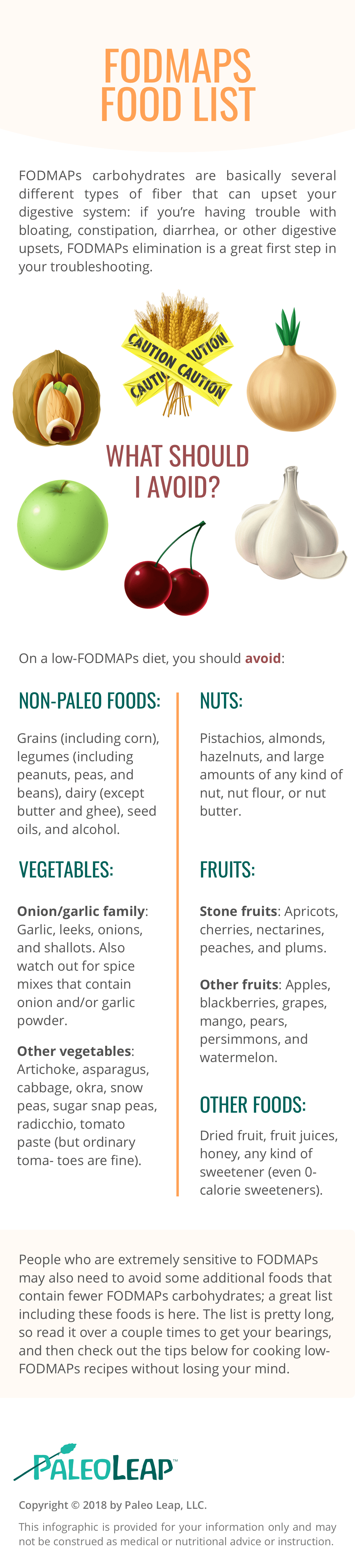
    FODMAPs carbohydrates are basically several different types of fiber that can upset your digestive system: if you’re having trouble with bloating, constipation, diarrhea, or other digestive upsets, FODMAPs elimination is a great first step in your troubleshooting.


    On a low-FODMAPs diet, you should avoid:

    NON-PALEO FOODS:

    • Grains (including corn), legumes (including peanuts, peas, and beans), dairy (except butter and ghee), seed oils, and alcohol.

    VEGETABLES:

    • Onion/garlic family: Garlic, leeks, onions, and shallots. Also watch out for spice mixes that contain onion and/or garlic powder.
    • Other vegetables: Artichoke, asparagus, cabbage, okra, snow peas, sugar snap peas, radicchio, tomato paste (but ordinary toma- toes are fine).

    NUTS:

    • Pistachios, almonds, hazelnuts, and large amounts of any kind of nut, nut flour, or nut butter.

    FRUITS:

    • Stone fruits: Apricots, cherries, nectarines, peaches, and plums.
    • Other fruits: Apples, blackberries, grapes, mango, pears, persimmons, and watermelon.

    OTHER FOODS:

    • Dried fruit, fruit juices, honey, any kind of sweetener (even 0-calorie sweeteners).

    People who are extremely sensitive to FODMAPs may also need to avoid some additional foods that contain fewer FODMAPs carbohydrates; a great list including these foods is here. The list is pretty long, so read it over a couple times to get your bearings, and then check out the tips below for cooking low-FODMAPs recipes without losing your mind.

    Cooking on a low-FODMAPs diet

    There are two parts to this section. Part 1 has recipes that are low-FODMAPs exactly as written. Part 2 has some strategic substitutions for onions and garlic, to help you modify recipes without losing flavor.

    Part 1: low-FODMAPs Paleo recipes

    Paleo recipes

    On this list, recipes without a * use only ingredients that are considered totally safe. Recipes with a * also include ingredients that are considered safe in small amounts. If you’re extremely sensitive to FODMAPs, then avoid the recipes marked with the *, but most people should be fine with them.

    Main courses

    • Barbecued sirloin in Dijon
    • Lemon and Thyme Lamb Cutlets
    • Lemon Chicken Kebabs
    • Chicken with Creamy Sun-Dried Tomato Sauce
    • Ginger Citrus roast Chicken
    • Butter Chicken
    • * Grilled Lemon-Herb Zucchini with sole (very small amount of pine nuts)
    • Oysters Kilpatrick
    • Whole Grilled (or Baked) Trout
    • Fish Fillets with Mint and Pepper salsa
    • Eggs Benedict and Ham
    • BLT Dressed eggs
    • * Zucchini and sweet Potato Frittata (sweet potatoes are on the “caution” list, but you could always replace them with white potatoes, which are completely safe).

    Salads and sides

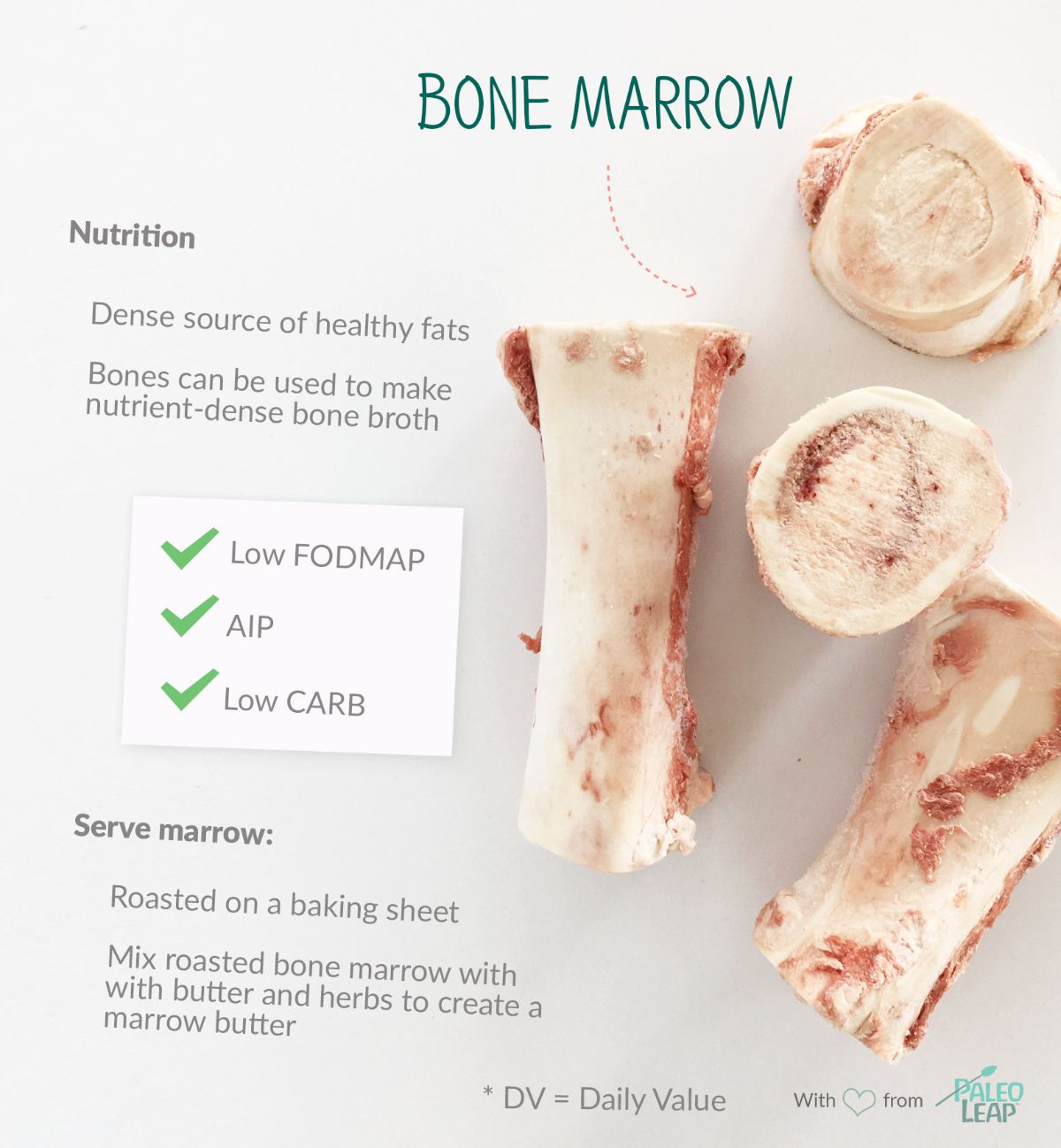
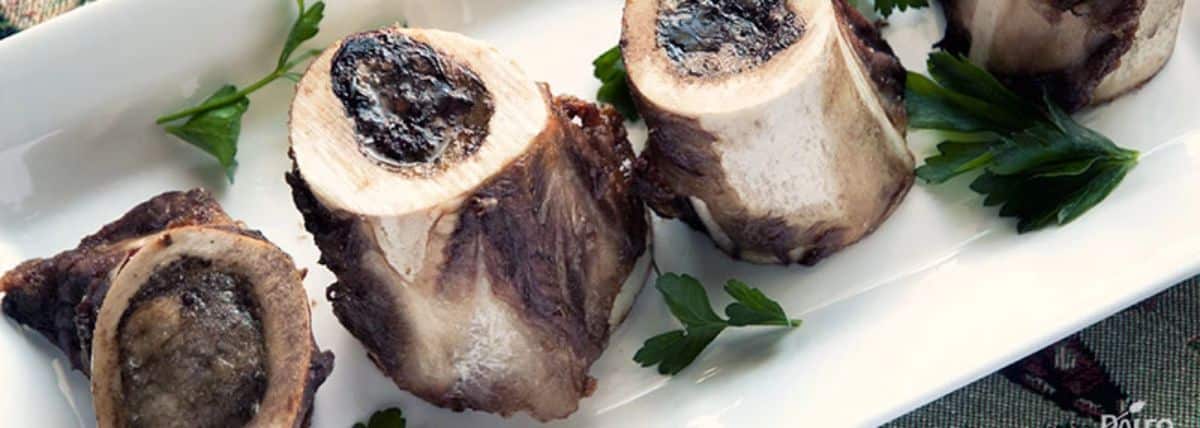
    • Roasted Bone Marrow
    • *Spicy Sweet Potato Wedges or Sweet Potato Fries
    • Butternut Squash Fries
    • Mint Zucchini or Oven Roasted Cauliflower
    • Roasted Cauliflower with Mint and Pomegranate
    • *Sweet Potato Casserole (contains sweet potatoes and a small amount of walnuts)
    • Egg Drop Soup
    • *Sweet Potato Lime Soup
    • Cream of Tomato Basil Soup (tomatoes are safe, but a whole lot of tomatoes at once can be iffy; if you’re extremely FODMAPs sensitive, you may want to avoid this dish)
    • Butternut Squash Soup

    Snacks, desserts and others

    • Pork Rinds
    • Blueberry Cucumber Smoothie
    • Kale chips
    • Strawberry Rhubarb Lemonade

    Part 2: Onion and garlic substitutions

    Onions and garlic are often the only things that stand between a delicious dinner and a low-FODMAPs diet. Unfortunately, these common ingredients are also some of the worst offenders where FODMAPs are concerned, so even just a little is often dangerous. But now comes the good news: you can still get the same taste! You just have to get a little creative. Two great strategies include:

    • Infused oils. The FODMAPs themselves aren’t fat-soluble, but the chemicals that give onions and garlic their flavor are. So oils infused with onion or garlic give you all the flavor without the stomachache. Make your own at home by heating on- ions and/or garlic in oil (and then storing any extras in the fridge), or get pre-made infused oils at the grocery store.
    • Asafetida (ass-uh-FeH-ti-duh) powder + celery. Asafetida powder smells dis- gusting raw, it’s true, but when cooked it tastes and smells a lot like onions
      and garlic. Beware when you’re using it: a little bit goes a long way, so err on the side of stinginess. The celery isn’t for flavor, but if you miss the texture of onions as well as the taste, well-cooked celery is a decent substitute.

    Below are some recipes where you could use these substitutions to good effect. In general, if you just want the flavor (as in a marinade), the infused oils are the best choice; if you want the texture as well, go for the asafetida and celery.

    Infused oils

    • Grilled Steak And Summer Vegetables (leave out the onions in the grilled vegetables. For the marinade, take out the garlic and use garlic-infused olive oil instead)
    • Herb and Prosciutto Stuffed Steak (garlic in the marinade)
    • Bacon-Wrapped Roast Beef  (garlic)
    • Zaatar Grilled Chicken (garlic)
    • Chicken with Mushroom Cream Sauce (shallot)
    • Porchetta (garlic)
    • Pork Roast with Dijon Glaze  (replace the garlic in the rub with garlic-infused oil in the glaze)
    • Grilled Salmon-Tomato Skewers (garlic)
    • Tuna Steak with Avocado and Cilantro (garlic)
    • Spicy Scallop Salad (garlic)
    • Roasted Bell Peppers (garlic)
    • Marinaded Beets (onion)

    Asafetida and Celery

    • Veal Paupiette (shallots)
    • Lamb and Sweet Potato Cottage Pie (garlic and onion)
    • Hearty Beef Stew (onion)
    • Braised Duck Legs with Vegetables (onions and garlic)
    • Canned Pork (onions)
    • Egg In A Jar (onions)
    • Irish Kidney Soup (onions)

    Another tip is that if you’re using leeks or scallions, it’s perfectly safe to use just the green tops, since all the FODMAPs are in the bulb. So for example, in the tuna burger recipe or for lomi lomi salmon, you can prepare it exactly as written but just make sure to use only the tops of the scallions.

    Hopefully this collection of recipes is helpful to anyone trying a low-FODMAPs diet or even just a 30-day elimination. Reducing FODMAPs in your diet doesn’t mean you have to do without delicious food!


    Here's the FODMAPs food list in an infographic format, for your reference:
    Filed Under: Learn About Paleo & Keto Diets

    Fiber for High-Fat Paleo Diets: Why You Need It and Where to Get It

    June 12, 2018 by Paleo Leaper Leave a Comment

    High Fat Paleo

    Why do real people eating Paleo or keto diets get such amazing health benefits even though studies of “high-fat diets” constantly suggest that eating lots of fat will give you everything from colon cancer to diabetes?

    One possible reason: most “high-fat” study diets are also (a) pretty high in sugar and (b) very low in fiber. Instead of calling them “high-fat” diets, it would be more accurate to call them “high-junk” diets because they mimic the nutrition you’d get from junk food.

    That’s useful if you want to study the typical American diet (ice cream, potato chips, cheese on everything, not a vegetable in sight) but not actually helpful at all if you’re thinking about a high-fat Paleo diet (butter, eggs, avocados, all on top of a big pile of vegetables). One key difference between Paleo and the typical Western diet is taking out fiber-poor processed carbs and adding in fiber-rich unprocessed carbs (typically in much smaller quantities).

    Here’s how fiber fits in as a complement to the fat in a Paleo-style diet: why it’s helpful, where to get it, what to do if you have a FODMAPs sensitivity or a similar issue, and the scoop on supplements.

    Fiber and Fat: They’re Better Together

    The short version: fiber and fat help smooth out each other’s rough edges and fill in each other’s gaps.

    The benefits of eating fiber on a high-fat diet include…

    • Better nutrient absorption: fat helps you absorb the fat-soluble nutrients found in fiber-rich vegetables, like vitamins A and E. In fact, certain types of fiber even reduce absorption of antioxidants from fruits and vegetables, but fat reduces this problem.
    • Balanced calorie density: fat is super calorie-dense (it has a lot of calories per bite), but fiber is exactly the opposite. Fiber is one of the most filling, least calorie-dense nutrients you can eat. Meals rich in both (e.g., broccoli with butter, salad with olive oil) get you to that happy median where you can just eat until you feel full without gaining weight.

    Weight-loss and metabolic benefits via better gut health

    Another reason to pair fat and fiber is the benefits for weight loss, insulin sensitivity, metabolic function, and liver health...all of which come indirectly through your gut.

    Let’s start off with this study. There were a bunch of diets in the study, but the interesting one is the high-fat, high-protein, low-carb (22 grams net carbs) diet. The low-carb folks weren’t eating junk; they got common low-carb foods like scrambled eggs for breakfast. They ended up eating less than 9 grams of fiber per day, on average.

    The low-carb diet…

    • Reduced total production of butyrate, an anti-inflammatory, cancer-protective fat
    • Reduced the number of good bacteria in the gut
    • Reduced the number of fiber-derived antioxidants (yes, you can make antioxidants from fiber! So cool!)

    They did lose weight, but this isn’t exactly the greatest of possible outcomes.

    This study showed that a high-fat, low-carb diet without fiber isn’t ideal, but there’s also evidence from animal studies that adding more fiber - without necessarily adding more net carbs - helps reduce/prevent these problems.

    Take this study, for example. Mice ate a high-fat diet without fiber and it messed up their gut biome and increased inflammation. But if the mice got prebiotic fiber, inflammation went down and glucose tolerance improved. This one also found that eating more beta-glucans (soluble fibers found in plant cell walls) reduced weight gain, normalized appetite hormones, and improved insulin sensitivity in mice eating a high-fat diet.

    In this paper, another type of fiber, chitin-glucan, made slightly different changes to the gut biome. In this case, researchers fed mice a high-fat diet and found that all the junk food reduced the concentration of a specific type of bacteria (clostridial cluster XIVa, for the curious). But the fiber completely resolved the problem, normalized the gut bacteria, and also “significantly decreased [high-fat diet]-induced body weight gain, fat mass development, fasting hyperglycemia, glucose intolerance, hepatic triglyceride accumulation and hypercholesterolemia, independently of the caloric intake.” Not bad!

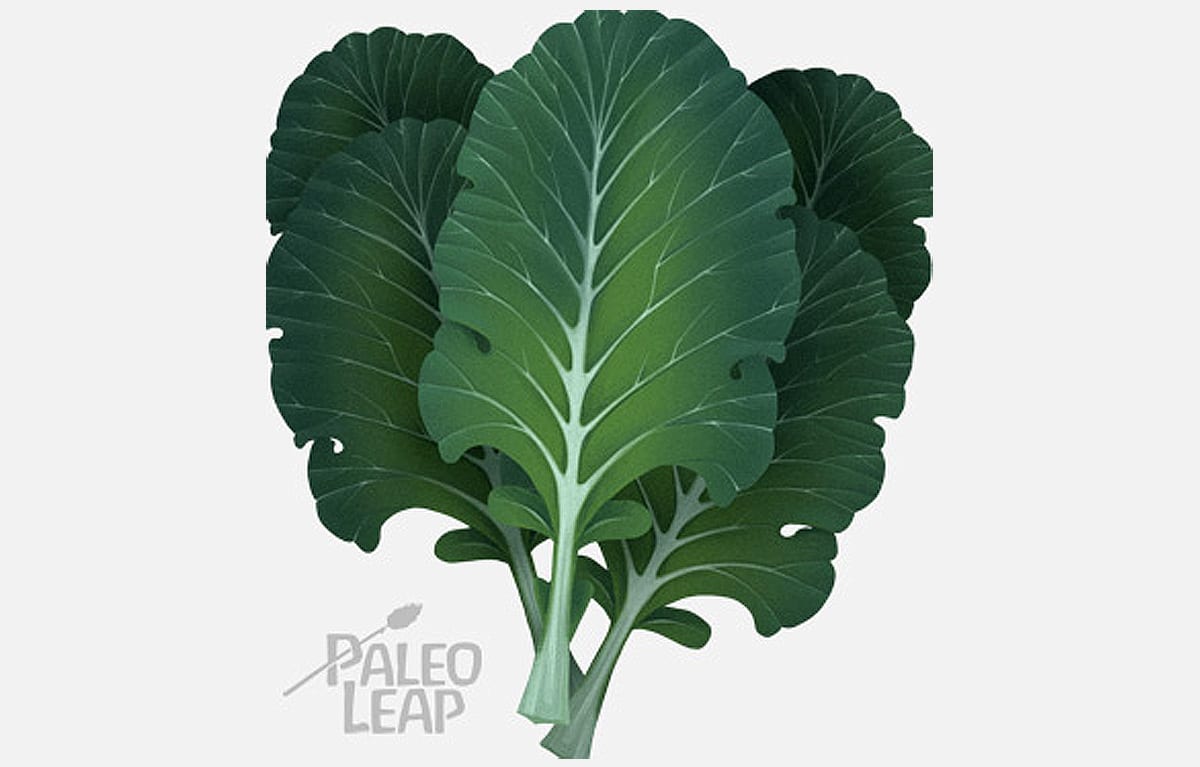
    collards
    "Eat me!"

    Here’s another study, this one on mice specifically bred to get heart disease. The mice got either a high-fat diet with no fiber or a high-fat diet with some fiber. The fiber group had much lower accumulation of plaque in the arteries (atherosclerosis). And one more: in this study, the combination of Omega-3 fats (from fish oil) and pectin (a type of fiber found in apples and a lot of other fruits) had unique benefits for preventing colon cancer. The researchers explained the effect by pointing to changes in gene expression in the colon.

    In the case of the mouse studies, it’s a little bit muddier because the “high-fat” diets were sometimes also pretty high in junk carbs, so they weren’t the same type of whole-foods high-fat diet in the human study. But from the human study, it’s pretty clear that even whole-foods high-fat/low-carb diets aren’t ideal for gut health if they don’t get you enough fiber. This study confirms: lack of fiber is bad even if you aren't eating junk carbs.

    The main point is that high-fat diets without any fiber do sometimes cause problems for gut health. When you take out junk carbs (if applicable) and add in fiber, the “high-fat diet” starts looking a lot better!

    Fiber choices for low-carb diets

    Now for the practical side. Fiber doesn’t just come from oat bran! Some fiber-rich low-carb foods include…

    Food nameNet carbs (grams)Total fiber (grams)
    Asparagus - 1 cup, raw3.42.8
    Almonds - ¼ of a cup33
    Eggplant - 1 cup, raw2.32 2.5
    Cauliflower - 1 cup raw3.222.1
    Collard greens - 1 cup raw0.451.4
    Summer squash (e.g., zucchini) - 1 cup, measured raw2.591.2
    Lettuce - 1 cup shredded.551.0
    Spinach - 1 cup raw0.390.7

    Even from the random selection of vegetables above, it’s pretty easy to beat the measly 9 grams of fiber that the men were getting in the study above! You could even stay within their carb limit of 22 net carbs and get more than 9 grams of fiber! It’s not actually that hard and it doesn’t require supplements, just vegetable-heavy meal planning.

    What if I have a fiber sensitivity?

    Some people are legitimately oversensitive to fiber - especially a particular group of fiber types called FODMAPs (learn about FODMAPs in more detail here). When they eat fiber-rich foods, they get symptoms from gas and bloating to constipation/diarrhea to awful abdominal pain.

    If that’s you, all the fuss about fiber might seem really annoying: sure, it would be great, if only you could eat the stuff without spending all afternoon on the toilet! One common first step is probiotics - finding a good probiotic can be tricky (tips here) but they do make all the difference to some people.

    One strategy to try is to eliminate only the worst offenders (typically onions, garlic, brassica vegetables like broccoli and cabbage, and huge amounts of fruit, plus anything that specifically bothers you personally). If that fixes you, then you’re totally fine because there are tons of other fiber-rich foods left in the world for you to eat! If your symptoms are worst/only there with fruit, it might be a problem with fructose/fructans and you might be just fine with vegetables instead.

    If nothing else works, some people really do need a low-fiber diet as a therapeutic intervention, at least temporarily. But it might be worth coming back to a fiber experiment in a few months after giving your gut time to heal.

    Can I just take a supplement?

    Probably not. As this study puts it:

    “Fiber supplements cannot be presumed to have the same health benefits that are associated with dietary fiber that is intact and intrinsic in whole foods. The clinically proven health benefits for fiber supplements are associated with specific characteristics (eg, viscous gel), and only a minority of marketed fiber products provide health benefits"

    All of the studies above used different types of fiber that are found in different plants, suggesting that there’s no one magically perfect fiber choice.

    Summing it up

    A typical Western diet is high in fat and low in fiber, which is probably one reason why Western diets cause so many health problems. But if your high-fat diet is also high in fiber (even if it’s low in digestible carbs), it’s a completely different story.

    Filed Under: Learn About Paleo & Keto Diets

    Keto Paleo meal prep: tips and ideas

    May 17, 2018 by Paleo Leaper Leave a Comment

    meal prep

    Meal prep is a lifesaver for busy people who want to eat home-cooked meals without spending all day in the kitchen. The basic concept is simple: whatever needs cooking, cook it all in one big batch at the beginning of the week, pack it out into individual serving containers, and then just grab and go Monday-Friday.

    Making your food in batches saves you time and energy on hectic weeknights. But here’s the real draw: you’ll only have to wash one single set of cooking dishes. Any Paleo cook can attest that reducing the pile of dirty dishes in the sink is huge for overall chef satisfaction!

    When it comes to a keto-style Paleo diet, meal prep can be a bit different, but once you get the hang of it, it’s not bad. Here’s a look at the basics: how to get enough fat in without drowning every salad in oil, how to add variety without adding a lot of prep time, and how to make delicious keto meals that travel and reheat well (or go down well cold).

    Getting the macros right

    Traditional non-keto meal prep focuses on protein + starch (Chicken + brown rice. Salmon + sweet potatoes. You get the idea). Of course, this isn’t going to work for keto - way too many carbs, not nearly enough fat.

    One way to make all these plans keto is to just swap the starch for low-carb vegetables and call it a day (Chicken + spinach! Salmon + cauliflower!). But depending on your protein, you might not actually get enough fat - or enough food - that way. Skinless chicken breast with steamed vegetables and no fat just isn’t enough food for a grown adult for lunch; you’ll be hungry again by 3 and that’s no way to live.

    The obvious answer is to swap out the carbs for vegetables...and then add fat. Lots of fat!

    • If you have access to a microwave, use a bed of vegetables to soak up a fatty sauce or dressing - cook a nice fatty roast and use some broccoli or cauliflower rice to catch the juices.
    • If you don’t have a microwave at work, it can be challenging to get your meals fatty enough without feeling like you’re eating cold grease. Try avocados as an easy fat source that tastes great even at room temperatures. Bonus: they don’t need to be refrigerated either! You can just bring the whole avocado and then cut it and eat it right out of its own skin.
    • Eggs are also surprisingly high in fat and low in protein, and they’re good hot or cold.
    • Use salad dressings to add lots of healthy fat and get some more variety at the same time. Try Asian-inspired almond butter dressings for a break from the classic oil and vinegar or whip up a batch of homemade ranch (hint: dressings can also go on roasted vegetables - they’re not just for leaves!)

    How-Tos and logistical variations

    A few quick logistical tips for newbies:

    Get high-quality containers - nobody likes opening their bag and finding their lunch all over their laptop! There is a time to spring for the name brand; this is that time.

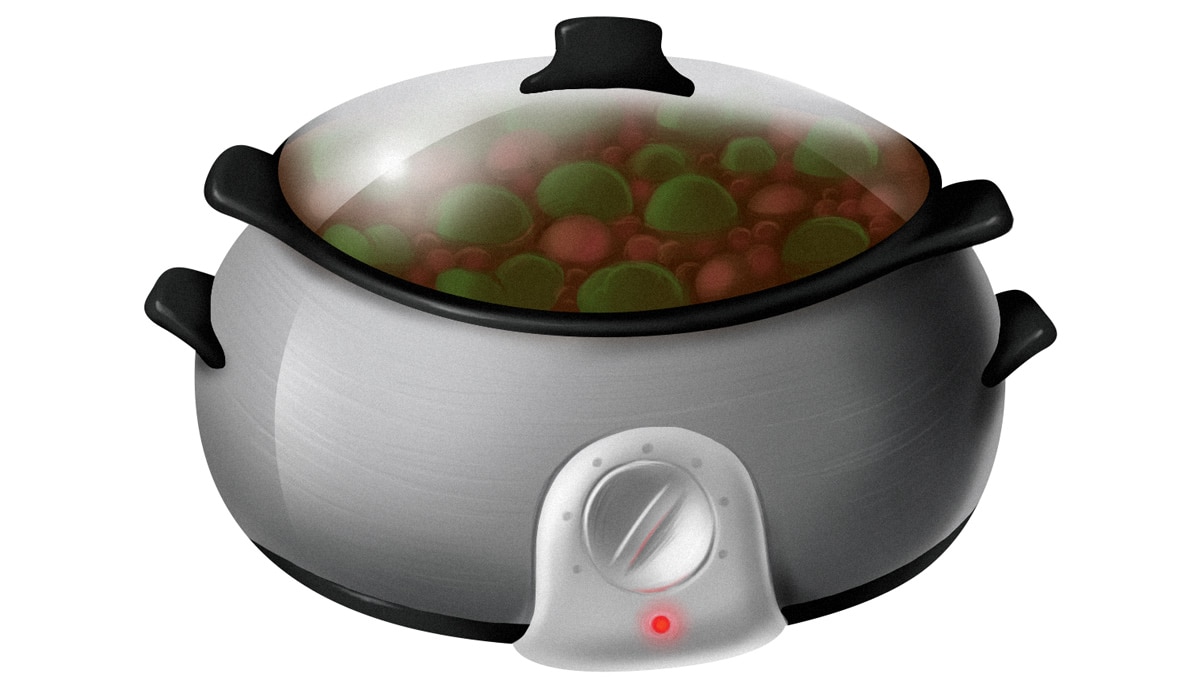
    paleo SlowCooker
    "I will save you so much time. "

    Consider a Dutch oven or slow cooker for making big batches of protein conveniently.

    You might not need breakfast at all on keto - one less meal to pack! Intermittent fasting is a common keto tweak that solves at least one of your meal-prep problems: just don’t eat breakfast at all and compress your eating time into a short window between lunch and dinner. Some people don’t have any calories before noon; other folks prefer coffee with cream or coconut oil. (You could also skip dinner and have your eating window between breakfast and mid-afternoon, but this is less popular).

    Keep a few keto-friendly snacks at your desk. In case you encounter a lunch disaster, you won’t be totally up the creek. Try macadamia nuts, fat bombs, or squeeze packs of nut butter.

    Sample keto cook-ups: breakfast

    For the menu-impaired, a few simple meal prep ideas, with macros:

    With eggs

    The simplest way to batch-cook eggs for breakfast: beat a dozen eggs together and pour them into a greased pan. Add some roasted vegetables, spices, cheese, bacon bits, and/or other fixings as desired and cook until it’s almost done in the middle (the recipe takes a while to cool down, so it will keep “cooking” itself for a few minutes after you take it out of the oven). This is good cold or reheated.

    Variations:

    • Mediterranean: eggplant (2 cups raw), onions (1 whole), garlic (3-4 cloves), and bell peppers (1 whole), fried in 2 tbsp. butter before adding them to the eggs: makes 5 servings at 5 grams net carbs per serving.
    • Indian: garlic (3-4 cloves) okra (1 cup raw, fried or roasted in butter), spinach (1 cup raw), and garam masala to taste, assuming 2 tbsp. butter for cooking: makes 5 servings at 3.1 grams net carbs per serving.
    • German: cabbage (2 cups raw, shredded), mustard (3 tbsp.), onion (1 whole), and bacon: 5 servings at 4.4 grams net carbs per serving
    • Fat-tastic deluxe keto domination: use 6 duck eggs instead of 12 chicken eggs + 3 slices of bacon with all the drippings: 5 servings at 1.44 grams net carbs per serving.

    No eggs

    For the egg haters, a few other ideas:

    • Sheet pan sausages and vegetables: 4 servings at 6 grams net carbs per serving, although you could just use more sausages for more servings.
    • Breakfast pork sausages: close to 0 grams net carbs per serving and good hot or cold.

    Sample keto cook-ups: lunch and/or dinner

    For the office workers or the just plain run-off-their-feet-busy people, some batch cooking menus for lunch or dinner:

    Protein option 1: pork shoulder

    Roast up a nice piece of pork shoulder (use this recipe or any other low-carb pork shoulder recipe)

    Dead simple option: also roast up a tray or three of low-carb vegetables (broccoli, cauliflower…) with lots of olive oil or butter. Divide the pork and vegetables into containers. Assuming 1 cup of broccoli + 1 tbsp. fat per serving, on top of 3-4 ounces of cooked pork shoulder with all the fat left on, that gives you about 6 grams of net carbs per serving.

    Variety options for the same protein: cook the pork shoulder in one fell swoop, and then give yourself some variation in your meals with...

    • Salad: shredded or chopped pork on spinach (2 cups) with walnuts (0.5oz) and red onions (1 tbsp); mustard + balsamic + olive oil for dressing: 6 grams net carbs per serving.
    • Shredded pork: shred the pork shoulder and pack it with keto coleslaw (add lots of mayo!): 4 grams net carbs per serving
    • Stuffed peppers: cut a green pepper in half and bake the halves until lightly charred. Stuff each half with shredded pork shoulder and wilted spinach. Top with cheese for the cheese eaters: 3.3 grams net carbs per half pepper without cheese; with cheese will depend on the cheese.

    Protein option 2: meatballs

    Use the fattiest beef or lamb you can find - try this recipe without the honey or any other meatball recipe you like.

    Dead simple option: meatball kebabs (also spelled kabobs): skewer the meatballs with your favorite low-carb vegetables and go nuts! You can add variety to this very easily just by putting different vegetables on each skewer. Carbs will vary depending on the vegetables but typically they’ll be low.

    Variety options for the same protein: make all your meatballs and then...

    • Put the meatballs over a bed of mashed cauliflower (8 grams net carbs) and drizzle with garlic butter
    • Use different dipping sauces. Add tzatziki sauce for Greek flavor, sriracha mayo for a spicy kick, garlic aioli, fresh pesto, or whatever other fatty condiments your heart desires!
    • Pack the meatballs over a bed of zucchini noodles (3.4 grams net carbs)

    What’s your favorite keto meal prep idea?

    Got a great recipe? Tips and tricks? Share with the crowd on Facebook or Twitter!

    Filed Under: Learn About Paleo & Keto Diets

    Bitterness: the taste we bred out of modern food and how to get it back

    April 10, 2018 by Paleo Leaper Leave a Comment

    Did you know that squash - which is one of the sweetest vegetables around today - used to be so bitter you wouldn’t want to eat it?

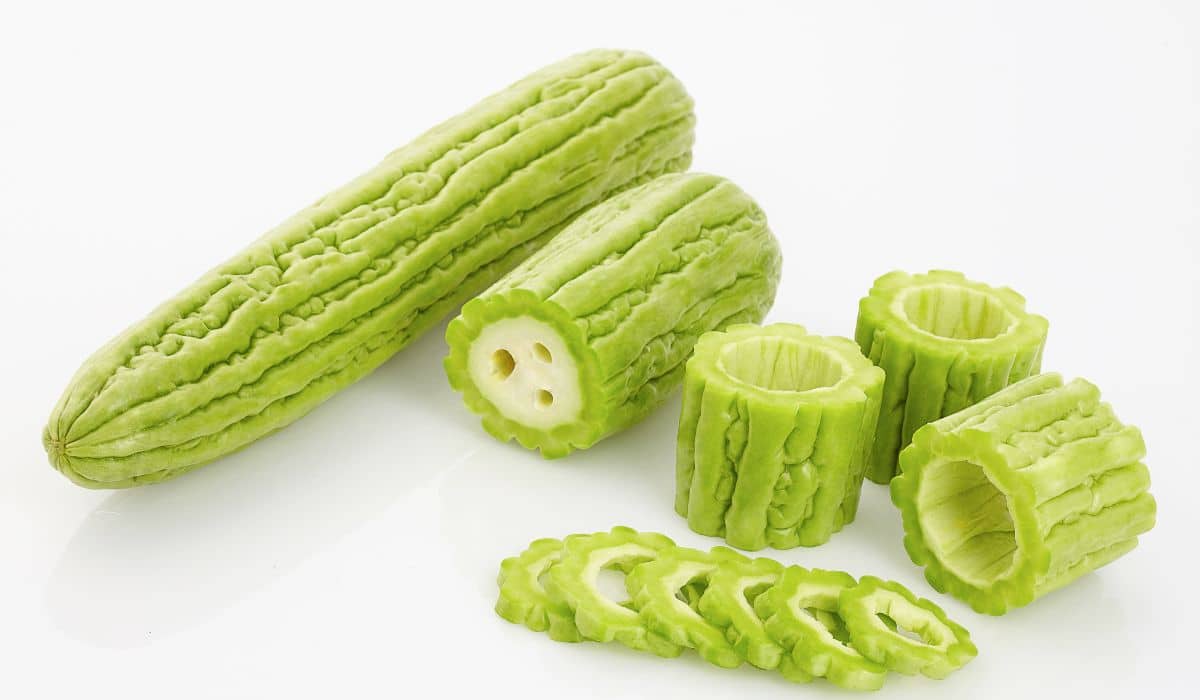
    Bitterness

    Back in the Paleo days, wild vegetables were small, stringy, and incredibly bitter. But as soon as we settled down on farms, humans started breeding our food to be tastier: less fibrous, less bitter, and more carbohydrate-dense. The de-bittering (and de-fibering) of our diet sped up as we got better and better at food processing, until most people today don’t even eat the domesticated vegetables that our ancestors spent so long breeding. Even our painstakingly de-bittered broccoli and kale are “too bitter” for most people compared to chicken McNuggets and Snickers bars.

    Here’s the problem with that: the compounds that give vegetables their bitterness are also powerful antioxidants that help protect us against inflammation and chronic disease. By processing bitterness out of our food, we’re losing out on essential health benefits.

    On the other hand, taking cues from traditional recipes (backed up with modern food science) can help you tone down the bitter flavor of modern vegetables without losing out on the health benefits. As it turns out, it’s totally possible to make delicious recipes full of antioxidant-rich vegetables: the key is to not be afraid of fat. Here’s a look at why you want some of those bitter compounds in your food and how to add them back in, the tasty way.

    What we lost in the great de-bittering.

    A lot of poisonous compounds are bitter (cyanide, for example), so it makes sense for humans to have an instinctive distaste for bitter stuff in our mouths. When we eat for fun, people rarely pick vegetables, and even just within the vegetable category, research shows that people tend to prefer vegetables that taste less bitter and more sweet.

    coffee

    But as this study explains, the bitter taste in vegetables comes from polyphenol compounds with important antioxidant activity. Just to name one study as a proof of concept, this paper showed that arugula (rocket) varieties with the most antioxidants also have the strongest bitter taste...because the bitterness comes from the antioxidants.

    Another case in point: coffee. Coffee is one of the few bitter foods still left in the typical American diet, and it’s also one of the few remaining antioxidant-rich foods. In fact, coffee is provides 20-45% of the antioxidants in typical Western diets. Coffee can account for such a huge percentage of our antioxidant intake, even though it’s such a small percentage of our total food/beverage volume, because it’s so rich in antioxidants, which is also what make it bitter.

    These bitter-tasting antioxidants have a huge range of health benefits, especially when they’re eaten in real foods as part of your diet (the evidence for antioxidant supplements is much patchier). This review cites better blood sugar control and insulin sensitivity, improving metabolism in fat cells, and reducing inflammation. This one added reductions in blood pressure. They also do right by your gut bugs - and yes, there’s some evidence that they help protect against cancer.

    An interesting fact: the benefits for blood sugar control might come specifically from the bitterness. You have bitter taste receptors in your gut - when those bitter compounds hit your GI tract, they signal your body to get ready for some incoming carbs. So for example, if you eat a big plate of beef, broccoli, and potato skillet, the polyphenols in the broccoli will get your digestive system ready for the accompanying carbs in the potatoes. Take out the bitter-tasting antioxidants and you no longer get that “warning signal,” so your body has to work harder to react to the carbs when they come down the pipe.

    Adding bitter antioxidants to your diet, the tasty way!

    First of all, it’s helpful to note that different antioxidants stimulate different bitter taste receptors and not everyone is equally sensitive to every type of bitterness. If you’re sitting here thinking “who are these weirdos who think that tastes bitter?” - you’re probably relatively insensitive to bitter tastes. But for the folks (especially kids) who can taste the bitterness, here’s where we can learn a thing or two from traditional food cultures.

    Too many people think that vegetables are all horribly bitter because they’ve only had them as penitentially gross “health food:” raw kale with fat-free dressing or steamed broccoli without butter or salt. But that’s not how people have traditionally eaten vegetables, and it’s not how you have to eat them either.

    Fat masks bitter tastes

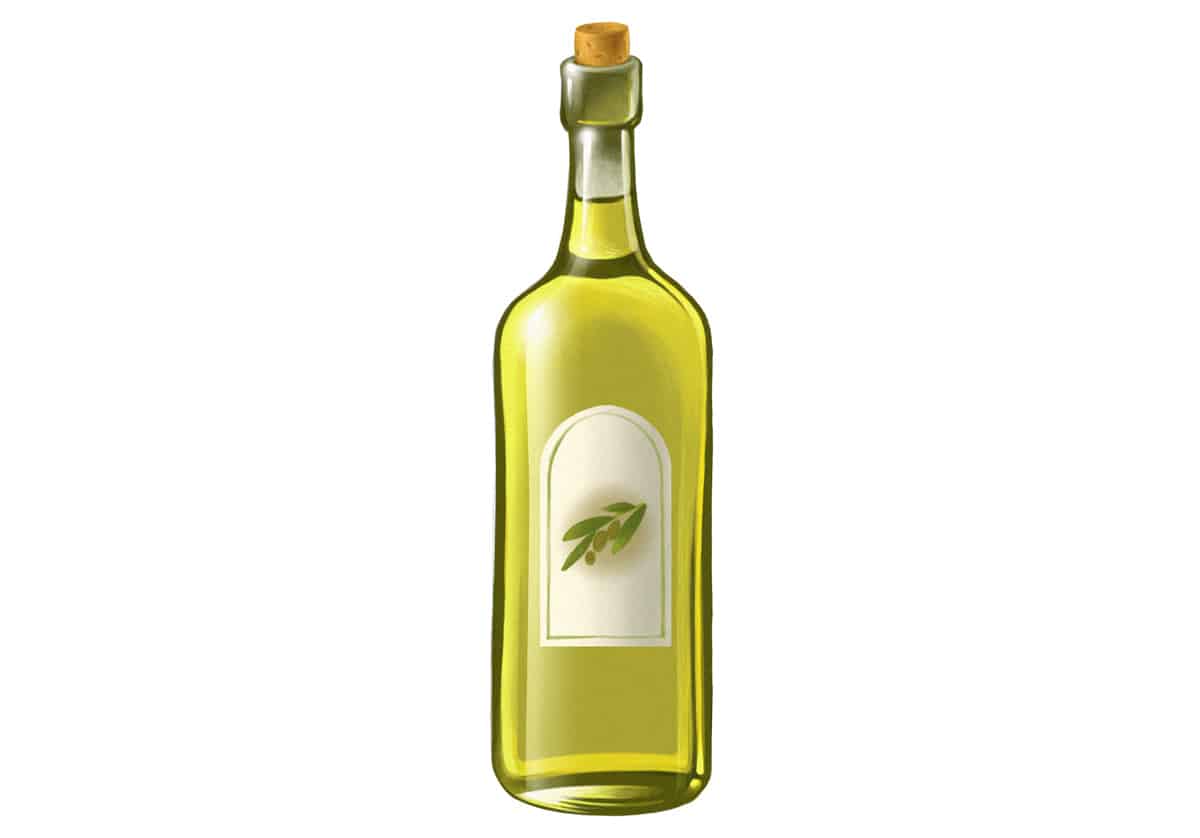
    olive
    "I love vegetables! Make my dreams come true and pair me up with some friendly salad greens!"

    Fat is an essential part of traditional diets and a huge part of cooking with vegetables. And studies (one, two) on have shown that the presence of fat in the mouth dulls receptivity to bitter taste (in that first study, coconut oil was particularly effective!). If you eat a big kale salad with olive oil or a pile of baked cabbage in bacon fat, the vegetables will taste less bitter, but you’ll still get all the benefits of eating the bitter compounds. For the butter enthusiasts, milk fat will also do the trick.

    As a side note, fat also helps you absorb all the fat-soluble vitamins from the vegetables - as long as it’s healthy fat and not some industrially processed “vegetable oil” creation, it’s basically nothing but good news

    Salt reduces perceptions of bitterness

    This study found that even small amounts of salt reduced the perceived bitterness of broccoli, spinach, and kale. And just to repeat: when it comes to health, pouring salt from a shaker onto your Brussels sprouts is not the problem. The real source of excess salt in the typical Western diet is salt added to processed foods, like bread and cookies, not salt added at the table.

    The less stress you’re under, the less sensitive you’ll be to bitterness

    No, really! This study found something almost unbelievable: stress increased sensitivity to bitter taste, at least in people who were “highly arousable” (if you’re highly arousable, it means you get emotional easily, whether the emotion is positive or negative).

    This study went into more detail on emotion and taste. The researchers studied two neurotransmitters, serotonin (5-HT) and noradrenaline (NA). Noradrenaline is released when people were stressed: the higher people’s noradrenaline levels, the more sensitive they were to bitter (and sour) tastes. This was also true of their self-reported feelings of anxiety.

    Part of this might be that stress increases inflammation. This study found that higher levels of the inflammatory protein TNF made taste buds more sensitive to bitter flavors (at least in mice).

    So in short: take a deep breath, roast (or fry, or dress) your vegetables with the delicious Paleo fat of your choice, and salt them until they taste good. That way, you can get the health benefits of bitter polyphenols without having to plow through a pile of raw kale (unless that’s your thing!). In fact, you might even find that once you get used to the more complex tastes of real food, it even starts tasting better than the expertly formulated fat-sugar-salt confections all over the middle aisles.

    Filed Under: Learn About Paleo & Keto Diets

    Keto Diet Frequent Questions

    Browse the FAQ below - or click to skip to a specific question:

    Nutrition

    Isn’t all that saturated fat and cholesterol bad for you?
    What about fiber? Does fiber count as “carbs”? Can I get enough fiber on keto?
    Why can’t I have fruit? Isn’t fruit healthy?
    What if I’m a vegetarian?
    How can I keep track of my macros? Do I have to count everything?
    Do I need to worry about hydration? What about salt and electrolytes?

    Is ____ Keto?

    Alcohol
    Artificial sweeteners
    Chocolate
    Coffee
    Corn
    Dairy
    Diet soft drinks
    Nuts
    Protein powder
    Stevia
    Tofu
    Whole grains

    Weight Loss and Weight Gain

    How much weight will I lose on keto and when will it come off?
    I’ve read that all the weight you lose on keto is water weight; is this true?
    Can I eat keto if I don’t want to lose weight? What if I want to gain weight?

    Etcetera

    What about eating out?
    How does keto affect sleep?
    Can I eat keto if I like to work out?
    Isn’t ketosis dangerous?
    Is keto the same as Atkins?
    How do I know if I’m in ketosis? How can I measure my blood ketones?
    What’s the cost of doing keto? Can it fit my budget?
    What does a basic day of food look like?
    Should I also be doing intermittent fasting?
    How do I deal with cravings?
    What if I have thyroid/hormonal issues? Can/should I still do keto?
    Should I be taking any supplements?

    Nutrition

    Isn’t all that saturated fat and cholesterol bad for you?

    When you look at nutrients like saturated fat and cholesterol, it’s valuable to go a little deeper and consider what kind of foods you’re getting those nutrients from. A hard-boiled egg and a Big Mac both contain saturated fat and cholesterol. But they’re completely different foods. The egg is a natural, unprocessed food full of essential nutrients and antioxidants; the Big Mac is hyper-processed junk food from the sugar and soybean oil in the bun (no, really! Look it up!) to the high-fructose corn syrup in the sauce.

    Studies have regularly shown that people who eat more saturated fat and cholesterol get more heart disease, because people tend to eat their saturated fat more from the Big Mac end of the spectrum. But for keto or Paleo purposes, those studies aren’t really relevant, because Paleo and keto aren’t about eating Big Macs.

    Eggs
    Eggs: not a recipe for death from heart disease.

    If you take a look at whole foods rich in saturated fat and cholesterol - like eggs, unprocessed meat, and full-fat dairy - you’ll quickly find that there’s no real evidence against them.

    To focus specifically on cholesterol for a second, eating more dietary cholesterol on keto doesn’t cause any increase in blood cholesterol because dietary cholesterol is actually a very small percentage of total cholesterol. Most of the cholesterol in your blood is made by your own body. Your body can easily respond to changes in dietary cholesterol by just making less cholesterol of its own. Learn more about dietary cholesterol here.

    As a final point: if eating saturated fat and cholesterol causes heart disease, then why does keto consistently improve heart health in human studies?


    What about fiber? Does fiber count as “carbs”? Can I get enough fiber on keto?

    “Fiber” is a catch-all term for carbs that you can’t digest. The bacteria in your gut can digest

    Brussels sprouts
    Fiber-rich foods, like Brussels sprouts, are nutritious and tasty.

    them, but you can’t. So a lot of people don’t count fiber when they count the number of carbs they eat. Some research also shows that adding a fiber supplement to a low-carb diet doesn’t reduce the benefits of the diet. This suggests that fiber doesn’t really “count” as a carb, so it’s likely safe to ignore it in your carb counts.

    The recommended daily intake of fiber for adults is between 25 and 35 grams per day. It’s easy to get that much fiber from low-carb vegetables and other keto-friendly foods, like avocado. If you need to restrict carbs to such low levels that you can’t get enough fiber - or if you’re having trouble with constipation - a psyllium supplement might be helpful.


    Why can’t I have fruit? Isn’t fruit healthy?

    Fruit is full of nutrients and antioxidants and generally good for you. It’s also higher in sugar and carbs than most keto diets can accommodate. If you’re trying to stick below 50 grams of carbs per day, an apple (30 grams of carbohydrate in one large apple) or a banana (31 grams of carbohydrate in one banana) just doesn’t fit in the plan. Even if you subtract fiber from that, you’re still getting about half your daily carb allowance in one little piece of fruit. That doesn’t leave enough room in the carb budget for the vegetables that you need to get enough nutrients.


    What if I’m a vegetarian?

    It’s possible to eat keto as a vegetarian, if a bit more difficult. Remember that keto isn’t about eating a ton of animal protein - it’s about eating a lot of fat. If you can eat eggs and full-fat dairy, you’ll be able to get plenty of protein for keto. Just focus on getting at least some protein-rich foods at every meal and eating plenty of healthy fats, like olive oil and coconut oil. Some sample vegetarian keto meals:

    • 3 eggs fried in 2 tbsp. butter with sauteed asparagus: 76% fat, 20% protein, 3.5% carbs (4.2 grams total carbohydrate, of which 1.7 grams are fiber)
    • Salad with 1 cup of lettuce, a few olives, red onions, 1 ounce walnuts, 4 tbsp. feta cheese, and olive oil: 81% fat, 11% protein, and 8% carbs (10 grams carbohydrate, of which 3.7 are fiber)

    How can I keep track of my macros? Do I have to count everything?

    Some people find it helpful to log and track all their food; other people find it exhausting. If you’re OK with it, it can be a useful tool. If you hate it, there are alternatives. Many people are OK just prioritizing fat-rich foods and focusing on meat, fat, and low-carb vegetables. This method is particularly effective if you can get into a routine that works really well for you and eat a lot of the same things every day - then there’s no wondering what’s in your food or whether it’s keto, because your daily eggs and bacon haven’t magically changed since the last time you had them.

    Other people can get away with tracking food once a week or so, not every day. Or you could only count carbs and not worry about fat or protein. Macro counting isn’t an exact science anyway; there’s no need to panic over it if it’s not right for you.


    Do I need to worry about hydration? What about salt and electrolytes?

    Water bottle
    Your new best friend on keto

    It’s important to drink enough on keto. In children who eat a keto diet to treat epilepsy, dehydration is one of the most common side effects. A good rule of thumb is to drink water until your pee is very light yellow - it shouldn’t be totally clear, but it also shouldn’t be a rich, dandelion-type color.

    In terms of electrolytes, people eating keto need more salt, and other electrolytes (like potassium) may also be helpful. If you’re having muscle cramps, that’s a big sign that you may need more electrolytes. Salt your food liberally! Bouillon cubes are another great source of keto-friendly salt. If bouillon doesn’t appeal, you can buy all kinds of sugar-free electrolyte mixes at running or sports stores. Lite salt (at grocery stores next to the regular salt) is a good source of potassium.

    Back to Top ↑

    Is ___ Keto?

    (This section is arranged in alphabetical order)

    Alcohol

    Regardless of what you think of the alcohol itself, many types of alcohol are just too carb-dense to be keto. A bottle of beer has about 10-12 grams of carbs (none of which is fiber). To fit that into a keto diet, you’d have to cut way back on vegetables for that day, and trading vegetables for beer really isn’t a responsible nutritional strategy.

    Some kinds of distilled spirits, like rum and vodka, don’t have any carbs - those could fit into a keto diet, depending on your individual alcohol tolerance. From a strict nutritional standpoint, alcohol is a Paleo “gray area” - it’s not doing your health any favors, but on the other hand, we’re all humans, not saints. Eating well should make your life better, not worse, and if the occasional rum or vodka is a worthwhile indulgence to you, it won’t throw you out of ketosis.

    Artificial sweeteners

    Debatable. You can read up on the research into artificial sweeteners here: the evidence suggests that they probably don’t cause weight gain, but they probably also don’t cause weight loss. On the other hand, some types of artificial sweeteners may cause gut problems in people who are sensitive to them. In general, a good rule of thumb is to minimize the amount of sweeteners you eat - it helps keep your palate used to the taste of natural whole foods.

    Chocolate

    Most chocolate bars have too much sugar to fit into a keto diet. For example, 1 ounce of milk chocolate (45-60%) has about 17 grams of carbs, and only 2 of those are fiber. Even dark chocolate (70-85%) has about 13 grams of carbs per ounce - and an ounce is not a lot of chocolate. Most regular-sized candy bars are closer to 2 ounces.

    Cocoa powder has just over 3 grams of carbs (1.6 of which are fiber) per tablespoon. If you want a chocolate taste, it might be best to add cocoa powder to a keto-friendly food and make your own treats.

    Coffee

    Coffee

    Yes. Sugar in your coffee is a no-go, but the coffee itself is fine. Heavy cream, whole milk, coconut milk, and other keto-friendly additions are also fine.

    Corn

    No. Corn isn’t a vegetable, despite being included in so many “frozen vegetable” mixes. It’s a grain, so it’s not Paleo, and in any case it’s too carb-dense to really fit into a keto diet.

    Dairy

    If you tolerate it well. A lot of people are lactose intolerant, and those people do better staying away from dairy. If you're in the lucky lactose tolerant group, full-fat dairy (butter, ghee, full-fat yogurt, heavy cream…) is very keto-friendly. But watch out for low-fat dairy (which often has too many carbs) and added sugar! A lot of yogurt products have extra added sugar, and that’s definitely a no on keto.

    Diet soft drinks (e.g. Diet Coke)

    Diet soft drinks aren’t Paleo. But if you don’t care about eating Paleo, they won’t kick you out of ketosis (see the entry on “artificial sweeteners” above).

    Nuts

    Yes, within your carb counts. Remember that peanuts aren’t nuts; they’re legumes, so if you want to eat Paleo-keto, peanuts are off the table.

    Protein powder

    Not really. A small amount of protein powder could fit into a keto diet, but keto isn’t meant to be super high in protein. It’s meant to be high in fat. Eating protein powder doesn’t leave a lot of room for more nutritious protein-rich foods, like meat and eggs.

    Stevia

    Stevia is OK if it doesn’t cause huge sugar cravings. Some people do better with getting that sweet taste out of their diet as much as possible; other people are just fine including it. Learn more about stevia here.

    Tofu

    Tofu isn’t Paleo, because it’s made of soy. It’s also high in omega-6 fat, which most of us could do with a lot less of in our diets. If you don’t care about eating Paleo, tofu can fit into a keto diet.

    Whole grains

    No. Whole-grain foods aren’t any less carb-dense than any other kind of grains. Pick up a loaf of whole-wheat bread or a package of whole-wheat pasta and look at the carb count for yourself: there are just too many carbs in there to make it part of a keto diet. The same goes for brown rice, oatmeal, quinoa, barley, etc. None of these foods are Paleo anyway, but even if you don’t care at all about Paleo, they’re not keto because they have too many carbs.

    Back to Top ↑

    Weight Loss and Weight Gain

    How much weight will I lose on keto and when will it come off?

    It’s impossible to predict anyone’s weight loss before it happens. Most people see a big initial drop of water weight in the first week, followed by slow and steady fat loss after that.

    Almost everyone plateaus at some point. Sometimes, the plateau breaks on its own. Other times, the plateau is a sign that it’s time to re-evaluate something - maybe there have been too many carbs creeping into your diet or maybe you’ve reached a point where keto isn’t the best diet for your current needs.


    I’ve read that all the weight you lose on keto is water weight; is this true?

    Scale

    This is only true of the weight you lose in the first week of keto. Carbohydrates cause your body to retain water, so when you stop eating carbs, you shed a lot of water weight in the first week or so. This can be 8-10 pounds for some people (although for others it’s less dramatic, so if you don’t drop that much weight, don’t stress about it). If you started eating carbs again, you’d start retaining all that water again and the weight would come right back on.

    After about a week, most people have lost as much water weight as they’re going to lose. Once the water weight is gone, the fat loss starts at a steady but slower pace. “It’s all water weight” only applies to the initial “whoosh,” not to the long-term fat loss.


    Can I eat keto if I don’t want to lose weight? What if I want to gain weight?

    Keto isn’t just a weight-loss diet. You can also do keto to gain or maintain weight; it just takes a little fancy footwork.

    • Make sure you’re eating enough food. This is harder than it looks! Because keto is so good at suppressing appetite, calorie-counting can be helpful here just to make sure you’re eating enough
    • Liquid calories (like smoothies) and really delicious food (like butter) can help you get enough calories in.
    • If you’re trying to gain muscle specifically, eating more protein than the average keto diet might be helpful.

    If you just can’t keep the weight on with keto, switching to a moderate-carb Paleo diet might be a better way to go.

    Back to Top ↑

    Etc.

    What about eating out?

    Most people actually find that it’s not a big problem. There’s something at almost every restaurant that you can have: salads with a generous amount of fat-rich dressing are usually a good bet, and at nicer restaurants you can get delicious fatty steaks slathered in butter or crispy grilled fish with aioli: yum! If your order comes with bread or potatoes or some other carb-loaded side, just ignore that part. There’s no vengeful breadstick god who will smite you if you leave the basket to the other folks at the table.


    How does keto affect sleep?

    There’s not a lot of scientific evidence here - most of the research on keto and sleep is in children with epilepsy, not grown-ups trying to lose weight - but some research has found that a very low-carb diet increases the time you spend in slow wave sleep (the deepest phase) and reduces REM sleep (that’s when you dream). An older study found that eating keto significantly decreased sleep abnormalities in obese patients, suggesting that keto might help improve sleep. And interestingly, one small study found that keto helped with narcolepsy.

    Sleep

    On the other hand, this study showed that patients eating keto initially had problems sleeping, but then everything resolved after a few weeks. Some people might have 2-3 weeks of trouble falling asleep while they adjust.

    If you have trouble falling asleep on keto, try a pre-bedtime magnesium or melatonin supplement - both can be helpful for winding down at bedtime.


    Can I eat keto if I like to work out?

    The short answer: yes!

    • For endurance athletes (runners, cyclists, triathletes, etc.): Many people see a decrease in performance for the first couple weeks, but after they adapt to the diet, they do fine. In fact, switching to a keto diet might even be helpful for endurance exercise, because it helps you use fat more efficiently during exercise (aka avoiding the dreaded bonk and less dependence on gels and chews during long events)
    • For strength athletes (powerlifters, weightlifters, highland games or strongman competitors, etc.): This study found that a ketogenic diet helped men lose fat while gaining muscle during a program of strength training, and another paper found that a keto diet was just as good as a standard diet for increasing one rep max on the squat, bench press, and deadlift. Many strength athletes use a ketogenic diet to excellent effect.

    Isn’t ketosis dangerous?

    No. If you think ketosis is a life-threatening complication of diabetes, you’re thinking of ketoacidosis, not ketosis. Ketoacidosis is absolutely dangerous, but it’s not the same as diet-induced ketosis.

    To get more specific about this, “ketosis” means that you’re producing ketones; “ketoacidosis” means that you’re producing so many ketones that they build up to dangerous levels in the blood. Ketoacidosis is ketosis taken to a dangerous extreme, and it’s typically caused by type 1 diabetes, not by diet.

    Ketoacidosis is most common in people with type 1 diabetes and it’s usually caused by problems with the hormone insulin. Insulin regulates ketone production, but people with type 1 diabetes can’t make enough (or any) insulin, so they’re at risk of totally uncontrolled ketone production and ketoacidosis.

    People eating ketogenic diets just don’t make enough ketones to get into ketoacidosis. In healthy people, ketogenic diets cause a much lower level of ketone production, because your body naturally regulates the number of ketones you produce and doesn’t make more than you need. There’s no evidence that ketogenic diets cause a dangerous overproduction of ketones in healthy people (this is why ketosis induced by a keto diet is sometimes called “nutritional ketosis” to distinguish it from ketoacidosis, which isn’t caused by diet).

    If you have diabetes or any other disease, absolutely talk to a doctor before you try anything like a keto diet. If you don’t have type 1 diabetes, ketoacidosis probably isn’t a risk for you.


    Is keto the same as Atkins?

    It’s similar to the induction phase of the Atkins diet, but with a focus on eating well, not just cutting carbs.


    How do I know if I’m in ketosis? How can I measure my blood ketones?

    You can use a product called ketostix to measure the number of ketones in your urine, but you probably shouldn’t. Here’s why: ketostix measure one kind of ketones, called acetoacetate. But on a ketogenic diet, you primarily care about a totally different kind of ketones, called beta-hydroxybutyrate. At the very beginning of eating keto, you’ll be excreting some acetoacetate in your urine, but after you get into the swing of things, beta-hydroxybutyrate is the name of the game. After the first few weeks, it’s possible to be fully in dietary ketosis and get a very low reading on ketostix because ketostix just measure acetoacetate.

    (Then why do they exist? They’re for people with diabetes who need to avoid ketoacidosis, a completely different problem that isn’t caused by eating a ketogenic diet and really has nothing to do with it except that both involve ketones)

    If you really care about measuring ketones, you’ll need to either get a breath meter for ketones or test your own blood - but neither of these is necessary for most people. Most people are fine just eating a ketogenic diet - there’s no need to measure or micromanage your blood ketones.


    What's the cost of doing keto? Can it fit my budget?

    Keto can be cheaper than a typical American diet, about the same cost, or more expensive, depending on how you shop and plan your meals. There are lots of keto luxuries that you can buy if you want to (lobster! Caviar! Artisanal cured meats!) but none of them are necessary. Here’s a quick list of tips for budget keto:

    • Buy cheap, fatty cuts of meat. Think less “bacon” and more “pork shoulder.” Fattier cuts are often less expensive: compare chicken thighs (cheap, higher-fat) to chicken breasts (pricey, low-fat). Or compare 75/25 ground beef (cheap, higher-fat) to 92/8 ground beef (pricey, lower-fat).
    • Cut back on relatively expensive optional foods, like nuts and bacon - save them for treats instead of relying on them for everyday meals.
    • Avoid “low-carb” products like specially formulated low-carb bars or low-carb ice cream. You always pay more if someone else has to do a lot of work to prepare the food.
    • Canned fish is typically (unless there’s a really great sale) cheaper than fresh.

    Another way to make keto affordable is to maximize the amount of money you have to spend on groceries. For example, in 2016, the average American household spent $4,049 on groceries and $3,154 on restaurant meals. In other words, just under half of the food budget was spent at restaurants. Cutting back on restaurant meals is a very easy way for many people to magically get more money for the grocery budget.


    What does a basic day of food look like?

    It can vary a lot, depending on your particular tastes, but here’s a sample day of keto:

    • Breakfast: 3 eggs fried in 2 tbsp. butter with sauteed asparagus
    • Lunch: Cucumber salad: 1 cucumber, 1 can sardines in oil, 1 tbsp. red onion, 1 tbsp. each olive oil and balsamic vinegar
    • Snack: Coffee with 2 tbsp. heavy whipping cream plus 1 oz walnuts (about as many as you can hold in your hand)
    • Dinner: 3 oz of pork shoulder; eggplant (2 cups raw) roasted in 1 tbsp. olive or coconut oil with curry powder

    Total macros for the day: 72% fat, 20% protein, 8% carbs (33 grams carbs in total, with 12 of those being fiber). This would be enough for a relatively inactive woman (or a very short/slight man) - people who work out a lot or larger men would want to eat a little more.

    For reference, on the scale of budget keto to luxury keto, this would probably be around the middle. On the one hand, there are some luxury foods, like the nuts; on the other hand, all the proteins are pretty inexpensive.


    Should I also be doing intermittent fasting?

    It’s optional. Do it if you want to and if it works for you. In intermittent fasting, you either skip a full day of eating once a week or eat within a restricted window (say, 12pm to 8pm) every day. You can read up more on this here - the short version is that it works for some people but not for others.


    How do I deal with cravings?

    There’s no one guaranteed way to deal with cravings - here are 8 suggestions. For keto specifically:

    • Make sure you’re getting enough salt. You need more salt on keto than you otherwise would. If you’re craving potato chips, pretzels, or other salty foods, you might be able to solve the problem completely with some extra salt on your food.
    • Make sure you’re eating enough food. Try adding some extra calories and see if that helps.
    • Make sure you’re getting enough sleep. Poor sleep turns up cravings, especially carb cravings.

    What if I have thyroid/hormonal issues? Can/should I still do keto?

    If you have hypothyroidism, hyperthyroidism, or any other kind of hormonal problem, you should talk to a doctor before you start any kind of diet. Some people with thyroid problems do just fine on keto, but those people aren’t you, and you don’t know how your particular body is going to react to a sudden drop in carbs.


    Should I be taking any supplements?

    Supplements

    Some people do best with some supplemental nutrition; other people don’t need it. It all depends on how restrictive you are with carbs/vegetables and whether or not you eat dairy. There's not really much research on supplement needs in adults eating keto, but just based on what you can and can’t get from the diet...

    • If you don’t eat dairy and also don’t eat a lot of bone-in fish, a calcium supplement may be helpful.
    • If you don’t eat fatty fish and also don’t go out in the sun much, vitamin D may be helpful.
    • The best way to find out what vitamins or minerals might be lacking in your diet is to plug a day or two of food into a nutrition tracker and see what you’re missing. If that sounds too laborious, there’s an easy mode: a multivitamin. Many children who eat keto for epilepsy just take a multivitamin as a matter of course, without any fuss or worry about specific nutrients. If you’re eating very few vegetables, that may be the easiest option.

    In terms of supplements other than nutrients, MCT oil may be helpful for people who want to eat slightly towards the higher end of the keto carb range. MCT oil basically helps you get into ketosis more easily, so you can get away with a slightly higher number of carbs in your diet.

    Keto and Protein for Weight Loss: Research and Suggestions

    February 16, 2018 by Paleo Leaper Leave a Comment

    Weight Loss

    “High protein” is the new “low fat:” all kinds of processed junk food from breakfast cereal to freezer dinners is getting a high-protein makeover in an effort to make it look healthier, and nutritionists are all busy telling us to eat more protein for appetite control and weight loss.And unlike the low-fat craze, the current high-protein moment does actually have some research in its favor: it actually is true that eating more protein tends to help people lose weight more easily (get a closer look at the evidence for this here). But does that still hold true on keto?

    Keto was originally designed as a high-fat diet, with enough protein to keep you alive but not much extra. So how does protein fit into keto? Is it still good to eat a high-protein diet even if you’re trying to get into ketosis? Will a lot of protein throw you out of ketosis?

    The bottom line is that depending on your reason for eating keto in the first place, eating a relatively high-protein diet may be helpful. There’s some evidence that up to 30% protein can be fine for weight loss on keto and it might be a good option for people who primarily want to lose fat and/or gain muscle. Check out all the research below!

    Keto was designed as a low-protein diet...but does your keto have to be?

    According to this review, the classic ketogenic diet, as it was originally developed for kids with drug-resistant epilepsy, has a 4:1 or 3:1 ratio of fat:everything else. That would be 3 or 4 grams of fat per 1 gram of (protein + carbs). Since fat has more calories per gram than protein or carbs, that translates to roughly 6.75-9 calories of fat per 1 calorie of (protein + carbs). Some newer versions use lower ratios (aka less fat, more protein and carbs). So the diet might go up to 10-15% of calories from protein, depending on the exact ratio and the carb target.

    The reason for the protein restriction on the classic ketogenic diet is simple: to control epilepsy, the patient needs to be making a lot of ketones. Just like carbs, protein triggers the production of the hormone insulin, which suppresses ketone production. With all other things being equal, eating more protein = producing fewer ketone bodies = less reliable seizure control. So for optimal seizure control, protein is kept low.

    On the other hand, most people who eat keto for weight loss aren't worried about seizures at all, which raises the question of whether these super low protein targets are still necessary. If you make more ketones than you need and they just come out in your urine, you haven’t accomplished anything except a nice photo of your ketostix for Facebook or Instagram. Ketones are a bit like vitamins: it’s good to have enough, but if you take a megadose of vitamin B6 and it all just goes into the toilet, what did you actually gain?

    You personally might not need an ultra-high rate of ketone production to stay in ketosis, and you might do better eating more protein, even if it cuts down on the ketone numbers a bit. After all, you don’t see your ketone bodies when you look in the mirror; you see your actual body, and if your actual body is changing the way you want it to change, then your mission is accomplished no matter what the ketostix say. So with that in mind, check out some of the research on protein and keto:

    Higher-protein keto: research and evidence

    First, a look at some studies on protein in adults trying to lose weight with keto (NOT kids with epilepsy, because if you’re reading this you’re probably not 5 years old and having uncontrollable seizures).

    Here’s a study where the researchers tested a ketogenic diet with 30% calories from protein (4% carbs, 66% fat) on a group of 17 obese men. Take this with a grain of salt because the study only lasted for 4 weeks, but the researchers found that the 30% protein keto diet successfully caused weight loss and reduced hunger in the men. That level of protein didn't kick anyone out of ketosis (all the men were in ketosis during the study diet), and the high-protein keto diet outperformed a moderate-carb diet.

    From that study, it looks like otherwise healthy adults who are eating keto for weight loss can go up to at least 30% protein without compromising their weight-loss goals (although maybe these men might have been even better off with 15% or 20% protein - the study didn’t test that.

    Meat
    Most popular meats have a relatively high amount of protein by keto standards, so it's not surprising that these subjects ended up with a higher-protein version of keto.

    In another study of a high-protein ketogenic diet, researchers didn’t specifically give subjects a protein target, but asked them to stay under 20 grams of carbs per day, with unlimited meat and other 0-carb foods. The subjects naturally ended up eating about 26% protein (at least, based on their food diaries, which aren’t super accurate) and over the 24 weeks of the study, they had great results for weight loss, with an average of 9.4 kilograms (21 pounds) of fat lost in the low-carb group.

    In other words, if you’re looking for weight loss, evidence suggests that it's very possible to lose weight on a higher-protein version of keto.

    More evidence from low-carb, non-ketogenic diets

    In other studies of non-ketogenic low-carb diets, people eating more protein diet also tend to do better than people eating less protein. For example, this study compared a high-protein and a normal-protein diet, both low in carbs but not ketogenic (25% energy from carbs). The high-protein diet was 20% protein, or 1.1 gram of protein per kilogram of body weight per day (if you weigh 150 pounds, that would be about 75 grams of protein). the low-protein diet was 10% protein, or 0.7 grams per day (for a 150-pound person, that’s about 48 grams of protein). The high-protein group did a lot better with their weight loss than the low-protein group.

    In general, higher protein diets have some advantages for fat loss, especially because they help manage hunger. If you want to gain muscle (or keep it while losing fat), eating a bit more protein is likely to be helpful - yes, it’s an old cliche that bodybuilders are totally obsessed with protein, but they’re obsessed with it because it works.

    What does 30% calories from protein actually mean?

    This can all be a bit hard to get a handle on, so just for reference:

    10-15% calories from protein:

    • 2 eggs fried in 1 tbsp. butter with ½ an avocado
    • Salad: 3 cups of spinach with ¼ cup of crumbled bacon, 1 ounce walnuts, and 1 tbsp. each olive oil and vinegar
    • 3 oz. pork belly with asparagus roasted with bacon (put the uncooked bacon in the roasting pan and let the asparagus cook in the fat from the bacon) and slathered in hollandaise sauce (2 tbsp.)

    20% calories from protein:

    • 3 eggs fried in 2 tbsp. butter
    • Salad: 3 cups of spinach with ½ an avocado, 3 ounces of salmon, 2 tbsp. olive oil, and 1 tbsp. vinegar
    • 3 oz. pork shoulder with grilled asparagus slathered in hollandaise sauce (2 tbsp.)

    30% calories from protein:

    • 3 eggs fried in 1 tbsp. butter with 1 ounce of smoked salmon
    • Salad: 3 cups of spinach with 1 can of sardines packed in oil + 1 tbsp. each olive oil and vinegar
    • 3 oz. pork loin roast with asparagus roasted in 1 tbsp. butter

    An addition to consider: MCTs or Coconut Oil

    Coconut Paleo
    "Eat me! I'm delicious and very ketogenic!"

    If you want to eat more protein but you’re scared of getting thrown out of ketosis, you might consider eating more protein and also eating more medium-chain triglycerides (MCTs). Because of the way they’re digested, MCTs are super ketogenic fats, so they give you a bit more leeway to eat protein and carbs. The best dietary source of MCTs is coconut oil (you can also buy MCTs in supplement form if you can’t handle coconut oil).

    Hint: recipes like this keto taco skillet and this cilantro-lime chicken recipe combine protein and MCTs in one delicious package for ultimate keto convenience.

    Summing it Up

    Just to summarize very briefly:

    • Adults told to limit carbs but eat unlimited meat will likely end up around 25-30% protein naturally.
    • The classic ketogenic diet is low in protein, but research suggests that it’s probably fine to eat more protein on keto if weight loss is your main goal.
    • Everyone is an individual and depending on your reasons for eating keto, you may do better or worse with more protein.

    So...how do you manage protein on keto? Let us know on Facebook or Twitter!

    Filed Under: Learn About Paleo & Keto Diets

    6 Easy, Paleo-Friendly Keto Substitutes for High-Carb Foods

    January 3, 2018 by Paleo Leaper Leave a Comment

    Paleo Friendly Keto

    If you hunt long enough, you can find a keto replacement for almost any food, but a lot of them either rely on non-Paleo ingredients or take forever to pull together. That’s not exactly practical for Wednesday night dinner! So in the spirit of simple keto cooking for busy people, here are 6 workhorse substitutes that don’t take a huge amount of time and money.

    Just to be clear: most of these aren’t intended to exactly imitate the taste of grain-based foods. They’re functional substitutes: you can use them to do the same thing that the grain-based foods used to do in your cooking. Vegetable noodles are a substitute for wheat noodles because you can load them up with lots of alfredo sauce and meatballs and have a satisfying meal, not because they taste exactly the same.

    1. Zucchini noodles (4 grams net carbs per 2 cups) for wheat pasta (73.3 grams net carbs per 2 cups)

    You can buy zucchini noodles all pre-noodled in grocery stores now (and you don’t have to go spend half your paycheck at Whole Foods: even mid-range stores have them now). Or you can make your own with a cheap handheld spiralizer - the upfront cost is about $20, but in the long run you’ll save money compared to buying pre-spiralized noodles at the store.

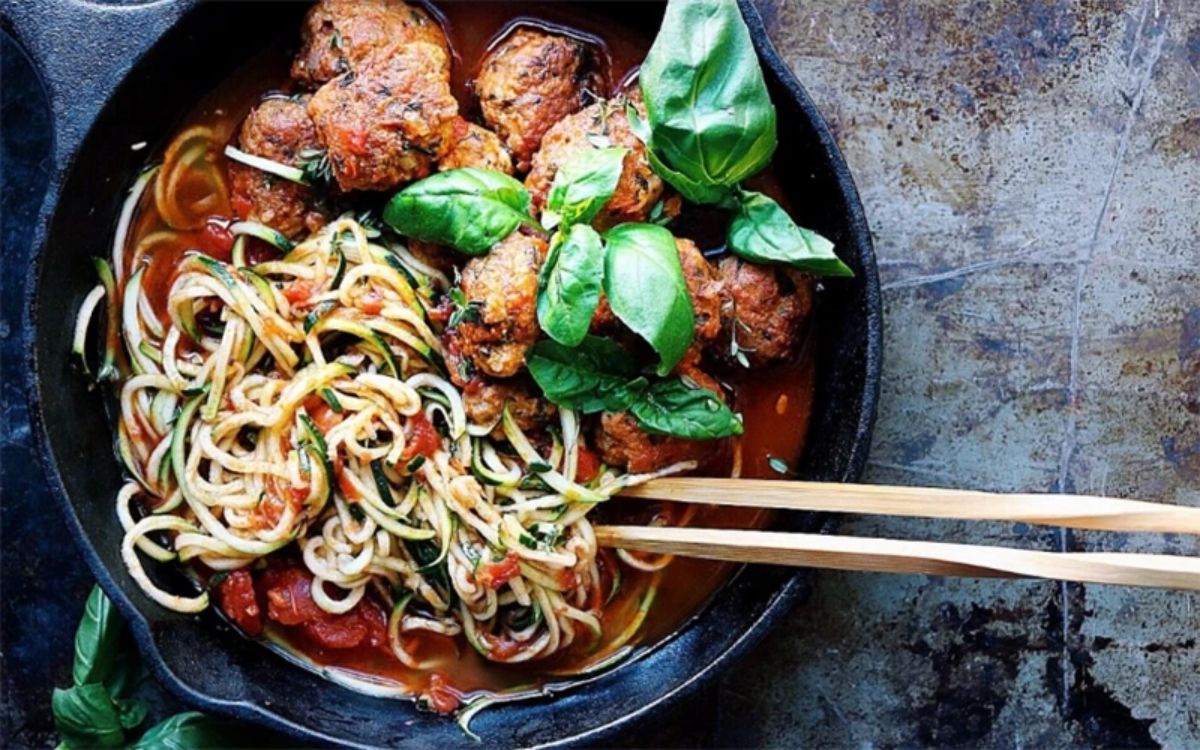
    Zucchini noodles are delicious with tomato sauce and meatballs, with creamy white sauce (a great way to get more fat in your diet!), or with basically anything else you’d normally put on pasta. They also go really well with Asian flavors.

    Recipe: Keto Zucchini Noodles with Tomato-Basil Sauce

    2. Riced cauliflower (2 grams net carbs per 1.5 cups) for rice (79 grams net carbs per 1.5 cups)

    Rice is an amazingly easy way to rack up a lot of carbs in a very little package. As anyone who’s ever eaten Chinese or Indian takeout knows, it’s very easy to plow through a whole lot of rice, especially if it’s covered in some kind of delicious sauce.

    The keto solution: keep the delicious sauce, add more butter (because everything’s better with more butter), and put it over riced cauliflower instead! Riced cauliflower is just as good as a sauce absorption vehicle. It can give texture to a soup just like regular rice, and it can double for rice in stuffed peppers or other recipes. You can buy pre-riced cauliflower either fresh or frozen, or rice it yourself in a food processor.

    Cauliflower bonus: you can also whiz it up in a blender and add plenty of butter and/or heavy cream to make a great mashed potato substitute.

    Recipes: Keto Creamy Mashed Cauliflower, Coconut Curry Shrimp with Cauliflower Rice

    3. Stevia (0 grams net carbs per tbsp.) for sugar (12.5 grams net carbs per tbsp.) - if you need a replacement at all

    Sweeteners are always a tricky question when you’re eating for good health, and a lot of people

    coffee
    Love coffee but need to quit adding sugar to it? Try a splash of coconut milk for some healthy fat instead.

    just psychologically do better without any sweeteners. Even 0-carb, 0-calorie sweeteners just get them craving the real deal. If that’s you, the best substitute for sugar might be “getting used to your food being less sweet.”

    But if the taste of sweetness doesn’t cause you any psychological issues, stevia is probably the best of the 0-carb options:

    • Sugar, honey, and maple syrup are obviously off the table: too many carbs
    • Sugar alcohols (sorbitol, erythrytol, etc.) can be OK for some people but famously cause GI problems for a lot of people. Since keto can already cause some issues, sugar alcohols probably aren’t the greatest choice here.
    • Artificial sweeteners (Splenda, aspartame, etc.) can also be OK for some people, but there are still questions about how they affect the gut biome

    Stevia looks like the best of the 0-carb sweetener options - again, that’s if you absolutely have to have a sweetener at all.

    Recipe: instead of a recipe with stevia, have one for a dessert without any sweetener: Keto Chocolate Almond Butter Fat Bombs.

    4. Lettuce wraps (1.3 grams net carbs/4 leaves) for sandwich bread(31.6 grams net carbs per 2 slices

    Sandwiches are such a basic staple of lunch food that it’s almost hard to imagine how to do

    without them. But take your cues from sandwich companies, some of which now actually offer lettuce wraps on the menu as an alternative to bread.

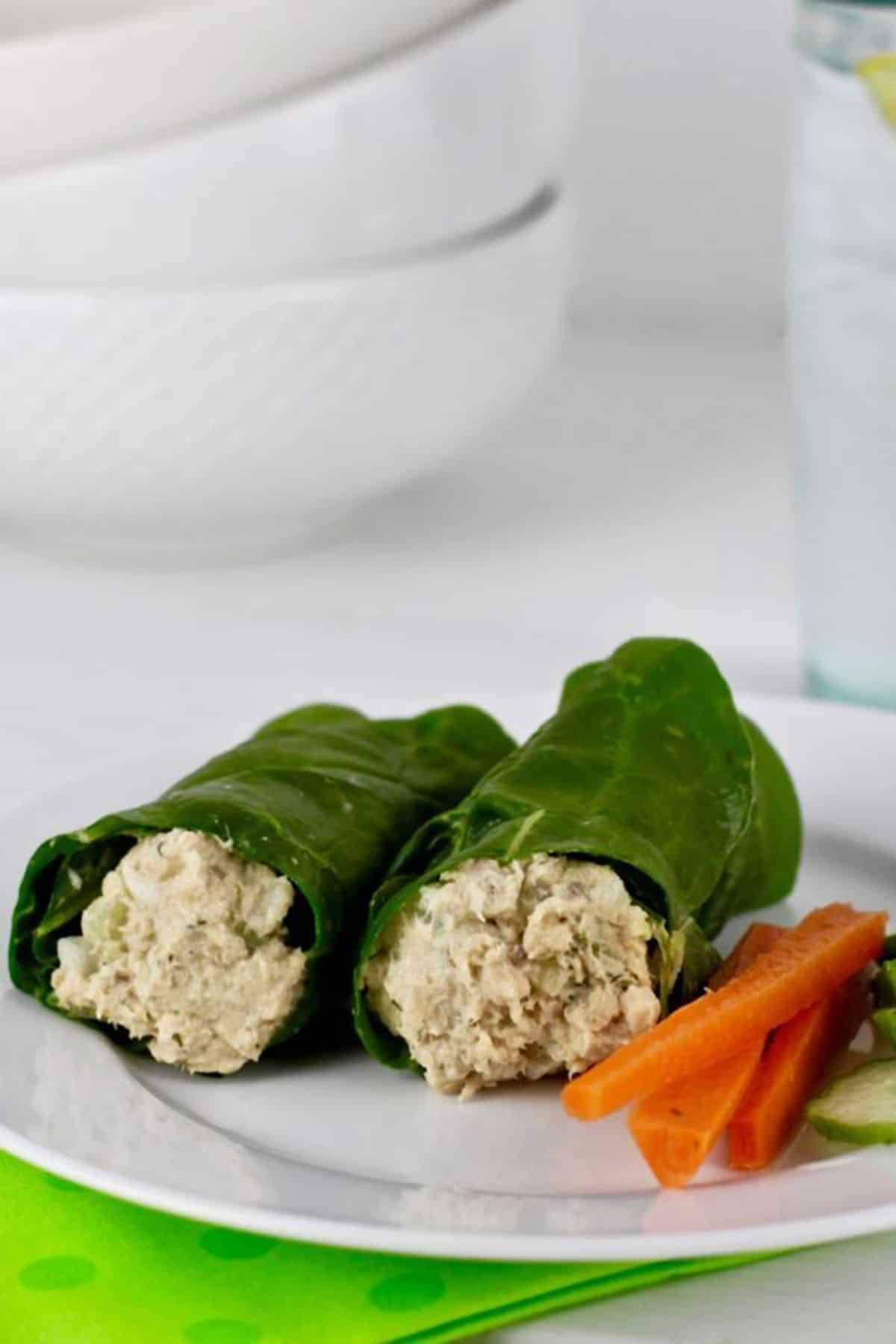
    To make it work: use a flexible type of lettuce (butter lettuce, bibb lettuce, or green/red leaf lettuce often work better than Romaine, since Romaine tends to have those thick, inflexible stalks - Swiss Chard also has really big, flexible leaves that could work perfectly here). Don’t be afraid to make several smaller wraps instead of trying to cram an entire sandwich-sized amount of filling into one wrap.

    You can make wraps with your favorite sandwich fillings (roast beef, horseradish, and cheese; tuna salad; turkey slices with pickles and mayonnaise) or you could fill the wraps with any other type of thing that sounds tasty.

    Recipe: wrap a lettuce leaf around this Keto Tuna Salad.

    5. Pork rinds (0 grams net carbs per 1 ounce) for potato chips (13.7 grams net carbs per 1 ounce)

    (For reference, 1 ounce is about the size of the snack bags that you get out of vending machines.)

    Crunchy snack food is one of the biggest things that people miss on Paleo or keto: without popcorn or chips, it might seem a little bleak. But if you’re craving that crunchy snack, no need to turn to deep-fried carbs for an answer. Just pick up some pork rinds instead! Pork rinds are high in fat and protein (and since they’re made from the skin of the pig, those proteins have a lot of collagen and other good stuff we don’t get enough of in the modern world).

    The recipe for this one is super simple: buy pork rinds, open bag, dig in and enjoy!

    6. Ground almonds (4.3 grams carbs per ½ cup) for breadcumbs (21 grams carbs per ½ cup)

    Need to batter something and fry it? Something like, say...a delicious fillet of fish, or maybe a nice slice of liver? Throw out the breadcrumbs and grab some ground almonds - the carb count is a lot lower. You could also do this with any other nut of your choice (for example, hazelnuts have 2.6 grams of net carbs per ½ cup ground; pecans have 2 grams).

    Another alternative is coconut flakes (2.9 grams carbs per ½ cup of shredded unsweetened coconut). Make sure to get unsweetened! Don’t let a surprise sugar bomb in your coconut derail your keto train.

    Recipe: Mustard-Crusted Chicken Drumsticks

    What's your favorite fast, simple kitchen substitution to use in keto-friendly recipes? Let us know on Facebook or Twitter!

    Filed Under: Learn About Paleo & Keto Diets

    Paleo Leap's Top 11 Recipes of 2017

    December 31, 2017 by Paleo Leaper Leave a Comment

    The end of the year always gives us an opportunity to stop and reflect on whats taken place over the past 12 months. This year we've done a lot, launching the new website layout and our app are definitely highlights. It also means we get to see our most popular recipes of 2017. This year features worldly flavors and a lot of heat. Which is fitting, because we always say once you cut out processed and already prepared foods it leaves you with a chance to change things up, explore other flavor profiles, and discover new ones. Maybe you'll find a new favorite or two right here. Cheers to a happy and healthy new year!

    Want even more of our top recipes? We compiled our best Paleo recipes for 2015 and 2016.

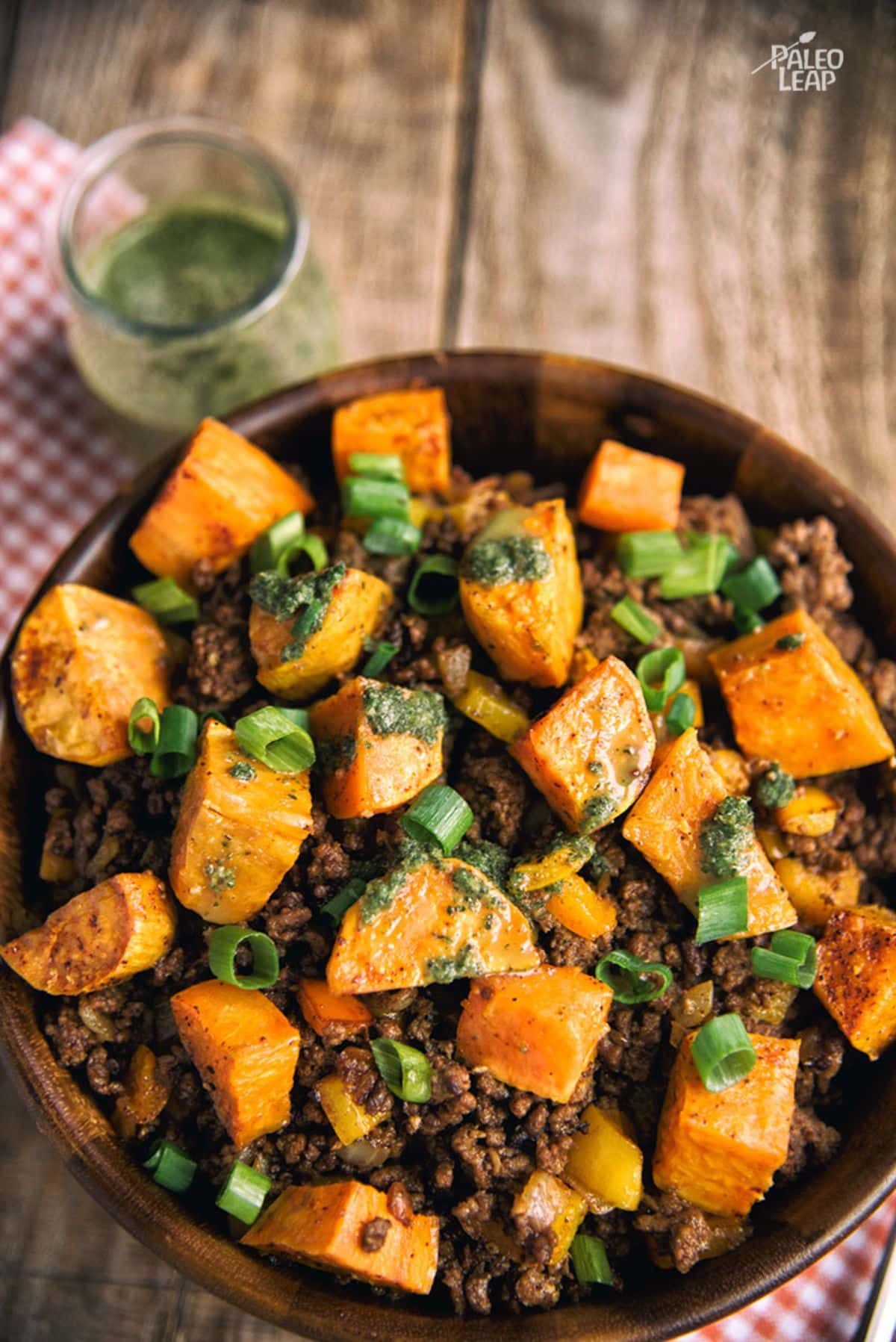
    Sweet Potato And Ground Beef Bowl

    Chili dusted sweet potatoes and ground beef drizzled with a cilantro sauce all served in a bowl.

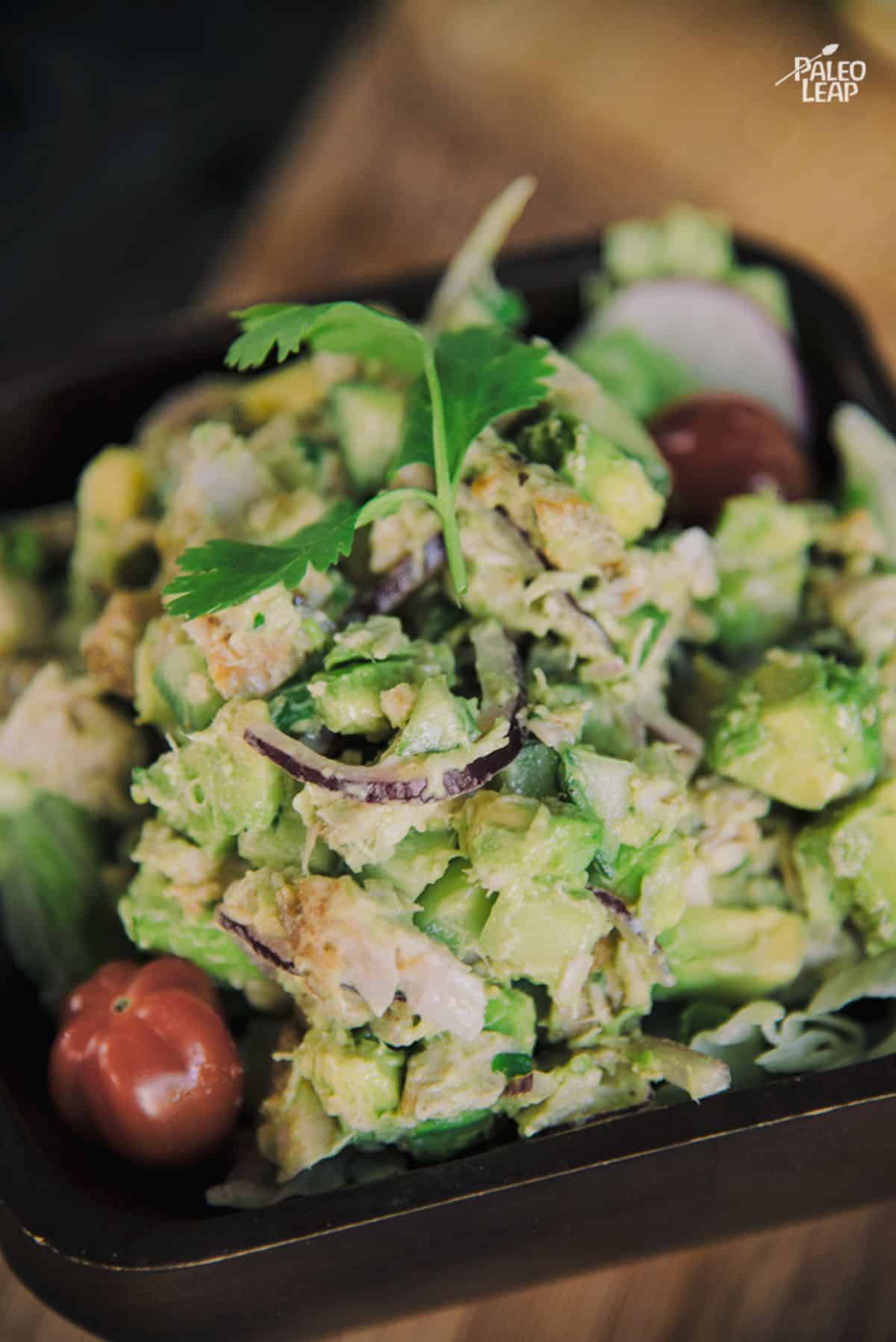
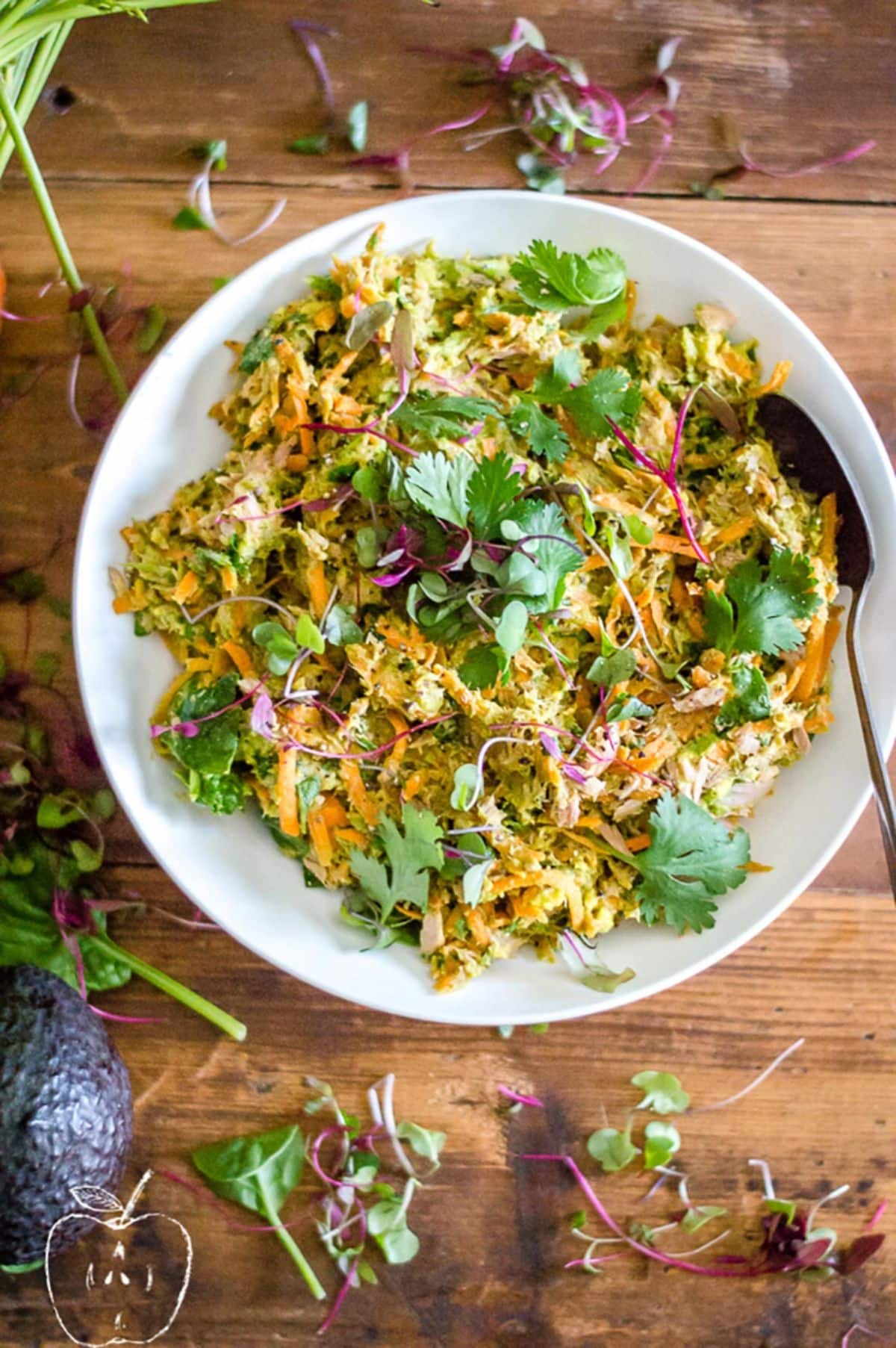
    Avocado, Cucumber And Cilantro Tuna Salad

    A mayo-less tuna salad recipe that uses cucumber, avocado, and cilantro to keep it refreshing. It also follows the Paleo autoimmune protocol if you omit the paprika.

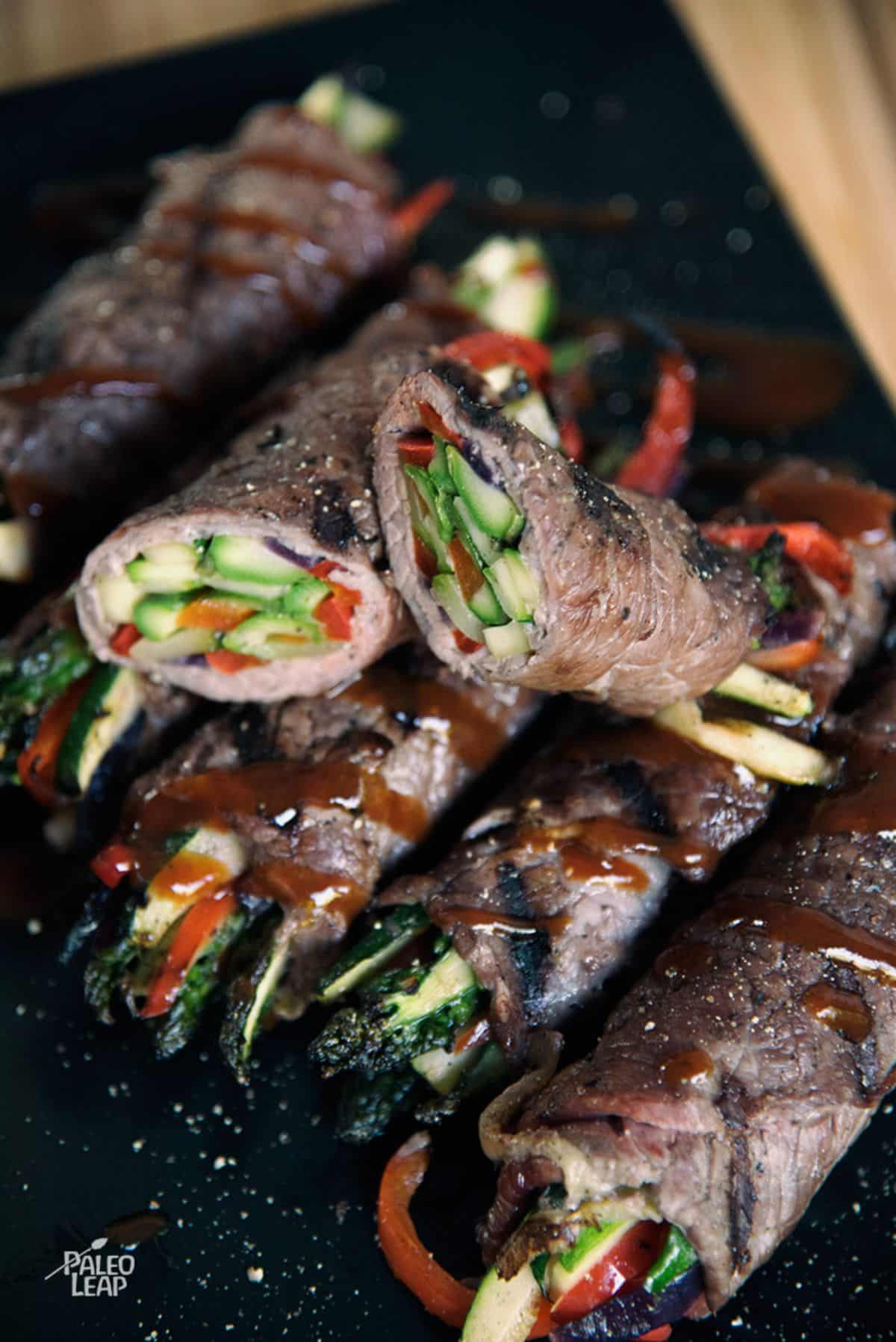
    Summer Vegetable Beef Rolls

    An update on our popular balsamic steak rolls, adding asparagus to the mix.

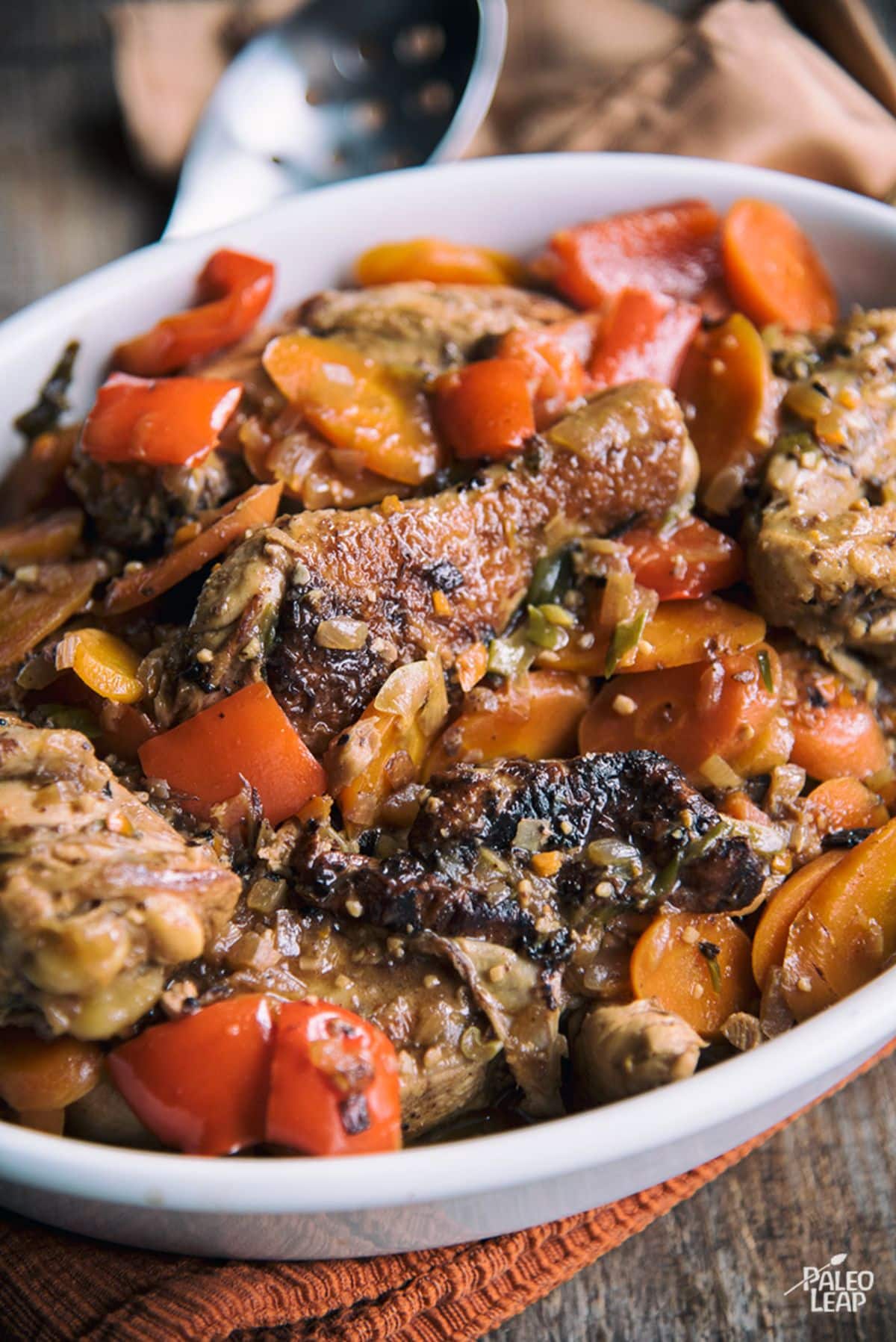
    Jamaican-Style Brown Chicken Stew

    A whole chicken stewed in coconut milk, spices and hot peppers will warm your kitchen just thinking about it.

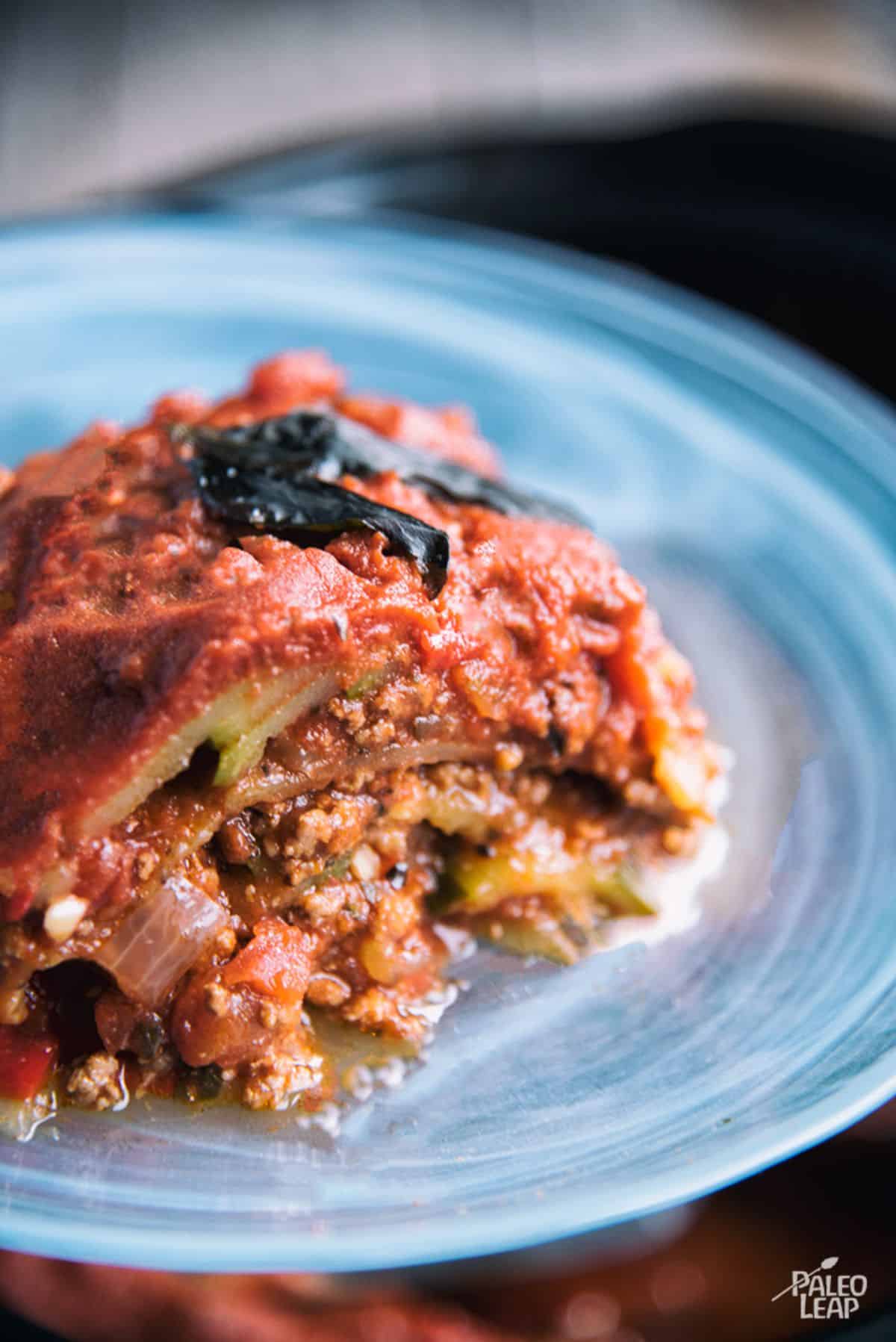
    Slow Cooker Beef Zucchini Lasagna

    Comfort food and a slow cooker go hand in hand, no wonder we tasked it with cooking up some zucchini based lasagna.

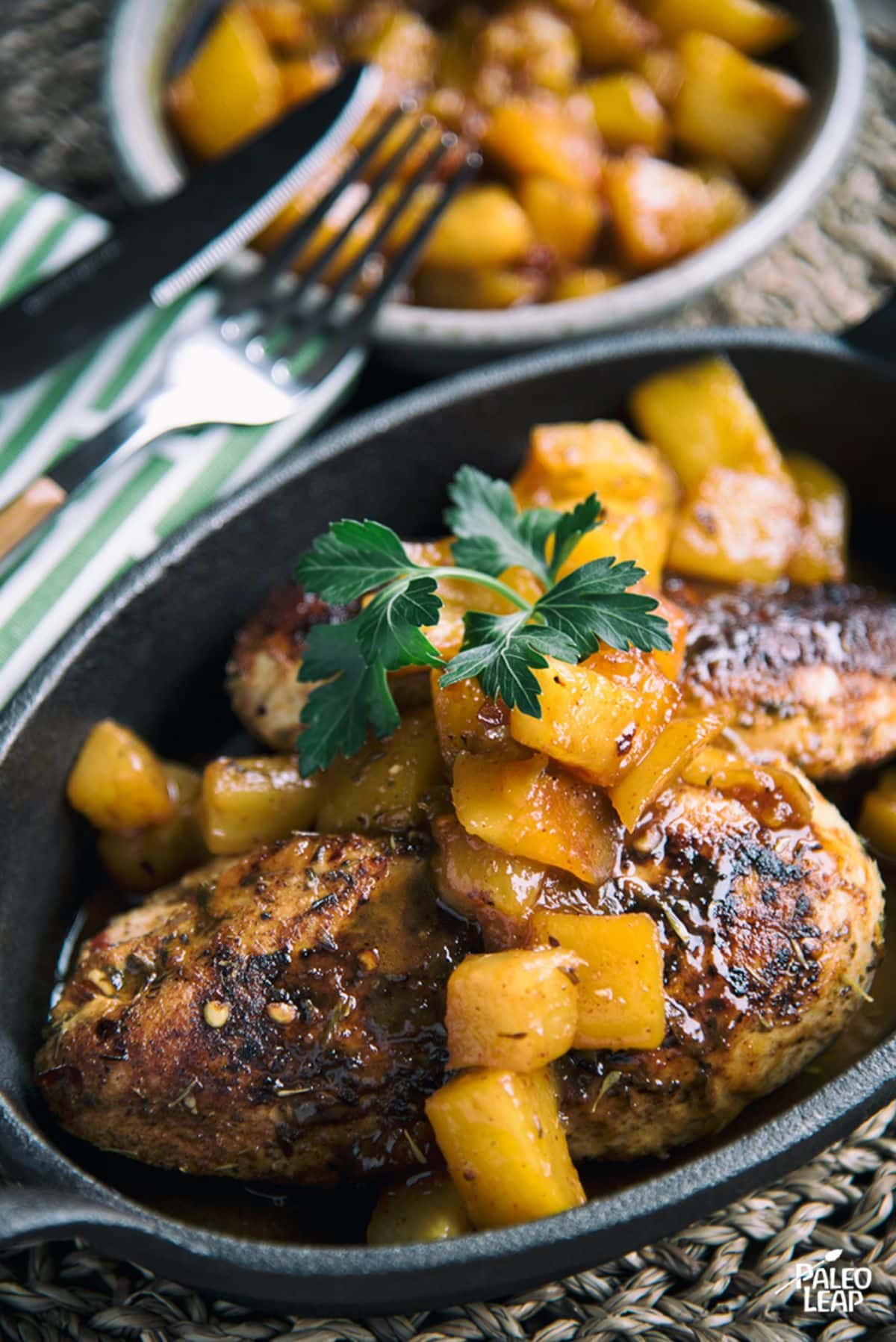
    Jerk Chicken with Mango and Pineapple Sauce

    This recipe brings the flavors of the islands right to your own kitchen.

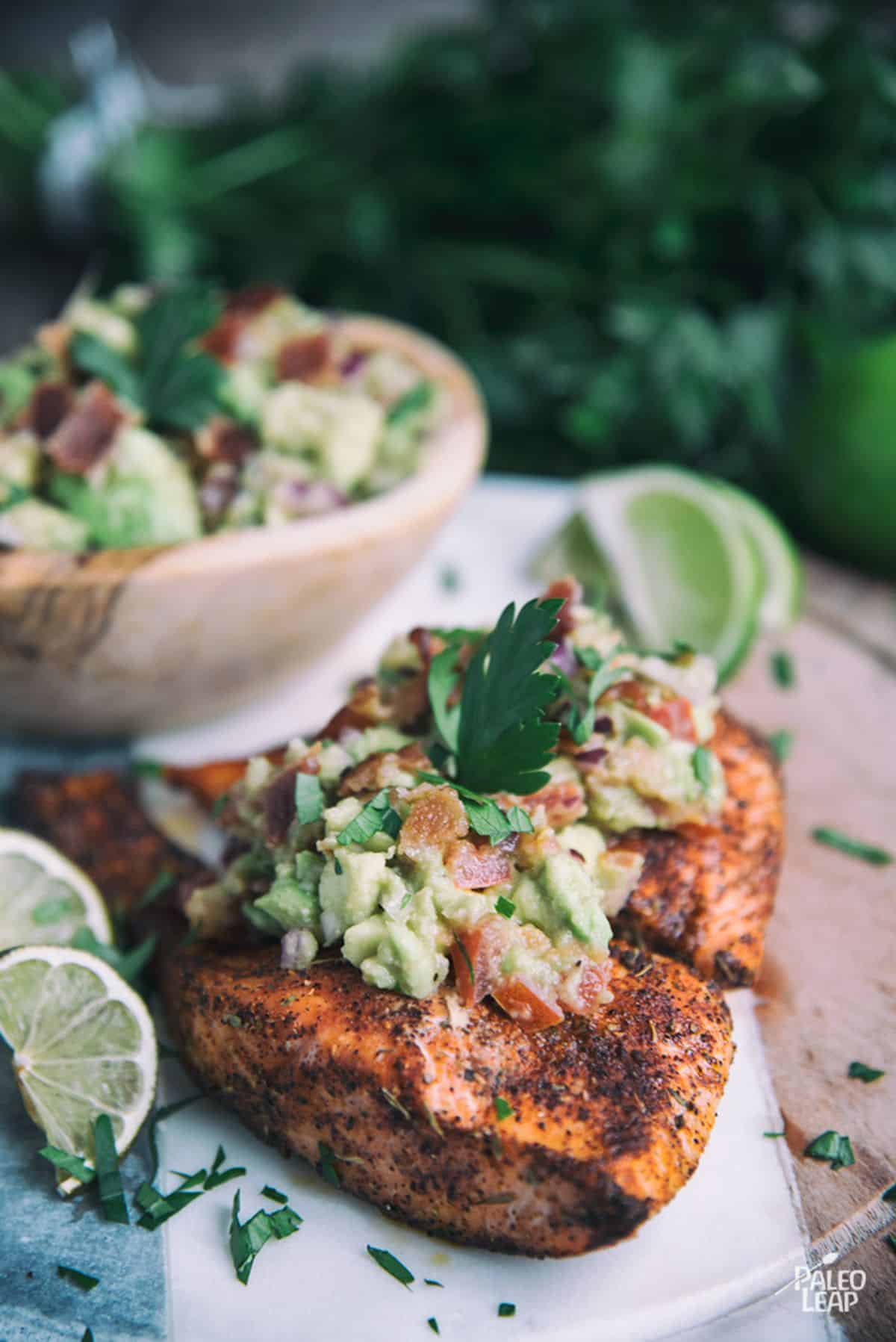
    Baked Salmon With Bacon-Avocado Salsa

    An avocado, bacon, and tomato salsa is exactly what's needed to go with these spicy salmon filets.

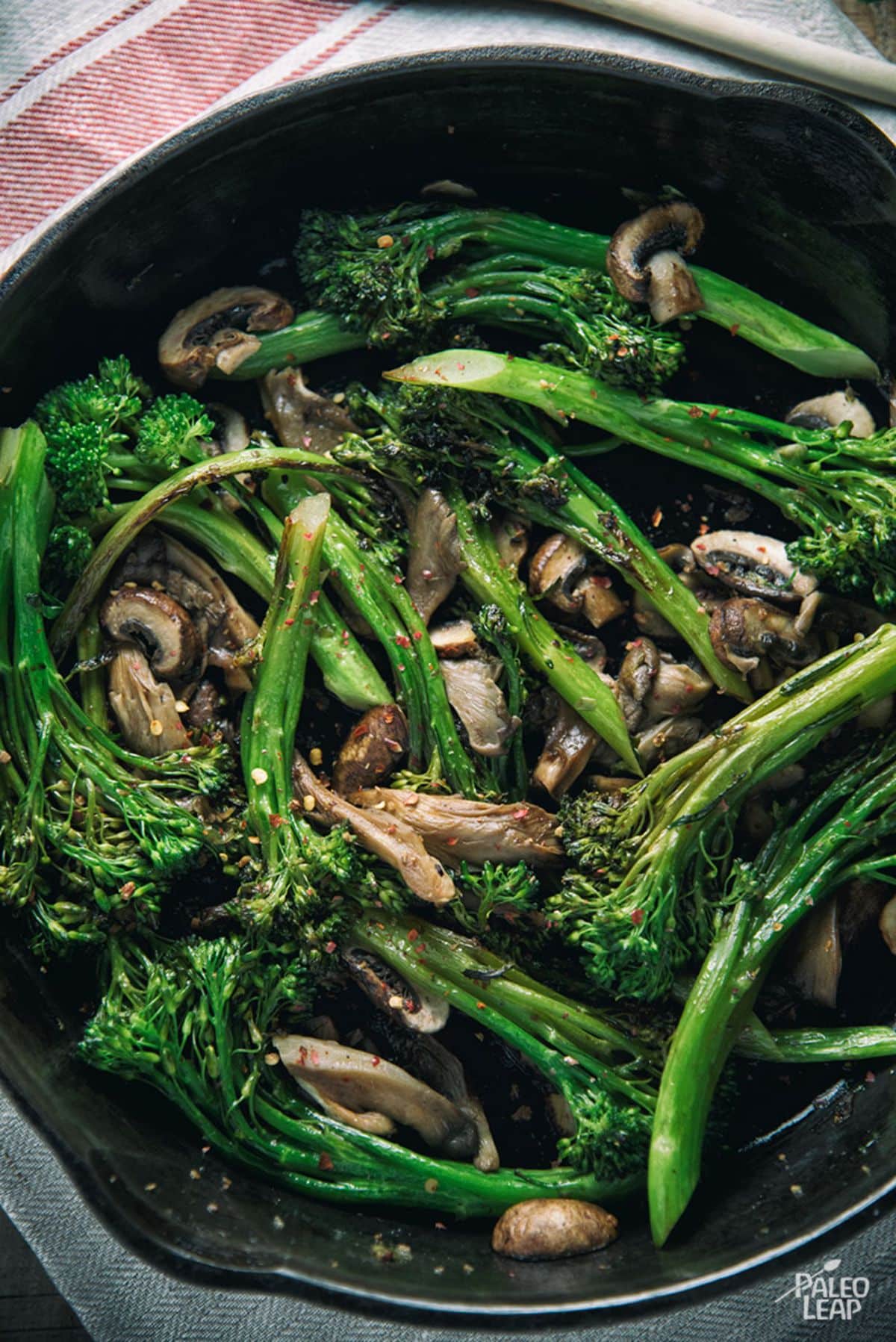
    Balsamic Broccoli And Wild Mushroom Skillet

    A simple side with wild mushrooms and broccolini. It's easily made vegetarian or vegan in if you switch out the cooking oil.

    Slow Cooker Honey-Garlic Pork Tenderloin

    Pork tenderloin slowly cooked in a homemade sweet, garlicky, and tangy sauce.

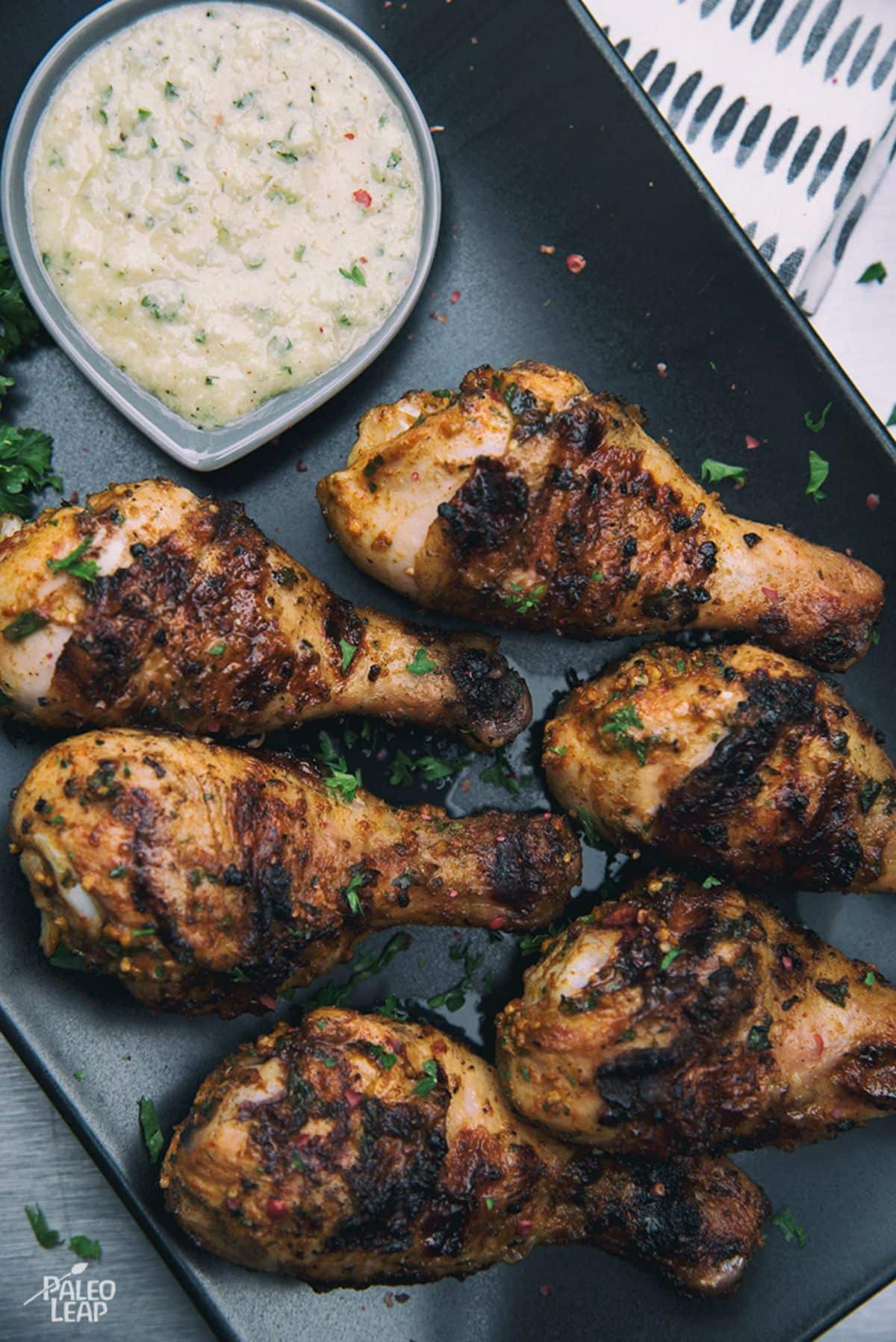
    Grilled Moroccan-Style Chicken

    Drumsticks are marinated with fresh herbs and warm spices like ginger, cumin, and coriander and then grilled to perfection.

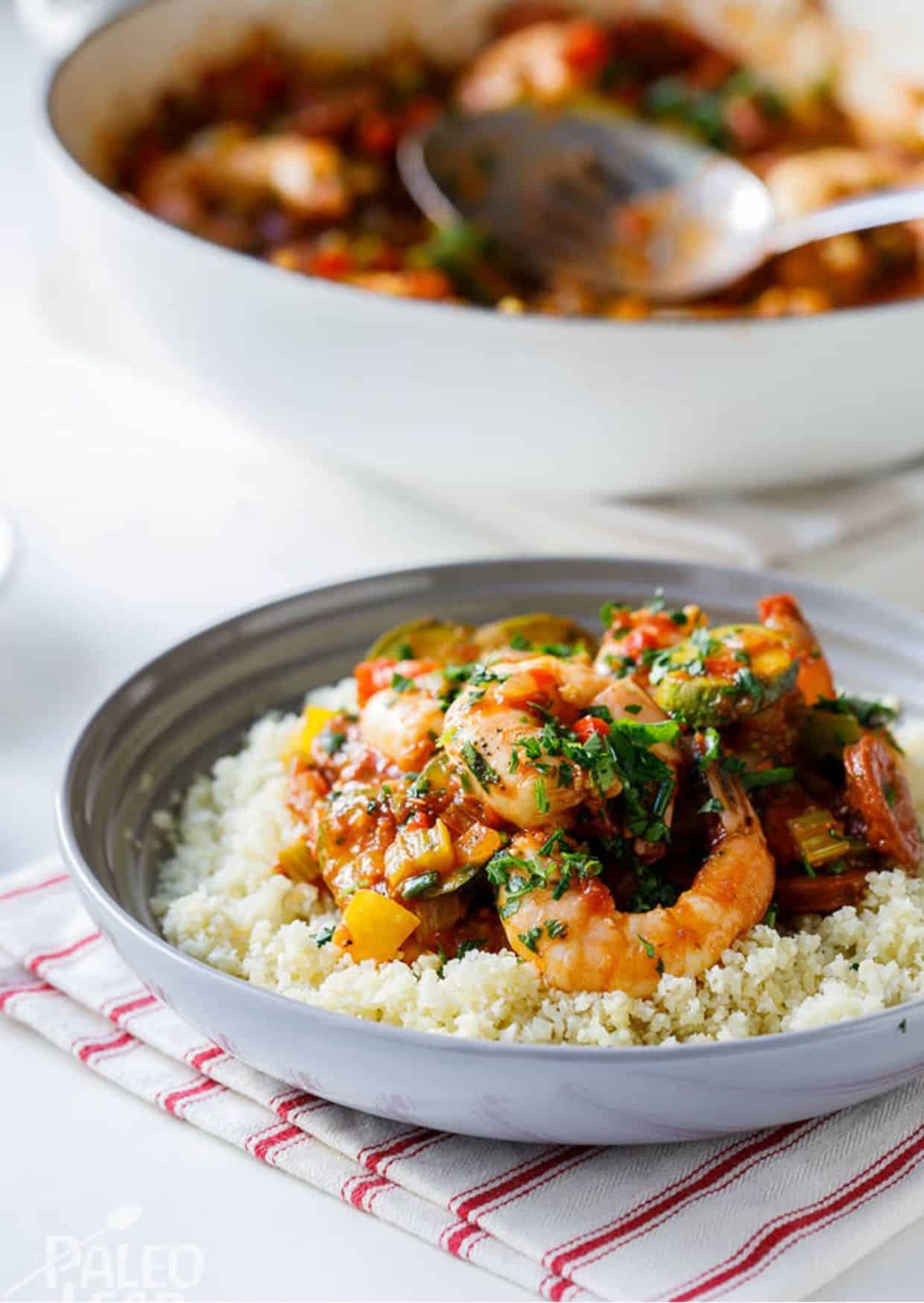
    Paleo Jambalaya

    Our most popular video of the year is our Paleo take on a Louisiana staple - Jambalaya.

    Filed Under: Paleo Recipe Compilations

    Getting Started with Keto Cooking: Three Complete Days of Easy Meals with Family Modifications

    December 13, 2017 by Paleo Leaper Leave a Comment

    When you first start with keto, the cooking can be a challenge. What does a typical keto day look like? What do you make for breakfast without carbs? What about work lunches? What about kids? What if you have to cook for your non-keto family on top of it all?

    Keto Cooking

    Think of this as part meal plan, part guide to making your own meal plans, and part instruction manual for modifying keto recipes for your specific needs.

    The plan is written for an imaginary keto beginner, Emma. Emma works Monday-Friday and needs to pack a lunch. She’s not a vegetarian and has no major food allergies. She eats some dairy and she’s trying to stay below 50 grams net carbs per day.

    Below are three days of meals, modified for three different scenarios:

    • Emma lives alone and is cooking only for herself - instructions for bulk meal prep, cooking ahead, and halving recipes to be manageable for one person.
    • Emma lives with her husband and 2 kids, and they’re all eating keto - instructions for cooking keto for a crowd.
    • Emma lives with her husband and 2 kids, and Emma is the only one eating keto - instructions for satisfying everyone without cooking two separate meals because nobody has time for that.

    Weekday 1

    Notice


    Protein: 142g / 29%


    Fat: 135g / 63%


    Carbs: 40g / 8%


    Net Carbs: 26.5g

    Values are per portion. These are for information only & are not meant to be exact calculations.

    Breakfast

    Protein/Fat: Egg frittata muffins

    Portion and prep instructions:

    Emma alone Keto familyNon-keto family modifications
    Make one recipe in bulk for a few days - these are great cold or reheated. Make one recipe as written for the whole family. If you want to cook in bulk, make several batches at the beginning of the week.


    If your kids are picky vegetable eaters, it’s easy to swap out one low-carb vegetable for another in these.

    Family eating Paleo, but not keto: serve the muffins with cranberry sauce (surprisingly great with eggs!), ketchup, or another sauce of your choice.


    For a non-Paleo family: if they won’t eat eggs, it’s not a lot of extra work to buy cereal or oatmeal. And then Emma could easily make the egg muffins in bulk for herself.

    Lunch

    Protein/Fat: Stuffed peppers (make the night before if you need them to go)

    Portion and prep instructions:

    Emma alone Keto familyNon-keto family modifications
    Make five peppers for a bulk recipe that will last all week.  Make one recipe as written for the whole family. For kids, depending on age/appetite, half a pepper might be plenty. Family eating Paleo, but not keto: add some tomato sauce for everyone but Emma for extra flavor.


    For a non-Paleo family: if desired, replace some of the ground beef in the peppers with wild rice or canned beans/chickpeas. Non-Paleo eaters could also have bread or couscous on the side.

    Dinner

    Protein/Fat: Baked salmon with avocado salsa

    Keto Side: Big tossed salad with spinach, red onions, walnuts and lots of delicious olive oil.

    Portion and prep instructions:

    Emma alone Keto familyNon-keto family modifications
    Cook just one salmon fillet and cut down on the salsa ingredients (unless you really like salsa, in which case, go wild!)Make one recipe as written for the whole family. If you have leftover salmon because your kids don’t want it all, save it to throw into some scrambled eggs or another batch of egg muffins - delicious!Family eating Paleo, but not keto: serve the salmon with mashed potatoes.


    For a non-Paleo family: Serve with crusty bread and butter.

    Weekday 2

    Notice


    Protein: 131g / 25%


    Fat: 160g / 69%


    Carbs: 30g / 6%


    Net Carbs: 19g

    Values are per portion. These are for information only & are not meant to be exact calculations.

    Breakfast

    Protein/Fat: Breakfast pork sausages

    Keto side: Fried mushrooms and onions

    Portion and prep instructions:

    Emma alone Keto familyNon-keto family modifications
    Make 1 batch of sausage for 4-5 breakfasts; fry up as many vegetables as you want each day (you could vary them from day to day, depending on what you feel like)Make 1 batch for the whole family. Plan on 2-3 onions and 1 pint of mushrooms for the family, depending on how many vegetables your family likes. You could also replace mushrooms and onions with any other vegetables depending on what the family likes. Family eating Paleo, but not keto: make 1 batch of sausages with fried vegetables for Emma and fresh fruit for the rest of the family.


    For a non-Paleo family: the typical “breakfast is easy to DIY” advice applies. Also, these sausage patties would be great for homemade sausage sandwiches - stick ‘em between two English muffins with a slice of cheese and let them have at it.

    Lunch

    Protein/Fat: Spicy bacon-wrapped meatballs (made with 75/25 ground beef, without the optional honey)

    Keto side: roasted cauliflower.

    Portion and prep instructions:

    Emma alone Keto familyNon-keto family modifications
    Make 1 batch of meatballs and 1 head of cauliflower (or more, if you’re a big vegetable lover!)  for 4-5 lunches.Make 1 batch of meatballs + 1 head of cauliflower for the whole family.Family eating Paleo, but not keto: serve with BBQ sauce (two suggestions: here and here!) and/or plantain chips in addition to the cauliflower.


    For a non-Paleo family: spaghetti is the obvious choice, but non-Paleo eaters could also have their meatballs over rice, mashed potatoes, or any other starch that they like.

    Dinner

    Protein/Fat: Roasted bone-in chicken thighs - for more fat and extra-crispy skin, drizzle the thighs in schmaltz (chicken fat), duck fat, or butter before roasting.

    Keto side: Roasted or pan-fried zucchini with lots of cooking fat (fat of your choice; ghee or butter would be delicious).

    Portion and prep instructions:

    Emma alone Keto familyNon-keto family modifications
    Make a big batch to have leftovers, or just enough for dinner - it’s up to you! (Nutrition information given for 1 thigh with a bit of extra fat)One full recipe as written should feed the whole family. Family eating Paleo, but not keto: Served with baked or hasselback potatoes


    For a non-Paleo family: serve with dinner rolls

    Weekend Day

    Notice


    Protein: 122g / 20%


    Fat: 193.5g / 71%


    Carbs: 53g / 9%


    Net Carbs: 31g

    Values are per portion. These are for information only & are not meant to be exact calculations.

    Breakfast

    Protein/Fat: Eggs fried in butter or coconut oil with salt and pepper

    Keto side: Wilted spinach and avocado slices

    Portion and prep instructions:

    Emma alone Keto familyNon-keto family modifications
    Make as many eggs as you like, fried up in lots of healthy fat, plus a big pile of spinach. Avocado optional for more healthy fats and nutrients.


    (Nutrition info given for 3 eggs with a few handfuls of spinach and half an avocado)

    2 eggs per child and 3 eggs per adult is a good ballpark to aim for. For the kids, you could leave off the spinach if they don’t like it. Family eating Paleo, but not keto: give the non-keto folks a side of baked sweet potatoes, topped with cinnamon and a pat of butter.


    For a non-Paleo family: Instead of serving avocado on the side, serve it on toast.

    Lunch

    Protein/Fat: Coconut curry shrimp with cauliflower rice

    Keto side: If you want even more vegetables besides the cauliflower rice, you could roast some tomatoes, broccoli, or anything else that sounds good: use a generous amount of fat and the same spices in the coconut curry shrimp recipe.

    Tip: to save time, you can buy fresh or frozen bags of pre-riced cauliflower.

    Portion and prep instructions:

    Emma alone Keto familyNon-keto family modifications
    If you have a bunch of leftover shrimp, try it over salad greens for easy lunches or dinners. Leftover cauliflower rice can easily be frozen. Make 1 full recipe for the whole family. If your kids aren’t fans of cauliflower rice, roasted cauliflower (in plenty of coconut oil) might be better because it has much more of a sweetness and crispiness to it. Family eating Paleo, but not keto: try baked Japanese sweet potatoes for a Paleo-friendly starch (they’re the ones that are purple on the outside but creamy white on the inside).


    For a non-Paleo family: if they don’t like cauliflower, substitute Asian noodles or white rice for the cauliflower “rice.”

    Dinner

    Protein/Fat: Slow-cooker fennel and rosemary pork shoulder

    Keto side: Baked bacon and cabbage

    Portion and prep instructions:

    Emma alone Keto familyNon-keto family modifications
    This would be a great make-ahead protein to cook in bulk on a Sunday night. Cook a big roast pork shoulder and you’ll have protein for the whole week ready to go. For the cabbage, you could just buy one cabbage, cook as much of it as you want, and save the rest - it keeps for weeks. Adding bacon is a great way to make cabbage more enticing to kids. It would also be easy to throw some Brussels sprouts, broccoli, or other vegetables into the baking dish to give any picky eaters a bit more variety to choose from. Family eating Paleo, but not keto: roast some squash (butternut would be good) as an extra vegetable side.


    For a non-Paleo family: pork and cabbage would be tasty with beer bread or dark rye bread.

    Dessert

    Chocolate and almond butter fat bombs

    What's your favorite way to modify keto recipes? Got a great easy bulk meal to prep for keto eaters living alone? Let us know on Facebook or Twitter!

    Filed Under: Learn About Paleo & Keto Diets

    Eating Fruit on Keto: Problems and Workarounds

    November 28, 2017 by Paleo Leaper Leave a Comment

    Eating Fruit

    In everyday conversation, it’s perfectly normal to talk about “fruits and vegetables” as if they were basically interchangeable. But on keto, vegetables are encouraged in small amounts while fruit is generally discouraged. What gives?

    Fruit is a great example of a food that’s perfectly healthy in the abstract but not right for keto specifically. The problem with fruit for keto purposes is that it’s just too high in carbs. With the exception of root vegetables like potatoes and carrots, most vegetables are low enough in carbs to fit into a ketogenic diet, but it’s a lot harder to squeeze a lot of apples or pears into a ketogenic carb count.

    There’s nothing “wrong” with fruit: it’s a perfectly nutritious type of food. But it just has too many carbs to fit into a keto diet - at least, in most ways.

    [As a nit-picky side note, the technical exceptions to this rule are avocados and tomatoes: both are botanically fruit, but nutritionally very different from apples and oranges. Avocados have quite a high carb count, but most of the carbs are from fiber. Tomatoes have about 6 grams of carbs (2 of those being fiber) per 1 cup of cherry tomatoes, so nutritionally they’re much more like vegetables than fruit. For the purposes of talking about “fruit,” we’ll consider avocados and tomatoes to be outside the “fruit” category, even though in the strictest of technical botanical terms, they’re “fruits.”]

    Fruit: a Carb-Counting PrimerBerries

    Take a look at the carb counts of a few common types of fruit:

    • Strawberries: 12 grams (3 of which are fiber) per 1 cup
    • Honeydew melon: 15 grams (1 of which is fiber) per 1 cup
    • Cantaloupe: 13 grams (1 of which is fiber) per 1 cup
    • Blackberries: 14 grams (8 of which are fiber) per 1 cup
    • Oranges: 18 grams of carbs (3 of which are fiber) per 1 orange
    • Blueberries: 21 grams (4 of which are fiber) per 1 cup
    • Cherries: 22 grams (3 of which are fiber) per 1 cup
    • Grapes: 27 grams of carbs (1 of which is fiber) per 1 cup of grapes
    • Bananas: 31 grams of carbs (4 of which are fiber) per 1 banana
    • Apples: 31 grams of carbs (5 of which are fiber) per 1 apple
    • Pears: 35 grams of carbs (7 of which are fiber) per 1 pear

    On keto, most people are trying to stay below 50 grams of carbs per day. That just doesn’t leave room for a lot of snacking on fruit, unless you’re planning to eat one apple as a snack and nothing but meat and fat for the rest of the day - probably inadvisable from a nutritional perspective.

    Nutritional Issues with Skipping Fruit

    But isn’t it dangerous to skip fruit? Won’t you miss out on a bunch of nutrition?

    Not really. Fruit is plenty nutritious, but there’s not really anything there that you can’t get from lower-carb vegetables. Take a look at some key nutrients, with fruit and vegetable sources compared in terms of nutrition per carb:

    Vitamin C

    Fruit is famous as a source of vitamin C, but if you're carb-counting, vegetables are probably a better bet. If you think about carbs as the "price" that you pay for the nutrition that you get from fruit and vegetables, then vegetables give you more bang for your buck - there's a lot more vitamin C per gram of carbohydrate in vegetables.

    FoodMilligrams of vitamin CNet carbs (without fiber)Milligrams of vitamin C per gram of carbohydrate (aka bang for buck)
    Apples (1 large)10260.4
    Bananas (1 large)12270.44
    Oranges (1 orange)83155.5
    Strawberries (1 cup)8999.9
    Cauliflower (1 cup)52317.3
    Yellow bell peppers (1 pepper)3411034.1
    Green bell peppers (1 pepper)132526.4
    Frozen broccoli (1 cup cooked)74418.5

    The fruits have between 0.4 and 10 milligrams of vitamin C per gram of carbohydrate - and that's including two fruits that are notably high in vitamin C. Meanwhile, the vegetables have between 17 and 34 milligrams of vitamin C per gram of carbs, which is a better bargain if your carb budget is keto-level strict.

    Antioxidants

    Tea

    Fruit does have a lot of antioxidants, but you know what else has antioxidants?

    • Spices
    • Coffee and tea
    • Vegetables
    • Egg yolks

    In fact, spices are some of the most antioxidant-rich foods around, and they have near-zero carbs. You can absolutely get an antioxidant-rich diet without fruit in it.

    The Good News: Ways to Keep Enjoying Fruit on Keto

    OK, here’s the good news: there are still ways to enjoy fruit flavors on keto. You just have to be a little strategic about it. Consider…

    Fruit-infused oils and vinegars. Lemon-infused olive oil is a salad dressing classic, but most fruits don’t really go with the olive taste. Not a problem: just branch out into coconut or avocado oil - if you get refined coconut oil, it doesn’t really have any taste. For vinegar, balsamic vinegar and white wine vinegar both go really well with fruit - the vinegar itself does have some carbs, but a lot less than a big pile of fruit would have. Using infused oils and vinegars lets you add fruit flavor to an entire salad for a manageably low number of added carbs.

    Spice blends and extracts. You can buy orange-pepper or lemon-pepper seasoning to get that tasty citrus tang in your savory dishes, or hit up the baking aisle for raspberry extract, strawberry extract, and other flavors. The extracts are particularly good for DIY homemade coffee flavorings: add a little of your favorite and some coconut oil or milk for a high-fat caffeine boost.

    Tea. There’s a fruit tea to everyone’s taste: apple cinnamon, rosehip, blueberry, raspberry, lemon-ginger, peach vanilla, pomegranate...some of them have some weird artificial flavors, but a lot of them are perfectly Paleo- and keto-friendly.

    It’s not really the same as digging into a big pile of fresh blueberries or an apple picked right off the tree, but it can be fun to experiment with different ways of adding fruit flavor to your meals without all the sugar/carbs.

    Fruit and Keto: Not a Great Match

    Fruit isn’t a “bad” food from a Paleo perspective, but it’s not a great choice for keto - most fruits just have too many carbs to play nicely with a keto diet. There’s nothing in fruit that you can’t get from vegetables, spices, and other nutrient-dense plant foods, and you won’t be setting yourself up for any nutrient deficiencies by skipping fruit as part of a keto diet.

    Filed Under: Learn About Paleo & Keto Diets

    5 Sneaky Carb Sources to Beware on Keto

    November 21, 2017 by Paleo Leaper Leave a Comment

    There are some carbs that everyone knows - bread, pasta, cookies, rice, oatmeal, and all of their grain-based cousins. But if you’re eating keto, your bar for “too many carbs” is low enough that you might blow your carb budget on foods you weren’t even considering.

    Carbs

    For most people on keto who have a specific carb target, the number to hit is 50 grams of carbs or under. Some people need to go as low as 20 or 30. With a limit that strict, even 5-10 grams of carbs in ketchup or seasoning mix can blow your goal numbers, so it’s important to keep tabs on everything, including these 5 sneaky carb sources that you might not be considering:

    1. Condiments

    Condiments can be a great way to add more healthy fat to a keto meal - but lots of sweet condiments are also full of sugar, which means they’re really high in carbs. Take a look at…

    • Ketchup: 10 grams of carbs per tablespoon.
    • Barbecue sauce: it depends on the specific brand: between 7-20 grams of carbs per tablespoon is a pretty average range.
    • Honey mustard dressing: depending on the brand, 6+ grams of carbs per 1 tablespoon.
    • Thousand island dressing: depending on the brand, 5+ grams of carbs per tablespoon.

    For all of these very little or none of the carb content is fiber - it’s mostly sugar. If you put a couple tablespoons of salad dressing or ketchup on a meal, that adds up pretty fast!

    In general, “safe” condiments include oil (olive oil, avocado oil, coconut oil…), mayonnaise, butter, and other fat-based toppings and dressings. As for vinegar, different brands list different carb counts, but the USDA standard reference entry puts balsamic vinegar at 2.7 grams of carbs per 1 tablespoon - something to be aware of, but not necessarily off the table, especially if you’re mixing it with lots of olive oil.

    2. Nuts

    food allergies main

    Nuts can also have a significant number of carbs - they’re probably fine if you’re eating them as a snack, but if you start using nut-flour baking to replace regular flour, be aware of how much you’re really using.

    Check out the number of carbs in one ounce of some different nuts. An ounce of nuts is about as many as you can hold in your closed hand.

    • Walnuts: about 4 grams carbs (2 of which are fiber) per ounce
    • Almonds: about 6 grams (3.5 of which are fiber) per ounce
    • Cashews: about 8.5 grams carbs (1 of which is fiber) per ounce
    • Pistachios: about 8 grams carbs (3 of which are fiber) per ounce

    ¼ of a cup of almond flour has 6 grams of carbs (3 of them fiber).

    Nuts are a nutritious snack food, but if you’re counting carbs super strictly, don’t forget to add up the snacks, too.

    3. Dairy

    Dairy is totally optional on keto, but a lot of people do choose to eat it, for variety and for the healthy fats. Butter is pretty safe as far as the carb count goes (technically, 0.01 grams of carbs per tablespoon, so in practice it’s basically carb-free), and so is heavy cream (about 0.5 grams per tbsp) but watch out for…

    • Greek yogurt, made with whole milk: 9 grams of carbs per 8 ounces
    • Regular yogurt, made with whole milk: 11 grams per 8 ounces
    • Regular yogurt, made with skim milk: 17.5 grams per 8 ounces
    • Whole milk: 12 grams per 1 cup
    • Cheddar cheese: about 1 gram per ounce

    All of the yogurt listings are assuming zero added sugar - if you buy the little yogurt cups with a bunch of flavors and stuff added, you’re likely to be getting even more sugar because there’s probably some sweetener added.

    The fattier the dairy, the lower-carb it’s likely to be, so if you’re counting carbs like a hawk, full-fat everything is definitely your friend.

    4. Spice Blends and Seasoning Mixes

    A surprising number of spice and seasoning mixes are just full of sugar. Obviously, this is going to depend on specifically what brand you buy and how much of it you use, but just to take some examples with a huge international range, let’s take a look at some Wal-Mart brand seasoning mixes. Assuming that 1 teaspoon is somewhere between 4 and 6 grams (usually a safe bet for most spice mixes), here’s the approximate carb count for a teaspoon of...

    • Beef stew seasoning mix: 3 grams
    • Taco seasoning: 4 grams
    • Fajita seasoning: 3 grams
    • Mild chili seasoning: 5 grams

    None of this sounds particularly extreme, but in a typical bowl of chili, you might have 2-3 teaspoons of chili seasoning, and that adds up pretty fast if you’re trying to stay under 50 grams of carbs for the whole day.

    The moral of the story is: read the label, keep an eagle eye out for anything like sugar (including glucose, dextrose, corn syrup, corn starch, rice syrup, sugar cane syrup, cane juice, and all other names for sugar)

    On that same note, also beware of any pre-cooked or pre-prepared food that contains spices or seasonings. For example, lots of grocery stores sell meat that’s pre-rubbed or pre-marinated in some kind of sauce.

    5. Sausages

    Sausages

    This isn’t something that most people realize, but a lot of sausages contain a nonzero number of carbs. Think about it: chicken and maple breakfast sausages are made with maple syrup, which is basically concentrated tree sugar. Pork and apple sausages are made with apples, which are relatively high in carbs. And even when there aren’t any named high-carb ingredients, carbs can sneak in as fillers, preservatives, bulking agents, etc.

    Just for some representative examples, here are a couple carb counts from the USDA nutrition database for store-brand sausages:

    • Meijer mild Italian sausage: 4 grams of carbohydrate per 1 sausage link
    • Safeway maple breakfast sausage: 4 grams per 3 of the little mini breakfast sausages
    • Wal-mart brand chicken apple sausage: 8 grams per 1 sausage link
    • Roundy’s chicken sausage, roasted garlic and mushroom: 4 grams per 1 sausage link
    • Kroger beer bratwurst: 4 grams per 1 sausage link

    There are also plenty of sausages that don’t have a lot of carbs - it’s not impossible to find a good brand. But you can’t just automatically assume that any sausage will be keto-friendly because it’s made of meat: check the label before you buy!

    Be as Strict as you Need to Be

    Not everyone needs to worry about the carbs in salad dressing and sausages. But some people do - and if that’s you, be aware that vegetables aren’t the only foods that might blow your carb budget faster than you realize. It's not just bread and pasta that have carbs, and it's not even just vegetables that might sneak carbs into a keto diet!

    Filed Under: Learn About Paleo & Keto Diets

    5 Ways Paleo Helps Reduce Blood Pressure Without Restricting Salt

    November 2, 2017 by Paleo Leaper Leave a Comment

    About 1 in 3 people in the US have high blood pressure, and the numbers aren’t that much better in other countries where people eat a lot of processed junk food. We’ve covered before how salt might not be the demon food here - in 2014, a major report from the Institute of Medicine even shot down the idea that reducing dietary salt is the One True Way to Prevent Hypertension.

    But even if you think that salt has something to do with blood pressure, it’s pretty clear from the published research that a lot of other dietary factors also affect blood pressure. So putting salt to the side for a minute, take a look at 5 other areas where Paleo stands out as a great diet for controlling blood pressure.

    1. Paleo Delivers Lots of Vitamin C

    orange
    Vitamin C: not so hard to get, if your diet isn't 90% processed sugar and refined grains!

    Vitamin C is an antioxidant: it helps fight oxidative stress and oxidative damage to blood vessels. And that turns out to be pretty great for blood pressure. This study found that dietary vitamin C, but not supplemental vitamin C, predicted lower risk of hypertension. The research concluded that “hypertension risk is reduced by improving overall diet quality and/or vitamin C status. The inverse association seen for dietary but not for supplemental vitamin C suggests that vitamin C status is preferably improved by eating foods rich in vitamin C.”

    Low vitamin C levels don’t just make high blood pressure more likely; they also make it more deadly - people with high blood pressure and vitamin C under 28.4 μmol/L had a much higher risk of stroke than people with high blood pressure and decent vitamin C levels.

    A surprising number of people eating an American-style diet have inadequate vitamin C intake. In this study of people from New Zealand, 50% had inadequate serum vitamin C levels, and 13% had levels below 23 µmol/L, or roughly the level that correlated with the highest risk of hypertension.

    Paleo fixes this in the simplest way possible: more fresh plant foods. The best source of vitamin C is raw fruit and vegetables (high heat is damaging to vitamin C, so cooking foods reduces their vitamin C content). Think: carrot sticks, coleslaw, pineapple cubes for dessert, big salads with the whole kitchen sink thrown in...it’s almost impossible to be vitamin C deficient if you’re eating Paleo, so there’s no need to even make a special effort here - the diet takes care of vitamin C automatically.

    2. Paleo is Designed to Reduce Inflammation

    Inflammation is a critical factor in developing hypertension. Increased levels of pro-inflammatory proteins are bad; so are reduced levels of anti-inflammatory proteins. Chronic, low-grade inflammation damages blood vessels (arteries and veins) and increases the likelihood that a person will develop high blood pressure in time.

    Inflammation can come from all different places, but diet-induced inflammation in particular is linked to an increased risk of developing high blood pressure.

    In terms of how Paleo addresses this, tackling inflammation is one of the basic goals of the whole diet. It’s built in from the ground up, from the anti-inflammatory fats to the antioxidant-rich spices to cutting out inflammatory gut irritants. If you're eating Paleo, you're eating an anti-inflammatory diet, and your blood pressure is probably thanking you.

    3. Paleo Limits Added Sugar

    Recently, there’s been a big focus on dietary sugar and blood pressure, with several studies connecting added sugar to hypertension. Some of them seem to be using really ridiculous amounts of sugar - 25-30% of calories from added sugar - but as this paper points out, 13% of Americans consume at least 25% of their daily calories from added sugar. Among teenagers, it’s even worse. That kind of sugar intake should be abnormal, but it’s definitely not unusual in the US context, and there’s good evidence that it contributes to high blood pressure on a population level.

    One easy way to test added sugar is to look at sugar-sweetened beverages (SSBs) like Coke and Pepsi, which are basically sugar water with a bit of caramel coloring. A meta-analysis of prospective cohort studies found that increasing SSB consumption increased risk of hypertension. Conversely, this study measured people’s SSB consumption and blood pressure at 0, 6, and 18 months. The people who reduced their SSB consumption also reduced their blood pressure, even after accounting for weight loss.

    To make the sugar story even more interesting, this study suggested that sugar might interact with salt - which would make sense, since the same types of processed junk food associated with high blood pressure tend to be high in both sugar and salt.

    In terms of Paleo, this one is a no-brainer: Paleo basically eliminates added sugar. Problem solved!

    4. Paleo Foods are Rich in Potassium

    This is covered in more depth here, but the short version is that sodium-potassium balance might be more important than the absolute amount of sodium in your diet. For example, in at least one study, high dietary salt consumption didn't have any negative effect on blood pressure as long as people were getting enough potassium.

    Potassium lowers blood pressure through a variety of different mechanisms. Just to name a couple, it increases the amount of sodium that your kidneys filter out of your body and also has hormonal effects that help the kidney adapt to changes in salt intake.

    Today’s diet is much lower in potassium than our evolutionary diet, and just like vitamin C, potassium is often a nutrient that people eating a typical American diet are lacking. But Paleo doesn’t have that problem at all, because it’s full of potassium-rich foods, just like our ancestral diet. Bananas are the most famous potassium-rich food, but potatoes are actually a better source. And a whole lot of vegetables have significant potassium content - if you’re eating a nice wide variety of plant foods, potassium shouldn’t be an issue.

    5. Paleo is Full of Nitrate-Rich Vegetables

    SwissСhard Paleo

    Nitrate is an inorganic compound found in beets and leafy dark green vegetables, like spinach and chard. In humans, there’s quite a bit of evidence that foods rich in nitrate help to reduce blood pressure. For example, in this study, the researchers put 19 women on a diet full of nitrate-rich vegetables and watched their blood pressure drop. And in this one, the authors found the same benefit in 25 people of both sexes: a “Japanese Traditional Diet” containing lots of nitrate-rich vegetables lowered blood pressure, while the same diet without the nitrate-rich vegetables had no real benefit.

    The most famous source of nitrate is probably beet juice - that’s why you’ll occasionally see beet “shots” or other beet-based supplements marketed for blood pressure, but these studies show that nobody needs special processed supplements to get enough nitrates - getting them from regular beets and dark leafy greens is good enough on its own.

    Blood Pressure: Don’t Under-Think This

    "Don't overthink this" is usually good advice, but in this case, "don't under-think this" might be more appropriate. “Salt = high blood pressure” is about as legitimate as “dietary fat = obesity” and “eggs = heart disease” - in other words, totally bunk. There are tons of other dietary factors - like vitamin C, potassium, nitrates, inflammation, and sugar - that affect blood pressure.

    Even without getting into the weeds on the salt/sodium issue, Paleo addresses these other factors by providing lots of nutrient-rich fruits and vegetables, cutting out refined sugar, and addressing inflammation at the roots. That’s a much more comprehensive way to address blood pressure concerns than just fixating blindly on salt - and tastier, too!

    Filed Under: Learn About Paleo & Keto Diets

    A Different Way to Think About Nuts: Getting Past the Nutrient Focus

    August 29, 2017 by Paleo Leaper Leave a Comment

    Think

    Outside of white potatoes, nuts might be some of the most hotly-disputed foods in the Paleo world. Depending on who you ask, you might hear that they’re inflammatory because of their Omega-6 content or anti-inflammatory because of their antioxidants. They might be “bad” because they’re high in lectins or “good” because they’re high in fiber.

    But whole foods are so much more complicated than any one nutrient. Nuts are high in Omega-6 fats and antioxidants and fiber. And they’re not all the same, either. Specific types of nuts can be unusually high or low in different nutrients: macadamia nuts are actually pretty low in Omega-6 fats; Brazil nuts are really high in selenium; walnuts are a good source of Omega-3 fats (recent research has actually found that Omega-3s from plant sources might be more valuable than people previously thought).

    All of these different nutrients affect each other in complicated ways. It’s impossible to understand the health effects of nuts by looking at just one nutrient at a time. So here’s a different way to look at the nut question: instead of counting individual nutrients, check out out some studies where real people ate nuts as part of their diet.

    If you look at it that way, there’s some evidence that a snack-sized serving of nuts a few times a week is beneficial for cardiovascular health and neutral-to-positive for inflammation and weight loss. This supports the guidelines in the Paleo template: nuts can be a great snack, salad topping, or treat, but they shouldn’t be a staple food and if they don’t work out for you personally, there’s no huge drawback to cutting them out.

    Nuts and Inflammation

    (if you don’t know what inflammation is, here's a quick explainer to read first)

    The bottom line: in real studies of actual humans eating a moderate amount of nuts, the research shows a neutral-to-beneficial effect on inflammation.

    The Back-and-Forth

    Nuts have some pro-inflammatory components and some anti-inflammatory components:

    • Nuts might CAUSE inflammation because (except for macadamias) they’re relatively high in inflammatory omega-6 PUFA. Eating too much omega-6 fat is a big factor in inflammation and one of the main reasons why the modern diet is more inflammatory than the Paleolithic diet.
    • Nuts might REDUCE inflammation because they’re rich in antioxidants, including the antioxidant vitamin E. Brazil nuts are ultra-high in the antioxidant mineral selenium. Antioxidants tend to reduce inflammation and oxidative damage.

    The Research

    So nuts have some pro-inflammatory aspects and some anti-inflammatory aspects. How does that play out when real people eat nuts as part of a normal diet?

    This review (not funded or written by any nut industry groups) found that a moderate consumption of dietary nuts doesn't have any consistent effect on inflammation or oxidation of LDL cholesterol. The review considered studies on all different kinds of nuts (including a couple on mixed nuts). The precise amount of nuts varied from study to study, but the servings were mostly in the range of “snack-sized” (1-2 ounces) or a little larger. These were real people eating actual nuts, so it had to be something that normal people could easily work into a basically reasonable diet.

    So on the one hand, it’s not like nuts have jaw-dropping anti-inflammatory powers, but on the other hand, eating nuts in snack-sized amounts doesn’t dramatically increase inflammation either.

    Nuts and Cardiovascular Disease

    The bottom line: Studies on real humans suggest that nuts are likely to be helpful for cardiovascular health, but the waters are a little cloudy thanks to industry funding research.

    The Back-and-Forth

    Inflammation is one big factor in cardiovascular disease, so people who think nuts increase inflammation probably wouldn’t see them as a very heart-healthy food. Nuts are also high in fat, and a lot of people still can’t get out of the “fat is bad for your heart” mentality (which is total bunk). But on the other hand, nuts are also rich in vitamin E, magnesium, and other nutrients that have documented benefits for cardiovascular health. So, which is it?

    The Research

    Unfortunately, the big recent intervention study of nuts for cardiovascular disease, the PREDIMED study, got money from the International Nut and Dried Fruit Foundation, and two of the researchers who wrote up the study results about nuts are on the scientific boards of industry groups.

    If that doesn’t bother you, then the study’s findings are encouraging. In people who were already eating a Mediterranean diet to start with, adding 3 or more servings of nuts per week significantly reduced the risk of death from cardiovascular disease. In other words, even people who eat a generally good diet in other ways benefitted from adding nuts. Walnuts stood out as particularly good.

    That finding is consistent with this non-industry-funded review of prospective studies (the next-best thing to intervention studies), which concluded that eating nuts reduces the risk of ischemic heart disease and cardiovascular disease more broadly.

    Nuts and Weight Loss

    paleo ProfScale

    The bottom line: nuts are likely to be neutral-to-positive for weight loss - don’t write them off just because they’re high in calories.

    The Back-and-Forth

    On the one hand, nuts are relatively high in calories and a lot of people find them very easy to overeat without realizing it, especially in the form of baked goods made with nut flour. On the other hand, nuts are high in fiber and other nutrients that make them very filling relative to their calorie count, unlike junk food. Survey studies have regularly found that people who eat more nuts tend to be thinner, but associations don’t prove causation! Instead, take a look at some other kinds of studies.

    The Research

    This paper is one of the few reviews of nuts and weight loss that isn’t funded by any industry groups or written by researchers who sit on any industry councils. The review found that a snack-sized serving of nuts every day had no consistent effect on weight - sometimes the subjects’ weight didn’t change and sometimes they lost a little bit of weight.

    Now here’s the interesting part: in a couple of these studies, the researchers expected the nuts to cause weight gain by adding total calories to the diet. But something about the nuts seemed to mitigate that effect. It seems like the calories in nuts might be harder to absorb or use than the calories in most other foods. In other words, nuts aren’t a magical weight-loss superfood, but maybe they don’t belong in the same category of “calorie-dense foods” as potato chips and cheesecake. Overall, studies in actual people eating nuts show that a moderate amount of nuts is neutral-to-beneficial for weight loss.

    Final Recommendations

    Overall, these studies support nuts as an optional food. Eating nuts in modest amounts probably contributes to better health but isn’t totally critical.

    • A snack-sized amount of nuts every day is more likely to help than hurt, especially for cardiovascular health.
    • Research suggests that moderate nut consumption doesn’t cause any serious inflammation issues, possibly because the anti-inflammatory factors in nuts balance out the Omega-6 fats (this is the difference between whole foods like nuts and refined foods like soybean oil!).
    • If you personally find that nuts don’t work for you (e.g. you always end up binging on them), or if you just don’t like them, you’re not missing anything critical by leaving them off your plate completely.

    Overall, this research supports the guidelines in the Paleo template: eat nuts (if you eat them) as snacks, salad toppings, and treats, and don’t use nut-flour baking as a cornerstone of your daily diet.

    Filed Under: Learn About Paleo & Keto Diets

    How to Evaluate “Paleo Cookies,” “Paleo Bacon,” and other Paleo-Labeled Foods in the Grocery Store: Learning from the Low-Fat Craze

    August 16, 2017 by Paleo Leaper Leave a Comment

    Paleo Cookies

    Even Paleo eaters can learn a thing or two from the low-fat craze. In this case, it’s a lesson about foods in the grocery store that are labeled “Paleo-friendly” or “gluten-free.” There’s been an explosion of Paleo-branded foods lately: some are great, but others are total duds. Here’s how to tell the good from the bad.

    Learning From Low-Fat Mania

    The peak of the low-fat craze has passed, but even today, you can still walk into any grocery store and buy low-fat cookies, low-fat salad dressing, low-fat “cooking spray,” and low-fat dairy products of every kind, from yogurt to cheese to coffee creamer. People have obviously been buying this stuff: if it didn’t sell, it would be off the shelves.

    But despite our apparently popular low-fat options, people in the US have kept right on gaining weight - because in most of these products, fat is just replaced with sugar. Swapping fat with sugar doesn’t magically make cookies into health food. Some low-fat foods are perfectly healthy (spinach, vinegar, and spices are all naturally low in fat!). But just taking the fat out of a food doesn’t make it good for you. Or, put more bluntly, low-fat junk is still junk..

    To put that in a more general form:

    Food companies can engineer junk food to technically follow any set of diet rules (low-fat, low-carb, gluten-free, Paleo, etc.) - that doesn’t make it good for you.

    That concept is a good starting point for thinking about the increasing number of Paleo-branded foods that have been popping up at grocery stores lately. Even foods that technically fall within Paleo guidelines can still be really high in sugar, or just not quite right for you personally. Don’t fall into the trap of just seeing the “Paleo approved” sticker and assuming it must be healthy: here’s what to do instead.

    The Rise of Paleo-Branded Foods

    As Paleo has been getting more and more popular lately, “Paleo-friendly” or “Paleo approved” products from bacon to granola to cookie dough have started appearing in the grocery aisles. On one level, that’s great: more choices and convenience for you, the shopper!

    But on the other hand, there are some real stinkers out there. Some foods are branded as “Paleo” when they really shouldn’t be. And there’s a whole other group of products that follow all the Paleo rules but just don’t work for everyone. Just because it’s technically Paleo doesn’t mean it’s right for you!

    In that spirit, here’s a guide to evaluating those products to find the ones that work for you. This isn’t a list of which meals or products are “good” or “bad.” There are way too many products out there to fit in one list, and more coming out every day. But hopefully, after reading this, it should be easy to look at whatever you have available and make an informed decision about eating it.

    "Paleo” doesn’t mean “healthy” or “right for you.”

    There’s no regulation for how companies are allowed to use the term “Paleo.” It’s not like “USDA organic,” where there are specific rules (and regular inspections to make sure they’re followed). It’s up to you to figure out whether “Paleo”-branded products are (a) actually Paleo, or (b) right for you personally.

    Step 1: Read the ingredients.

    OK, sure, they're not very exciting. But if everyone in the world took 30 seconds to skim an ingredients list instead of making assumptions based on packaging or branding, we’d all collectively save ourselves a lot of unnecessary weight gain and health problems.

    What you see on that list can tell you a lot about whether the food is Paleo at all, and if so, whether it’s right for you. “Paleo” on the whole has a lot of gray areas and debated foods (white potatoes, dairy, bean sprouts…), but you personally should have a decent idea of what does or doesn’t work for you. Check the ingredients to make sure everything is OK: watch out for…

    • Sweeteners. Some people do best without any kind of sugar in their diet, whether it’s sugar from honey, maple syrup, or table sugar (all of which are basically the same, metabolically speaking). Other people are happy to eat honey and maple syrup, but not sugar alcohols. Then there's another group of people who will only eat Stevia and nothing else. You know which camp you’re in: does the type of sugar or sweetener in the product fall into your personal limits?
    • Nut flours. They can be gut-irritating and inflammatory in big doses, and some people do better without them.
    • Additives and preservatives. Everyone has a different case for which preservatives they will or won’t accept - check the list and see how it stacks up against your personal preference

    Step 2: Read the Nutrition Facts.

    checklist

    The ingredients list tells you what is in a product, but not how much. In some cases, the “how much” matters.

    For example, maybe honey is on the ingredients list. Honey is high in carbs. If you care about restricting carbs, then a tiny amount of honey per serving would be fine because it barely adds to the carb count. So if the Nutrition Facts says “5 grams of carbs per serving,” you’re good to go, even with a high-carb food like honey on the list. But on the other hand, if there are 100 grams of carbs per serving, that might be too much honey for you.

    Step 3: Decide how the food will fit into your diet.

    Based on your reading of the ingredients and the Nutrition Facts, is this an all-the-time food, a special treat, or something to put back on the shelf immediately and forget about forever?

    This isn’t about purity judgement and being More Paleo Than Thou. We’re all humans, and sometimes humans eat for pleasure. That’s totally normal and fine. There’s a time and a place for “less-bad” versions of candy and pizza - so long as you know that’s what you’re eating. Maybe a particular food clears your bar for “less-bad replacement” but doesn’t make the cut for “regular diet staple.”

    The Price Tag: Reducing the Paleo-Label Premium

    Not always, but often, the “Paleo” label comes with a premium price tag. You can sometimes save money by asking “why am I paying a premium for the Paleo version of this product, and is there a non-Paleo-branded version that would be equally good?”

    For example, with Paleo cookies, the cookies could be Paleo because they use almond flour (or similar) instead of wheat flour. You can’t just get that from a regular old package of Chips Ahoy. But with Paleo-branded bacon or sausages, you might find “accidentally Paleo” versions of the food without the markup. After all, it’s not the “Paleo” sticker on the front you care about; it’s the food inside.

    Paleo-Branded Foods: Are they Right for You?

    To repeat from above:

    Food companies can engineer junk food to technically follow any set of diet rules (low-fat, low-carb, gluten-free, Paleo, etc.) - that doesn’t make it good for you.

    When you spot some new product with a “Paleo approved” sticker, it might be a really awesome find, but it might also not be. Read the ingredients, read the nutrition facts, and then decide whether the food is right for you and how it’s going to fit into your diet.

    Filed Under: Learn About Paleo & Keto Diets

    5 Paleo Meals that Beat Whole Grains at their Own Game

    July 18, 2017 by Paleo Leaper Leave a Comment

    whole grains

    One of the big claims of conventional nutrition advice is that whole grains are "superfoods" incredibly high in various nutrients - just look at all the fiber and B vitamins and antioxidants! But it’s easy to come up with Paleo meals that are even better than grain-based meals - without the antinutrients and other bad stuff found in grains.

    To prove it, here's a look at 5 sample meals: an easy workday dinner, a hearty salad, an office lunch, a soup recipe, and a breakfast. For each meal, there’s a whole-grain-heavy alternative, plus a Paleo option with equal or better...

    • Fiber
    • Total B vitamins (B1/Thiamin, B2/Riboflavin, B3/Niacin, B5/Pantothenic Acid, B6/Pyridoxine, and B9/Folate.). B12 isn't included because this is about beating whole grain and B12 isn't found in whole grains, only in animal foods.
    • Antioxidants

    Technical notes, for the curious (skip this part if you just want the numbers):

    • B vitamins are measured in RDA percentages because they make it easy to see roughly whether a food is high or low in a given nutrient, not because it’s essential to get exactly 100% of everything every day.
    • There are so many different antioxidants in plants that a direct comparison of each specific one would take way too long, and that would be silly anyway since micromanaging specific antioxidants isn't a great use of your time. Instead, we just list antioxidant-rich foods in each meal.
    • Only nutrients relevant to whole grains are considered. For example, nobody is touting whole-wheat pasta as a great source of calcium, so calcium isn’t measured in the nutritional comparisons (but if you’re worried about that, you can look up 5 dairy-free meals with more calcium than a yogurt).
    • Nutrition information taken from the USDA nutrient database

    1. Easy Workday Dinner

    Need something quick for dinner? A big pile of brown rice with some protein and vegetables is a super healthy choice...until you put it next to a Paleo dinner! Take a look:

    • Whole-grain meal: 1.5 cups of cooked brown rice, 1 pork chop, and 1 cup of cooked spinach
    • Paleo meal: Salmon (5 oz) with fried spinach and onions (1 cup spinach + 1 medium onion) and and 1 baked potato (yes, white potatoes are OK on Paleo)

    Antioxidant explanation: salmon is rich in the antioxidant mineral selenium; spinach and onions are rich in antioxidants like carotenoids and quercetin.

    paleo salmonFlorentine
    Tasty B vitamins, delivered straight to your mouth.

    Unless you’re seriously deficient in thiamin, the Paleo meal is clearly the more nutritious choice.

    2. Hearty Salad

    If you ask most recipe sites, “grain salad” is apparently a legitimate category of recipe, even though some of them don’t even seem to include anything green. So how do they stack up to a salad made of actual vegetables?

    For a comprehensive comparison, there are two whole-grain meals here. One is a traditional pasta salad that you might see at any potluck; the other is a healthified organic quinoa salad that wouldn't be out of place at a vegan health food convention:

    • Whole-grain meal 1: Pasta salad (Pasta salad recipes obviously vary, but for calculating this nutritional info, 1 cup of salad = .5 cup of cooked whole-wheat pasta + .25 cup cherry tomatoes + .25 cup red pepper slices)
    • Whole-grain meal 2: Quinoa salad (1 cup of salad = .5 cups cooked quinoa, .25 cups raw cucumber, and .25 cups tomato chunks)
    • Paleo meal: Roasted Vegetable Salad (1 cup of salad = .2 cups beets + 0.2 cups butternut squash + 0.4 cups Brussels sprouts + 0.15 cups sweet potato + a sprinkling of pecans)

    Here are the nutrition facts for 1 cup of each salad:

    Antioxidant explanation: Beets, butternut squash, and sweet potatoes are all rich in antioxidants. For example, beets get their color from betalains, which are highly anti-inflammatory.

    No matter whether you’re looking at the classic pasta option or the trendier quinoa take on “grain salad,” making a hearty Paleo salad out of root vegetables still nets you a more nutritious meal.

    3. Office Lunch

    Need to grab something fast for lunch? The classic office lunch by conventional standards is a sandwich, but Paleo leftovers blow that out of the water for nutrient content. Compare…

    • Whole-grain meal: Sliced roast beef (2 deli slices) sandwich on whole-grain bread with pickles (3 dill slices), mustard (1 tbsp), mayo (1 tbsp), and cheese (2 slices provolone)
    • Paleo meal: Leftover Rosemary and onion roast chicken (1 thigh with a few of the onions) and leftover broccoli and mushrooms (¼ of the recipe)

    Antioxidant explanation: Broccoli is rich in all kinds of antioxidants, including flavonoids and vitamin C.

    And when it comes to ease of packing, leftovers from dinner might also beat making a sandwich from scratch. Pretty much a win for the Paleo team here.

    4. Hearty Comforting Soup

    If you’ve ever tried to buy canned soup at a grocery store, you know how many soups put rice and barley and noodles in their recipes. Supposedly, all those “heart-healthy whole grains” make them more nutritious, but compare that to a Paleo choice:

    • Whole-grain meal: Vegetable barley soup (1.5 cups, based on the USDA database entry for a generic/typical recipe)
    • Paleo meal: Slow-Cooker Butternut Squash and Apple Soup (¼ recipe)

    Antioxidant explanation: Among other antioxidants, the rich orange color of this soup comes from carotenoids in the squash and the sweet potato.

    The fall vegetables in the Paleo soup pack a serious nutritional punch; nutritionally speaking, this soup is probably a better choice than the vegetable barley.

    5. Breakfast

    The first meal of the day comes last on the list, featuring a whole-grain English muffin vs. a tasty omelet:

    • Whole-grain meal: whole-grain English muffin with honey (1 tbsp) and peanut butter (2 tbsp)
    • Paleo meal: Omelet (3 eggs, ½ onion, ½ red pepper, ¼ cup of ham) with half an avocado

    Antioxidant explanation: avocado is incredibly rich in antioxidants, but did you know that eggs also have significant antioxidant activity? It’s all in the yolk: antioxidants are the same chemicals that give the yolk its golden-yellow color.

    paleo avocado
    On top of the fiber and B vitamins, avocados are also rich in healthy fats, vitamin E, and other nutrients.

    Whole Grains Aren't Necessary for a Balanced Diet!

    Whole grains do have some nutritional content - this isn’t Wonderbread we’re talking about here. But it’s very simple to put together Paleo meals that match or beat grain-based meals in fiber, B vitamin, and antioxidant content. So now you have proof with specific numbers and even some recipes to go with them: nobody needs grains to get all the nutrition they need.

    Filed Under: Learn About Paleo & Keto Diets

    6 Non-Paleo Ingredients that Might be Hiding in your Trail Mix

    June 6, 2017 by Paleo Leaper Leave a Comment

    Trail Mix

    Trail mix is a great snack, and it’s often one of the few Paleo options in a gas station or a convenience store. But a lot of trail mix is full of hidden junk, even the kinds that look OK. The package might say “almonds, cashews, & cranberries” on the outside...but then when you look at the ingredients, the “cranberries” turn out to contain added sugar, junk oils, and four different preservatives.

    This isn’t about the trail mix ingredients that are obviously non-Paleo, like peanut butter cups or M&Ms. Those are just candy, and everyone can clearly see that they're candy, so they're easy to spot and avoid. But here’s a list of 6 ingredients that you might not notice or recognize as non-Paleo, from tricky foods that confuse newbies to hidden junk fats.

    1. Partially Hydrogenated Oils

    When you see “partially hydrogenated oil,” think “trans fats,” and when you see “trans fats,” think “heart disease.” As this review explains:

    “A 2% absolute increase in energy intake from trans fat has been associated with a 23% increase in cardiovascular risk...The presence of small amounts of trans fat in hydrogenated or partially hydrogenated oils/food products will likely cause many Americans to exceed their recommended maximum.”

    Here’s where it gets tricky. US food labeling regulations allow companies to round down the amount of trans fat in food. If it’s less than 0.5 grams per serving, they can legally say there’s 0 grams of trans fat. It’s basically a technically-legal lie that they’re allowed to put on the nutrition label. Don’t fall for this! If you see “partially hydrogenated” anywhere, there’s at least some trans fat in the food.

    Example culprit

    Fisher Mixed Nuts Deluxe, No Peanuts (link to nutritional info): Cashews, Almonds, Pecans, Brazils, Filberts, Vegetable Oil (Peanuts, Cottonseed, Partially Hydrogenated Soybean and/or Sunflower Seed), Salt.

    2. Omega-6 Rich Seed Oils

    Partially hydrogenated oils are unhealthy because of the way they’re processed. But some oils are also off the Paleo plate just because of what’s naturally in them: omega-6 polyunsaturated fats (PUFA). You can read all about the details of this here, but in a nutshell, one of the big differences between the modern diet and the diet that humans evolved to eat is the huge amount of omega-6 PUFA in the modern diet. Eating a huge amount of omega-6 PUFAs causes constant low-grade inflammation, which is one of the big factors in chronic diseases like diabetes and heart disease.

    Industrial oils like soybean oil, canola oil, peanut oil, corn oil, and “vegetable oil” are high in omega-6 PUFA: they’re not Paleo, and they’re not good for you. Unfortunately, they also get thrown into a lot of trail mixes.

    Example culprits

    Planters Nuts, Cranberries, and Seeds trail mix (link to nutritional info): Raisins, peanuts, sunflower seed kernels, pumpkin seed kernels, cashews, almonds, peanut and/or cottonseed oil, sea salt.

    Great Value Cranberry trail mix (link to nutritional info): Dried Cranberries (Cranberries, Sugar, Citric Acid, Sunflower Oil (Processing Aid), Elderberry Juice Concentrate (Color)), Sunflower Kernels (Sunflower Kernels, Peanut Oil, Salt), Golden Raisins (Raisin, Sulfur Dioxide (to Preserve Color)), Raisins, Almonds (Almonds, Peanut Oil, Salt).

    3. Organic Cane Juice and Other Names for Sugar

    Dried fruit in trail mixes is often sweetened with sugar - or with sneaky names for sugar that food companies use to trick you. Dried fruit is already high enough in sugar: there’s no need to go adding more sugar on top of it.

    Example culprits

    Whole Foods Island Hopper trail mix (link to nutritional info): Almonds (almonds, expeller pressed canola oil, sea salt), macadamia nuts (macadamia, expeller pressed canola oil, sea salt), cranberries (cranberries, cane sugar, expeller pressed sunflower seed oil), ginger (ginger, cane sugar).

    Sahale Snacks Raspberry Crumble trail mix (link to nutritional info): Cashews, Peanuts, Dried Red Raspberries (Red Raspberries, Sugar), Banana Chips (Bananas, Coconut Oil, Cane Sugar, Natural Banana Flavor), Dried Cranberries (Cranberries, Sugar), Sunflower Oil, Sea Salt.

    (As a side note: why is it necessary to add “banana flavor” to bananas? Bananas are already banana-flavored! Processed foods really get ridiculous sometimes.)

    4. Peanuts, Corn, and Other Sneaky Grains and Legumes

    soy and phytoestrogens

    Number 4 on this list is a quick review of things that are often confusing for Paleo newbies - you might assume that they’re Paleo, but they’re not. Don’t feel bad if you mix up one or more of them: you’re definitely not alone. But watch out for:

    • Peanuts. Peanuts are nuts in the same way that eggplants are eggs: in name only. Peanuts are actually legumes, which aren’t Paleo.
    • Corn. Trail mix can also contain corn kernels, popcorn, and other corn products. Corn is a grain, not a vegetable, and it’s not Paleo.
    • Edamame and other forms of soy. Soy is another legume, so it’s not Paleo either. Watch out for edamame and soy sauce.

    Example culprits

    Planters Spicy Nuts and Cajun Sticks Trail Mix (link to nutritional info): Peanuts, corn, vegetable oil (soybean, peanut, corn, and canola oil), yellow corn masa flour, unbleached wheat flour, sesame seeds, bulgur wheat, contains 2% or less of salt, sea salt, dextrose, dried chili peppers, maltodextrin, spices, dried onion, corn flour, vegetable color (turmeric extract, beet powder, oleoresin paprika, paprika extract), dried garlic, potato flour, monosodium glutamate (flavor enhancer), dried tomato

    It’s like a Who’s Who of non-Paleo foods! Peanuts, corn, and wheat all make an appearance, not to mention all the industrial oils lumped into the “vegetable oil.”

    Sahale Korean BBQ Almonds (link to nutritional info): Almonds, Cashews, Dried Pineapple (Unsulfured Pineapple, Sugar, Citric Acid), Organic Tapioca Syrup, Sesame Seeds, Organic Fermented Soybean Paste (Water, Organic Rice, Organic Soybeans, Sea Salt), Organic Cane Sugar, Sea Salt, Brown Sugar, Rice Wine Vinegar, Spices, Shiitake Mushroom Powder, Dried Garlic, Cayenne Pepper.

    These almonds contain both soy and rice (a grain, not Paleo either). Also, for bonus points, can you spot all the different kinds of sugar in this list? On top of “sugar,” there’s “tapioca syrup,” “organic cane sugar,” and “brown sugar.”

    5. Sesame Sticks

    Sesame is OK in Paleo meals as an ingredient in salad dressing or Paleo baking. There’s nothing wrong with the sesame itself here. But sesame sticks are actually made of ordinary wheat flour - they just have some sesame flavor added and a few sesame seeds stuck onto the outside for decoration. Sesame sticks are often found in Tex-Mex or Asian-style trail mixes, so watch out for them.

    Example culprits

    Kar's Sweet 'n'Spicy Trail Mix (link to nutritional info): the sesame sticks contain "enriched wheat flour [unbleached wheat flour, malted barley flour, niacin, iron [reduced iron], thiamine mononitrate, riboflavin, folic acid], soybean oil, sesame seeds, honey coating [sucrose, wheat starch, honey], bulgur wheat, tack blend [maltodextrin, xanthan gum], salt, beet powder {color}, turmeric {color})."

    Great Value Asian Nut Crunch (link to nutritional info): the sesame sticks contain "Unbleached Wheat Flour [Wheat Flour, Malted Barley Flour], Soybean Oil, Sesame Seed, Bulgur Wheat, Salt, Beet Powder [Color], Turmeric [Color]"

    6. Yogurt-Covered Anything

    Dairy is a Paleo gray area, and some people do just fine eating full-fat dairy, especially from grass-fed cows. There’s nothing inherently wrong with yogurt - real fermented yogurt is full of probiotics, healthy fats, and other good stuff. But how many kinds of yogurt do you know of that can sit out on a store shelf at room temperature for months at a time without going bad?

    The “yogurt” in trail mixes is barely recognizable as yogurt - there’s a place for traditional dairy foods on Paleo, but “yogurt-flavored raisin coating” isn’t one of them.

    Example culprits

    Wild Roots Coastal Berry Trail Mix (link to nutritional info): in the ingredients list, the yogurt chips contain “sugar, palm kernel oil, whey powder, nonfat dry milk powder, yogurt powder [cultured whey, nonfat milk], lactic acid, soy lecithin.”

    Emerald Nut Berry Blend Trail Mix (link to nutritional info): the yogurt coating on the raisins contains “sugar, partially hydrogenated palm kernel oil, calcium carbonate, yogurt powder [cultured whey protein concentrate, cultured skim milk, and yogurt culture], artificial color, soy lecithin, natural flavor.”

    (In addition to all the other junk, notice that partially hydrogenated oil is making a reappearance here.)

    Read the Ingredients, Not the Advertising

    To quickly recap, if you’re trying to stay Paleo, avoid trail mix with any of the following ingredients:

    • Partially hydrogenated oils
    • Vegetable oils
    • Sugar, including “cane juice” and other misleading names
    • Peanuts, corn, edamame, and other grains or legumes
    • Sesame sticks
    • Yogurt coatings or yogurt chips

    All of this is why it’s so important to read the boring, black-and-white ingredients label, not just look at the front of the package. Marketing jargon like “all natural” doesn’t actually tell you if something is Paleo or not.

    It can be pretty discouraging trying to find good Paleo-friendly options in the huge maze of junk - but if that’s getting you down, one simple alternative is to make your own - buy raw nuts, high-quality chocolate, sugar-free dried fruit, and other ingredients in your favorite combination and make your own custom blend. You could even add some chocolate-covered almonds to the mix for a special treat.

    Filed Under: Learn About Paleo & Keto Diets

    Metabolic Endotoxemia: One Link Between Gut Problems and Chronic Disease

    May 30, 2017 by Paleo Leaper Leave a Comment

    Metabolic Endotoxemia

    If you’ve been eating Paleo for a while, you probably know that gut problems and inflammation are involved in weight gain, diabetes, and other metabolic problems. But do you know how it works?

    Here’s a look at…

    • Specifically how poor gut health upregulates production of inflammatory proteins, and specifically how those proteins contribute to weight gain and metabolic disease
    • Why this process is caused by dietary junk, not dietary fat
    • What diet and lifestyle strategies can help prevent or reverse the damage

    What is Metabolic Endotoxemia?

    This is going to get a little bit technical right at the start, but just bear with it.

    The story starts with the gut bacteria. The cell membranes of some gut bacteria contain molecules called lipopolysaccharides (LPSs). In healthy people, the LPSs stay inside the gut wall and don’t cause any problems. But in response to certain foods and other types of stress (more on this below), the walls of the gut can become “leaky” and let LPSs through into the bloodstream. As this paper describes it:

    “significant alterations in the intestinal barrier lead to increased intestinal permeability, favoring translocation of microbiome-derived lipopolysaccharide to the bloodstream. This has been shown to result in a two- to threefold increase in its serum concentrations, a threshold named ‘metabolic endotoxemia’”

    An increased level of LPSs/endotoxins in the blood is called metabolic endotoxemia, and it's pretty bad news. LPSs are endotoxins, one of the two main types of bacterial toxins - as the name implies, they're not doing you any favors.

    Metabolic Endotoxemia Connects “Leaky Gut,” Obesity, and Inflammation

    (Just to clarify, there’s a very extreme version of endotoxemia that can lead to septic shock - that’s not what we’re talking about here. This is a chronic problem that’s lower in intensity, with lower levels of endotoxins released into the blood but over a long period of time. It’s not visibly obvious and doesn’t cause a clear emergency at any specific point).

    If you need a refresher on any of these concepts, now would be the time to take it: inflammation, intestinal permeabilitly (aka “leaky gut”), insulin resistance.

    Metabolic endotoxemia is very bad news, mostly because it causes inflammation. Metabolic endotoxemia upregulates the production of inflammatory proteins like interleukin 1 (IL-1), interleukin 6 (IL-6), and tumor necrosis factor alpha (TNF-α). Those proteins cause a whole lot of damage. Just to take one example, TNF-α inactivates insulin receptors in muscle tissue, causing insulin resistance in muscles. Add up a whole bunch of these inflammatory proteins with all different effects and you’ve got a serious metabolic problem brewing. As this review puts it:

    “Seeking an inflammatory factor causative of the onset of insulin resistance, obesity, and diabetes, we have identified bacterial lipopolysaccharide (LPS) as a triggering factor....This new finding demonstrates that metabolic endotoxemia dysregulates the inflammatory tone and triggers body weight gain and diabetes.”

    Metabolic endotoxemia is one connection between gut problems and chronic diseases like diabetes and heart disease. To quickly recap in a slightly more visual form:

    Abnormal permeability of the gut wall (“leaky gut”) > LPSs get out into the bloodstream > inflammation > insulin resistance and metabolic problems.

    Does a High-Fat Diet Cause Metabolic Endotoxemia? Depends on the Fat!

    So endotoxemia is bad news. But the next logical question is “what causes it and how can I prevent it?” - and that’s where you’ll meet a familiar demon, the Notorious HFD (High-Fat Diet).

    Lots of studies claim that a high-fat diet causes metabolic endotoxemia, and that might seem like really bad news for Paleo. But take a look at the “high-fat” diets they’re using. It would be much more accurate to call them “high junk”

    For example, here’s one of the few human studies. The researchers compared a high-fat meal to a low-fat meal and found that the high-fat meal induced metabolic endotoxemia. But the “high-fat” meal was basically sausage and egg McMuffins (“egg muffin and sausage muffin sandwiches”) and hash browns. It’s no surprise to anyone that eating fast food for breakfast is bad for you, but it doesn’t make sense to use this study as ammunition against a Paleo-style diet. This “high-fat” meal is also full of industrial oils, refined carbs, and a long list of processed-food gunk.

    cheat day food
    This might be a "high-fat" diet, but it's pretty much the polar opposite of Paleo.

    Want another example? Take this one, where the high-fat meal was bread with butter. Again, high fat + high carb from refined grains =/= Paleo. One last one: this study fed 8 subjects either “Western-style diet” or a “prudent-style diet” for a month. The prudent-style diet was lower in fat and saturated fat, but also higher in fiber, calcium, and anti-inflammatory nutrients like 3-omega fatty acids, vitamin C, and vitamin E. As evidence against saturated fat, this is pretty silly. The prudent-style diet was a more nutrient-dense and anti-inflammatory diet in general - of course the people on that diet had better outcomes! There are way too many differences in the picture here to pin down anything on saturated fat.

    The problem with “high-fat” study diets is the junk, not the fat.

    This review probably said it better. Instead of focusing on a “high-fat” diet, the review blamed “meals with high-fat and high-carbohydrate content (fast-food style western diet).”

    A typical Western diet might also induce endotoxemia because it’s simply too high in calories. Overfeeding causes post-meal endotoxemia regardless of carb/fat composition, so if your “high-fat” diet is also a super high-calorie McMuffin diet, then it’s probably going to cause endotoxemia just for that reason alone.

    Essentially, these studies show that typical American-style diets (which often happen to be high in fat) do cause endotoxemia. But none of these studies are convincing proof that a Paleo approach will cause the same problems, because the study diets just don’t resemble Paleo at all.

    Other Nutritional Factors in Metabolic Endotoxemia

    With that out of the way, let’s take a look at some of the other dietary factors in metabolic endotoxemia.

    Good Guys: Probiotics and Prebiotics

    Probiotics are live bacteria that you eat to replenish the population of good bacteria in your gut. They’re found in sauerkraut, kimchi, yogurt, and other fermented foods. Prebiotics are fibers that provide food for the good bacteria. They’re found in most fruits and vegetables.

    This review goes over the role of probiotics and prebiotics in protecting against metabolic endotoxemia. There are some good studies on this, including this one where prebiotic fiber supplements reduced endotoxemia in women with type 2 diabetes. Basically, pro- and prebiotics help keep the gut healthy and prevent LPSs from leaking out into the bloodstream in the first place.

    Good Guys: Plant Antioxidants

    Dietary antioxidants help reduce inflammation, and at least in animal studies, dietary antioxidants can help protect against endotoxemia. For example, in in this study, cocoa antioxidants were protective against endotoxemia in mice on a junk-food diet.

    orange

    But there’s another study that’s even more interesting. In human subjects, researchers even found that it was possible to prevent endotoxemia from a fast-food-style meal just by adding antioxidant-rich orange juice. They fed 10 healthy people the same fast-food breakfast as in the previous study (egg McMuffins and hash browns), but this time, they gave them orange juice with it. To quote the study, the juice “prevented meal-induced oxidative and inflammatory stress, including the increase in endotoxin and TLR expression.” The researchers credited the flavonoid antioxidants in the orange juice for the benefit.

    This just confirms the differences between Paleo and the “high-fat diets” used in these studies. If your “high-fat diet” is a junk food diet with basically no fruits and vegetables at all, then sure, it probably will cause all kinds of metabolic problems. But the Paleo approach has always valued plant foods and encouraged eating plant foods and animal foods together. The problem isn’t high-fat foods; it’s the Western dietary pattern. Eating high-fat animal foods together with plant foods, in the traditional human dietary pattern, just doesn’t present the same problem.

    Bad Guys: Gut Irritants

    Remember that this all starts with intestinal permeability, aka “leaky gut,” which sounds like a completely made-up disease but is actually a real thing that’s been studied in legitimate research papers.

    Gut irritants are foods or other things that damage the gut lining. You can get all the details and research on this here, but very briefly, some of the big bads are:

    • Chronic stress
    • Systemic inflammation
    • Gluten exposure
    • NSAID painkillers

    Summing it Up

    If you’ve ever felt a little fuzzy on specifically why inflammation and gut problems are supposed to be so dangerous, hopefully now it’s a little clearer. Damage to the lining of the gut allows LPSs to leak out into the bloodstream, causing metabolic endotoxemia and increasing the production of inflammatory proteins like IL-6 and TLR-α. Then those proteins mess with fat tissue and insulin metabolism, contributing to weight gain and metabolic problems.

    Dietary fat isn’t the villain here so much as dietary junk. But studies have indicated that eating antioxidant and prebiotic-rich plant foods and maintaining good gut health can help prevent the problem.  Lunch, anyone?

    Filed Under: Learn About Paleo & Keto Diets

    30 Recipes for a Paleo BBQ

    May 26, 2017 by Paleo Leaper Leave a Comment

    Warmer weather is synonymous with being outdoors, which means entertaining outdoors too. We've put together 30 recipes great for BBQs and cookouts. Whether it be a summer holiday or an old-fashioned get-together, the recipes we chose have entertaining in mind. This means little to do indoors the day of and a lot to do with being outside with your guests. It also has a variety of recipes, so you should be able to plan a good portion, if not all of your menu just from this roundup!

    Smoked Lamb Shoulder - by Colorful Eats

    This smoked lamb shoulder uses 4 simple ingredients and is cooked low and slow. And don't fret if you don't have a smoker, it's possible to turn your grill into one!

    Skirt Steak With Chimichurri Sauce - by Paleo Hacks

    This recipe gives you some good tips on how to cook your steak to perfection and the chimichurri sauce can be used as a marinade or served with just about any protein.

    Maple Balsamic Chicken and Bacon Skewers - by A Calculated Whisk

    These chicken and bacon skewers have everything - salty, sweet, protein, and veggies. We'd recommend letting the chicken marinate if you have time and preparing the skewers before your guests arrive so all you have to do is put them on the grill.

    Pulehu Steak - by The Domestic Man

    Pulehu? What's that? It's a style of Hawaiian cooking over an open fire. These steaks get a nice rub of seasonings and Russ does a great job of explaining how to cook them using a charcoal or gas grill.

    Cilantro Garlic Shrimp Skewers - by Real Simple Good

    Cilantro, garlic, and lime sound like a flavor match made in heaven for shrimp. This recipe only serves two, but it's pretty simple to scale up. These probably wouldn't hurt from prepping ahead of time and letting the flavors meld even more either.

    Grilled Bacon Burgers - by The Real Food RDS

    Instead of making the bacon separately and using it as a topping, this burger adds the bacon right into the meat mixture. Genius, if you ask us!

    Grilled Char-Siu Chicken - by Paleo Leap

    Char-Siu is traditionally made with pork, but this recipe uses nice and tender chicken thighs. Make the sauce and marinate the chicken the night before or early in the morning.

    Lemon Butter Grilled Lobster Tails - by What Great Grandma Ate

    While lobster gets a fancy rep, it's pretty simple to cook. Throw it on the grill and let it cook in the lemon butter. The greatest part? No utensils required while eating!

    Paleo Oven Baked Ribs - by Jay's Baking Me Crazy

    We have a slight obsession with ribs over here, but we used restraint and only included one in this roundup. These dry rubbed ribs look so delicious and tender. You put them in the oven, set a timer, and spend time outside while they are cooking. Then you finish them on the grill for a nice char.

    Slow Cooker Paleo Pulled Pork - by Anya's Eats

    If you don't have a grill, or you are worried about having everything fit, this is where the slow cooker can work its magic. While the pulled pork is not traditionally smoked, the flavors and essence is spot on.

    Mushroom Pâté - by AIP Lifestyle

    A mushroom pâté is a light appetizer perfect for snacking while the main courses cook. It's AIP-friendly, vegetarian and vegan.

    Ensalada Rusa – Spanish Take On A Classic Potato Salad - by Eat Drink Paleo

    We know almost every BBQ has a potato salad, so why not change things up a bit? This Ensalada Rusa or "Russian Salad" is a Spanish version of a potato salad. It's full of carrots, pickles, olives, and tuna. Don't let that last ingredient deter you - it's yummy! It also has lots of substitution ideas to work for any dietary needs.

    Loaded Cauliflower Salad - by The Healthy Foodie

    This recipe's name says it all - it's loaded! All of the ingredients play a part and create a wonderful combination of flavors and textures. And it was made for a potluck so the recipe is ready to feed a crowd.

    [midpost]

    Cucumber Salad With Avocado and Blueberries - by Rubies & Radishes

    This salad is light, refreshing, and the flavors play well when paired with a grilled piece of meat. It really is a perfect BBQ accompaniment. It's even supposed to sit up to 30 minutes to let the flavors meld, so that is a bonus when it comes to prepping.

    Grilled Plantain Fries - by Living Loving Paleo

    Fries at a BBQ? We say yes, please! We love that they aren't made from the more traditional potato, and are kid and AIP friendly.

    Avocado Caprese Salad With Heirloom Tomatoes - by Cook Eat Paleo

    Take advantage of beautiful summer tomatoes for this recipe. The creaminess of the avocado easily stands in for the typical mozzarella found in a caprese and the pairing is just perfect.

    Classic Potato Salad - by A Girl Worth Saving

    If you like to stick to the classics, then this recipe is for you! Although the recipe doesn't mention it, you may be able to use sweet potatoes if you don't include white potatoes in your diet.

    Grilled Romaine Salad With Creamy Turmeric Dressing - by Savory Lotus

    If you've never tried grilled romaine, you're missing out! The charred-heat really transforms this leafy green into a whole new vegetable. Rather than stick to the go-to dressings and salad fixings, we think this recipe adds bold flavors that will impress your guests.

    Marinated Grilled Vegetables - by Real Simple Good

    You can't have a cookout without grilled vegetables, the ones that are marinated and grilled to perfection are so satisfying. This recipe uses a variety of vegetables, and we like that you can choose whatever works for you.

    Grilled Zesty Sweet Potatoes - by Paleo Leap

    This recipe is great for a heartier side dish. You can grill the potatoes and then toss them in the lemon vinaigrette right before serving.

    Paleo Strawberry Shortcake - by My Heart Beets

    A classic dessert turned Paleo. And just in case you're wondering, these aren't loaded with sugar, which is a huge plus in our book. They use 2 tablespoons of coconut sugar for a whole batch and really let the strawberries standout. They are also nut-free.

    Lemon Curd Tartlets - by Paleo Running Momma

    Nothing is quite as yummy as a sweet and tart dessert - that's bite-sized! Michelle is a genius and uses her cookie base as the tartlet, so there's no need to worry about baking Paleo pastry. We'd make everything ahead and assemble them when you are ready to serve.

    Mixed Berry Coconut Creamsicles - by Peace, Love and Low Carb

    This low-carb dessert is great for kids and adults to help cool down during those summer days. If you don't have popsicle molds, you can make mini ones using an ice cube tray.

    Honey Lime Fruit Salad With Homemade Cinnamon Sugar Chips - by Lexi's Clean Kitchen

    Fruit salad is a summer staple and this one has a delicious honey and lime dressing. If you want to go the extra step and make the cinnamon sugar chips, we are sure your party-goers will devour them.

    Blissful Triple Berry Wine Slushies (Frosé) - by Cotter Crunch

    Frosés have been taking over and just because you're Paleo doesn't mean you can't partake in the trend. This slushie has an alcoholic or non-alcoholic option, leaving the choice entirely up to you.

    Strawberry Basil Italian Lemonade - by Healthful Pursuit

    As a refreshing drink try serving this keto sparkling lemonade. It would be fun to have a drink station with other fruits too, so guests can assemble their own to their liking.

    Primal Mocktails - by Mark's Daily Apple

    Bring the cocktail bar outside to your BBQ! Here are 3 non-alcoholic mocktails with unique flavor combinations like cucumber chamomile or spiced ginger fizz.

    South Carolina-Style Mustard Barbecue Sauce - by Paleo Leap

    Maybe you already have your protein picked out and you're just looking for something to jazz it up a bit. This barbecue sauce is a mustard-vinegar base, something you may not have tried before depending on where you are from. Treat it as you would a tomato-based sauce and get grilling!

    Grilled Eggplant and Roasted Red Pepper Dip - by Cook Eat Paleo

    Channeling Italian flavors, this recipes is great as an appetizer dip or a topping for just about any protein.

    Paleo BBQ Sauce - by Against All Grain

    BBQ sauce - it's a staple condiment, but finding a pre-made barbecue sauce that isn't full of non-Paleo ingredients is hard. We wouldn't ask you to give up such a thing, so here is a recipe that uses dates as a sweetener and is so tasty you'll probably keep it on hand for future meals.

    Filed Under: Paleo Recipe Compilations

    4 Paleo Tips to Escape Common Beginner Traps

    May 8, 2017 by Paleo Leaper Leave a Comment

    It’s natural to be a little nervous when you’re thinking about starting Paleo - and it’s also completely normal to mess it up a little bit at the beginning. Some people spend the first month eating lentils (which aren’t actually Paleo) or unnecessarily avoiding foods like coffee and butter. Little goofs like that aren’t a big deal in the grand scheme of things. But other beginner mistakes can be more serious - they can make Paleo a miserable experience, or even remove essential nutritional content from the diet.

    To help prevent those types of mistakes, here are 4 beginner tips to set yourself up for success. They’ll help you avoid nutritional deficiencies, meal planning disasters, analysis paralysis, and getting stuck in a rut that just isn’t working for you.

    1. Let Go of the Food Pyramid.

    food pyramid

    One common newbie blunder is eat a “Paleo” diet that also conforms to the standard low-fat dietary guidelines. It’s very understandable why people do this: they’re starting Paleo to improve their health, but they come into it with a reflexive negative reaction to fat and cholesterol-rich foods like egg yolks and fatty meats. If you don’t question that reaction, it’s easy to assume that Paleo obviously wouldn’t encourage those foods, since it’s supposed to be healthy, right?

    This line of thinking leads to a “Paleo” diet that basically looks like the Food Pyramid but with the grains and dairy cut out: egg white omelettes, salad with skinless chicken breast, and steamed vegetables with no dressing.

    This type of diet might work for some people who are deliberately planning on a period of extreme effort. But for most newbies, it’s not necessary and it’s so miserable that it understandably makes people want to quit. Paleo isn’t just cutting out grains and legumes. It’s also about adding more nutrient-dense whole foods that have been unfairly demonized because of their fat and cholesterol content. Coconut oil, egg yolks, avocados, and liver won’t make you fat, and the evidence suggests that saturated fat from whole foods isn’t dangerous. The high-fat foods that cause heart disease are Big Macs and pizza, not eggs.

    If you don’t accept the science behind this, maybe Paleo isn’t the right diet for you. But if you’re going to do Paleo, let go of the Food Pyramid. Don’t try to combine two sets of incompatible guidelines into one uber-restrictive diet of only vegetables and protein: it’s miserable, it’s unsustainable, and it’s definitely not Paleo.

    2. If you care about a specific nutrient, don't guess: look it up!

    <em>If you're targeting specific ranges for one or more nutrients</em> (e.g. you want to stay below a certain number of carbs), knowing the nutrient content of your staple foods can save you from a lot of terrible diet advice and unnecessary restriction. Gut instincts and fuzzy assumptions about the nutrient content of different foods can be completely off-base.

    Here’s a pop quiz: the average person eating Paleo will typically eat 50-300 grams of carbs per day, with 50-150 being “low-carb” and 150-300 or so being “medium-carb” (These are all ballpark numbers, but they’re close enough for now). Without looking anything up, how do the following foods fit into that daily carb intake?

    • 1 cup of beets
    • 1 cupof broccoli
    • 6 ounces (approximately 1 medium potato) of white potatoes
    • 6 ounces of sweet potatoes

    If you don’t know and if you’re planning to target a specific carb range on Paleo, you might want to look up the numbers. For example, a lot of people might say that white potatoes have a lot more carbs than sweet potatoes, and that neither would fit into a diet with 150 grams of carbs per day. But those people would be wrong:

    • White potatoes and sweet potatoes are more or less equivalent in carbs. 1 medium baked potato, (about 6 ounces) has ~37 grams of carbs. The same amount of sweet potato has ~36 grams of carbs.
    • If you’re eating 150 grams of carbs a day, 36-37 grams of carbs from potatoes (white or sweet) could easily fit under your limit.

    If a specific nutrient really matters to you, look up a few of foods you plan to eat or avoid. Here is the USDA nutrient database: use it to check the nutrient content of different foods. You can save yourself a lot of pain just by knowing simple facts about the nutrient content of different foods. Don’t rely on vague gut feelings about which foods are “high” or “low” in different nutrients: they tend to be wrong.

    On the other hand, there’s no need to quantify everything down to the milligram. If you have a specific reason to track a particular nutrient, then look up the numbers and know-don't-guess how much you're eating. But for everything else, the Paleo template should set you up just fine without a lot of number-crunching.

    3. Before you start, do a shadow week.

    planner

    A shadow week can help you prevent a lot of shopping, meal planning, cooking, and meal prep crises before they ever happen.

    To do a shadow week, keep eating the way you normally do, but every time you eat something, write down (a) what it was, and (b) a Paleo alternative that you could have eaten instead. For example, if you had a PB&J for lunch, you could write that down, and then note that a Paleo option would be salad with chicken, avocado, and olive oil/vinegar.

    This will help you get a bead on how much you need to buy at the grocery store, and it can double as a starter meal plan. It’s a good way to avoid under-shopping, over-shopping, or meal-planning disasters like forgetting to plan for breakfast. And unlike actual grocery shopping, it’s totally free and takes almost no time.

    Bonus: Plan/Preview your Cooking and Prep Time

    If you’re coming from a diet of takeout or prepackaged meals, it might be a shock at first to spend so much time cooking (not to mention grocery shopping, washing dishes, finding recipes…). During your shadow week, think about when you’d make all this food. Will you do bulk cooking on the weekend for the entire work week? Invest in a slow cooker? Is there anything you need to buy or dust off?

    4. Make a Flexible Commitment

    Making a “flexible commitment” to Paleo helps avoid the extremes of analysis paralysis on the one hand and blind dogmatism on the other.

    A flexible commitment means that you're committed to eating Paleo (as opposed to, say, falling off the wagon into a pile of donuts), but you're not married to any one specific version or variation of Paleo.

    This helps you avoid two common beginner problems:

    • Analysis paralysis There's so much information out there that it's easy to get bogged down in the infodump and end up never doing anything because you’re too busy looking for information and trying to figure out in advance what’s “optimal.”
    • Dogmatic persistence past the point of usefulness. A lot of people get confused by the information overload, so they just pick one particular approach or program and treat it as gospel. They stay fixated on that specific version of "Paleo" as the “true Paleo” approach, even if it's clearly not working for them and something else might work way better.

    To avoid both of these problems at once, pick one version of Paleo that looks good enough to be getting on with and commit to it for a week or two, recognizing that you might change it up in the future. Do that until you can clearly see that it is or isn’t working. Then re-evaluate, research 1-2 things that might not be working for you, and adjust your diet as necessary.

    This approach lets you just get started without getting tied down in endless nutrition research. But at the same time, it gives you flexibility to change your approach if you find that it's just not optimal for you. After all, the whole point of Paleo is that it helps improve your health. If it doesn’t help you, it’s not working and it’s time to change things up!

    Experienced Paleo eater, what tips helped you as a beginner? Any advice for newbies? Let us know on Facebook or Twitter!

    Filed Under: Learn About Paleo & Keto Diets

    Diet, Memory, and Attention: 3 Strategies for Getting your Mind off Junk Food

    March 19, 2017 by Paleo Leaper Leave a Comment

    Junk Food

    Have you ever been trying to resist some kind of junk food, but you just couldn’t stop your mind from wandering back to it? For a lot of people, really delicious food has a way of hooking its claws into your brain and inexorably dragging your attention back every time you try to focus on something else. But that response isn’t equally strong for everyone – and in particular, that feeling of being helplessly pulled towards sugar (or your other junk-food weakness) isn’t universal and it’s not inevitable.

    For some people, food (especially junk food) grabs their attention right away. This is most famously true in people with obesity, and people with a stronger attentional response to food are more likely to become obese later in life. It’s also true in people with eating disorders. On the other hand, some people are much less vulnerable – even the tastiest of junk food just doesn’t grab them that way.

    If you’re trying to stick to a Paleo diet, the second group is probably where you want to be! Living in the first group is really tough, especially when there’s junk food (and ads for junk food) everywhere you look. So here’s a look at how a typical American diet actually changes your brain to drive attention towards junk food, plus 3 strategies that you can use to get out of that cycle.

    How Hyper-Rewarding Food Rewires Memory and Attention

    The short version: most modern junk food is engineered to be too much for your brain to handle. A diet full of high-fat/high-sugar junk food rewires food-related memory and reward in ways that draw your attention more strongly to junk food and make it harder to focus on other things.

    For the detail hounds, this review explains how it works. Memory and attention are related. When humans eat something delicious, we remember how good it made us feel. On a subconscious level, that memory motivates us to pay attention to the food the next time we see it. This is reinforced every time we eat the food again and make a stronger memory of how delicious it is.

    As the review goes on to explain, most of today’s junk food is a super-stimulus. It’s specifically designed to push our buttons too hard, which makes us desensitized to normal stimuli (if this is interesting to you, here's some more on hyper-stimulating food, and a good book is Fat, Sugar, Salt, by Michael Moss). Now it’s harder to make memories about normal food – the only thing really appealing is the extreme reward from the junk food. So eating a lot of junk food strongly ingrains memories that direct your attention toward more junk food.

    And it gets worse. In theory, it’s absolutely possible to make different memories and rewire those memory-attention pathways. The hippocampus, where memories are formed, is actually one of the few brain regions that can create completely new neurons into adulthood. But eating a lot of junk food makes this process harder by causing inflammation in the brain and chronically high blood sugar. Inflammation and high blood sugar damage neurons and reduce synaptic plasticity, your brain’s ability to make new memories.

    So a high-junk diet is double trouble.

    • It overwhelms the brain’s normal processes for making memories about delicious foods.
    • It causes physical damage to neurons, making it harder to rewire those memory pathways.

    “Stop eating junk food” clearly isn’t a solution when eating junk food makes it really hard to stop eating junk food. So after that lengthy introduction, here are 3 strategies you can use to help rewire your memory/attention response to junk food while you’re trying to eat well.

    1. Attention Training

    This study found that simply training people to pay attention to healthy food actually changed the way they directed their attention and – even better – influenced their eating behavior. The researchers divided college-age women into two groups:

    • “attend healthy:” instructed to pay attention to pictures of healthy food and ignore pictures of unhealthy food.
    • “attend unhealthy:” instructed to pay attention to pictures of junk food and ignore pictures of healthy food.

    All the women looked at a computer screen and saw two pictures: one of junk food and one of healthy food. They had to pay attention to one or the other, depending on which group they were in. At the end of the study, all the women got some healthy snacks (fresh fruit, mixed nuts) and some junk food (M&Ms, potato chips). The women in the “attend healthy” condition paid more attention to the healthy snacks and ate more of them (and less of the junk).

    If you’re a fan of Instagram, this is great news. Fill up your feed with pictures of delicious healthy food and enjoy. You can even use it just walking around – when you see a massive billboard hawking pizza or whatever, deliberately redirect your attention to something else. Don’t fixate on the junk food, not even in a negative way (like thinking about how bad it would be for your health). Instead, train yourself not to focus on it.

    citrus avocado salad
    Just for example, you could start by focusing on some tasty citrus-avocado salad!

    2. Flavonoids

    Another strategy is eating a diet high in flavonoids. Flavonoids are a group of antioxidants found in fruits, vegetables, tea, and wine. This review discusses dietary flavonoids, synaptic plasticity, and human memory. The review goes over a lot of evidence that flavonoids help improve neuron regeneration and synaptic plasticity, making it easier to learn new things and modify memories (like, say, training your brain to stop being so hyper-responsive to junk food).

    Interestingly, the review actually found that the antioxidant action of the flavonoids isn’t the reason why they’re helpful for memory – instead, it’s all the other ways that they act in the brain (for example, they interact with other proteins in the brain to reduce inflammation, which is great because inflammation is one of the big reasons why junk food is dangerous to brain health). Flavonoids also increase levels of brain-derived neurotrophic factor (BDNF), a key neurochemical for synaptic plasticity.
    If you’re trying to rewire some food-related memory/attention pathways, dietary flavonoids are probably a good bet because they help repair the neuronal damage caused by previous junk. Green and black tea in particular are great sources.

    pomegranate green tea
    Continuing on the "pictures of delicious healthy food" theme...try some flavonoid-rich pomegranate green tea.

    3. Exercise

    Another secret weapon for rewiring your brain: exercise. Lots of different research groups have found that exercise increases BDNF levels and improves synaptic plasticity. Again, increasing synaptic plasticity makes it easier for you to build new memory-attention pathways (or break down the ones that you don’t want). If junk food gets your brain stuck in a rut of cravings, then increasing synaptic plasticity helps you get out of that rut.

    Several studies have shown that exercise can make junk food less compelling and attention-grabbing. Here’s one: the researchers tested overweight and obese subjects before and after a 6-month exercise intervention. After 6 months of regular exercise, their brains showed a reduced response to pictures of junk food.

    This is one more example of exercise helping with weight loss for reasons that have nothing to do with burning calories.

    Summing it Up

    A lot of people really struggle with how strongly their attention is drawn to junk food. And we live in a world where temptation is everywhere – you can’t leave your own house without being barraged with ads for junk food, all of it dressed up to look as delicious as possible. If that type of thing really grabs your attention, it can be very hard to stick to a Paleo eating plan.

    At a certain level, humans are biologically hardwired to pay attention to food. But hyper-stimulating modern junk food overwhelms our natural memory and attention pathways and directs our attention to junk food in a way that’s hard to break. Several studies show that training yourself to redirect your attention, getting enough dietary flavonoids, and getting enough exercise can help – those would probably be good add-ons to a Paleo diet for anyone struggling with the siren call of hyper-processed junk demanding their attention.

    Filed Under: Learn About Paleo & Keto Diets

    Dietary Fat and Satiety: The Paleo Context

    February 26, 2017 by Paleo Leaper Leave a Comment

    Satiety main

    If a food is satiating, that means it makes you feel full. One of the big premises of Paleo is that dietary fat is satiating. So Paleo, which is relatively high in fat, is more satiating than a typical high-carb, low-fat weight loss diet. That makes people naturally eat less, not because they're counting calories and white-knuckling it, but because they just don’t want to eat more.

    But if you start going through the scientific literature on this, you’ll notice something: “high-fat” diets are constantly used to cause weight gain in lab animals. In fact, judged in isolation, fat definitely isn’t the most satiating of the three macronutrients. As this review explains, that particular prize goes to protein by a pretty big margin. Carbs and fat have to duke it out for second place.

    But if that’s all true, why do we keep getting studies like this one? Here, the subjects got either a low-fat/high-carb or a low-carb/high-fat diet, and they could eat as much as they wanted. After 1 year, the low-carb/high-fat group lost 3.5 kilograms more than the high-carb/low fat group.

    Here’s another one. Subjects were either put on a low-fat, calorie-restricted diet (basically the kind of diet that all the Food Pyramid types are constantly telling us to start eating) or on a high-fat/low-carb diet. The high-fat dieters lost more weight, without deliberately counting calories – they ate to hunger and still ate less.

    What gives? Two things:

    1. Lab measurements of appetite aren’t always useful. People eat for all kinds of reasons that aren’t hunger (stress, comfort, habit…) and people are often very bad judges of their own appetite anyway. Who hasn’t sat down to a meal thinking they weren’t hungry and then realized that they were hungrier than they thought? Questionnaires about appetite given to subjects in a lab don’t really reflect people’s real-world eating behavior. A lot of studies - like the review above - slam fat because it doesn't always make people say they aren't hungry, but that's just not always applicable to the real world.
    2. It’s all about context. Not all high-fat diets are the same. Fat can be satiating in some contexts but not in others. So simply saying “high-fat diet” isn’t enough – technically, both an avocado and a bowl of ice cream are high in fat.

    So here’s a look at how high-fat meals, in the context of a Paleo-style diet, actually get people to naturally eat less. In the Paleo context, fat is satiating, because of the way it interacts with the other aspects of the diet.

    For the calorie-confused: yes, “less” here means “fewer calories.” Calorie balance does matter on a basic physiological level, as even low-carb advocates will tell you. But calorie balance is determined by way more than adding calories eaten and subtracting exercise. Lasting weight loss depends on doing different things with the calories you take in (this would be where hormonal factors like insulin come out to play) as much as it depends on manipulating the number of calories going in and out. If you’re confused about this, here is a good place to start, but in the interest of space, the basic idea underlying this post is that calories do “count” at some level, but that counting calories is a bad plan and metabolic healing should be the primary focus of weight loss, with calorie reduction coming as a natural consequence of a decrease in hunger.

    High Fat in the Paleo Context

    Not all high-fat diets are the same. Unless you’re eating sticks of pure solidified coconut oil, your “high-fat” diet has something in it besides fat. That “something” could be sugar and refined flour (if you’re eating a doughnut or a cookie) or it could be spinach and tuna fish (if you’re eating a salad).

    Lots and lots of studies have found that the doughnuts-and-cookies version of a high-fat diet isn’t satiating at all. In fact, it’s the opposite. High fat + high sugar (especially if you also add high salt) is a perfect recipe for compulsive and even addictive overeating. Adding more fat to a junk-food diet makes people more likely to overeat it, not less. (You can read more about food addiction and hyper-rewarding foods here, here, and here).

    Fat doesn’t have some magic property that instantly makes all high-fat foods satiating just because they’re high in fat – far from it. The magic comes from eating fat in the context of a Paleo diet.

    Specifically...

    Fat + Vegetables

    Paleo isn’t just high-fat. It’s high-fat and high-vegetable (for most people, although there are a few people with very extreme fiber or other sensitivities). The fat makes the vegetables taste good and motivates people to eat more of them. This has two important effects:

    • It increases fiber consumption. Vegetables are high in fiber, which has been shown to increase satiety in approximately a million different studies (here's a review). By getting people to eat more vegetables, fat gets them eating more fiber, which increases satiety.
    • It negates any calorie density problems. This study found that calorie density (basically the number of calories per bite of food) was one big reason why people ate more on a high-fat diet. It’s just too easy to eat 1,000 calories of shortbread cookies, peanut M&Ms, or other high-calorie-density, high-fat foods. But when researchers kept the calorie density the same, men on high-fat, low-fat, and medium-fat diets all ate the same amount of food. But if your “high-calorie-density” butter is spread out over a huge pile of low-calorie-density Brussels sprouts, then the fat isn’t actually contributing to increased calorie density.

    So one reason why high-fat Paleo works for satiety is that Paleo is also a high-vegetable diet. The fat and the vegetables work together.

    Fat and Metabolic Healing

    Another reason why fat naturally helps people eat less on Paleo is that it’s eaten in the context of an appropriate carb intake for each person. A lot of people come to Paleo with pre-existing metabolic issues – poor blood sugar control, insulin resistance, or outright diabetes. For those people, a carb-based diet often causes big blood sugar spikes and crashes that throw their hunger and appetite signaling completely out of whack.

    One simple solution is to reduce carbohydrates and replace them with fat, which doesn’t have the same roller coaster effect. Fat in the Paleo context helps people manage their hunger by giving them a reliable source of energy that isn’t carbohydrate. In other words, fat is a replacement for carbs. Instead of eating a bagel with jam for breakfast (high in carbs, low in fat), people eat eggs (high in fat, low in carbs) This is completely different from the standard American model of fat as an addition to carbs (the "high-fat" diets that researchers use to make mice obese in a lab are typically also high-carb diets: instead of replacing the hypothetical bagel with eggs, they've just added a bunch of butter on top of the bagel).

    That’s another reason why a high fat consumption reduces hunger in the Paleo context: it helps resolve metabolic problems that cause crazy hunger hormone signaling.

    Summing it Up

    In the Paleo context, fat helps people manage their appetite and naturally feel hungry for less food. It’s not just because the fat in isolation has some kind of appetite-suppressing magic. It’s because the fat works together with all the other aspects of the diet.

    It’s true that researchers often use a high-fat junk-food diet to make mice and rats gain weight. In terms of satiety, that model of high-fat diet is awful. But a Paleo-style high-fat diet works because you're eating the fat in a completely different context.

    Filed Under: Learn About Paleo & Keto Diets

    6 Tips for Making Paleo Office Lunches Happen

    January 28, 2017 by Paleo Leaper Leave a Comment

    Office Lunches

    "I'll start packing my lunches:" everyone says it with such great intentions, but so many people can't keep it up longer than a week or two. It takes too long. It makes too many dirty dishes. Pack lunches are boring and flavorless. Or an emergency happens and they end up getting fast food and it all goes downhill from there.

    Don't let that be you! Here are 6 tips to make packing lunch less tedious, less time-consuming, and more delicious.

    1. Minimize the Dishes

    Between the lunch-cooking dishes and the lunch-transporting dishes, packing lunch can add up to a huge stack of pots and tupperware in the sink. And all that dish-washing time can be a huge deterrent to actually sticking with your plan to pack healthy lunches. It’s really annoying to feel like you’re spending your whole life washing out lunchboxes!

    Some tips:

    • If you usually use multiple containers per lunch, try a single container with different compartments.
    • Leave oil and vinegar for salad dressings at the office. Packing a separate container of dressing with your salad leaves you with one extra container to wash out and deal with. If you have a fridge, you can also bring other long-lasting condiments or extras.
    • Cut down on the lunch-cooking by cooking in bulk (more on this below). There’s no need to get whole set of pans dirty every day just for your lunch.
    • Try packing more foods that don’t create any extra dishes. For example, canned fish (just recycle the can at work) or whole fruit (instead of cutting up apple slices or other fruit, just bring the apple).

    2. Bulk Cooking is your Friend

    There’s no way around this: home cooking takes longer than

    PaleoCooking Paleo

    Lean Cuisine. There’s no amazing magic trick to change that. (This is why people are willing to pay through the nose for pre-packaged food.) But bulk cooking can help cut way down that time commitment.

    Three alternatives:

    • Cook double at dinner and pack up the leftovers right away for lunch the next day.
    • Use a slow-cooker to make a big pot of chili or stew over the weekend. Pack it all up for the week and you’re done.
    • Roast a ton of vegetables (spaghetti squash, broccoli, beets, etc.) and a big chunk of animal protein (whole chicken, pork shoulder, beef roast). Add sauce(s)/seasoning(s) of your choice. Divide and pack.

    A few more recipe ideas for bulk cooking:

    • Slow-cooker beef and onion stew
    • Chicken meatballs with marinara sauce
    • Simple herb-seasoned carrots
    • Slow-cooker herb and garlic roast beef
    • Italian-style vegetable medley

    3. Use Fat and Seasonings. Liberally!

    Fat gives things flavor and different sauces can help spice up bulk recipes where you’re eating the same main protein/vegetable for a week.

    For fat, use olive oil on your salads, butter on your vegetables, mayonnaise on cold chicken... This is doubly important if you’re reheating things in an office microwave. Microwaves do nothing for the texture or flavor of your food and they have some kind of secret black magic that lets them make some food dry and tough while also making other food soggy and mushy. Don't make it worse than it has to be! (Speaking of microwaves: they also don’t cause cancer/autism/obesity/alien mind control - they might not make the tastiest of food, but they're not dangerous).

    You can also use seasonings to spice up bulk recipes if you get bored of eating the same recipe every day for a week. All it takes is a bulk recipe that can be easily changed with different dressings or additions. For example, cook chicken breasts for salad in bulk, but make one salad with cranberries and almonds over kale and another with raisins and walnuts over spinach. Some other sauce/seasoning ideas:

    • Cranberry sauce
    • Nut butters and nut butter-based salad dressings (like this one)
    • Creamy coconut milk sauces (like this one)
    • Pesto
    • Mustard BBQ sauce
    • Sriracha

    4. Don’t get Fooled by "Free"

    Another barrier to packing lunch is the psychological lure of free food that's already there. Office pizza. Catered lunch (if you’re lucky enough to get it). Random baked goods that people being in because it’s a day that ends in y. Candy bowls.

    Free office food seems like a great combination of frugality and convenience, but in the long term, unhealthy food has a cost. Being sick is expensive. If something makes your health worse, then it isn’t free, even if you don’t exchange any money for it at the time you eat it.

    It’s perfectly fine to cook your own lunch even if there’s pizza for the office. If you have a lunch meeting with absolutely no Paleo options, plan ahead and bring a snack for before and after. Obviously, there are workplaces where this is more difficult than others, but if you don’t make a big deal out of your dietary choices, it’s almost always possible to make it work. Unless you work as a professional Nutella taster, you shouldn’t have to choose between Paleo and your job.

    5. Have a Back-Up

    Even the most prepared and dedicated of Paleo eaters have emergencies sometimes. Be prepared for them so they don’t throw you off your game:

    • Scope out the available restaurants near your office so you have a Paleo-friendly backup plan. Even 7-11 sells plain hard-boiled eggs; there’s almost always something that can do in a pinch.
    • sardines main
    • Keep a couple of emergency snacks (jerky, Paleo-friendly bars, nuts, etc.) at your desk in case you get unexpectedly hungry. If you’re a boredom eater, pick something tasty enough that you don’t mind eating it when you’re actually hungry, but not so tasty that you’re sitting there thinking about it all day. Canned meat is usually good for this, and you can get cans of chicken breast if eating tuna in the office isn’t an option.

    6. Consider an Alternate Eating Schedule

    There’s no evolutionary reason why people need to eat in the morning, around noon, and in the early evening. That’s just a cultural habit. Especially if you work earlier or later than 9-5, it can make perfect sense to not eat "lunch" in the traditional sense.

    You could have a big breakfast, a small snack in the afternoon (maybe a couple hard-boiled eggs, something that’s really easy to pack and transport), and a big dinner. That solves a lot of lunch-cooking and lunch-packing problems automatically.

    Some people also like to just fast until dinner (intermittent fasting). It’s not for everyone, but it’s also not dangerous at all if it agrees with you. Your metabolism absolutely won’t come stuttering to a halt because you didn’t eat for a few hours: that’s a complete myth and you can learn about it here.

    Alternate eating schedules don't work for everyone, but some people find them much easier to keep up with.

    What do you do to make packing office lunches easier? Let us know on Facebook or Twitter!

    Filed Under: Learn About Paleo & Keto Diets

    4 Minerals that Support Healthy Blood Sugar

    January 22, 2017 by Paleo Leaper Leave a Comment

    Blood Sugar

    There's a long debate about macronutrients (protein, carbs, and fat) and blood sugar, but there's a lot less information out there about micronutrients (vitamins and minerals). Here's a look at four minerals that are important for blood sugar control, plus some ideas for getting them from delicious, nutrient-dense Paleo recipes.

    A quick review (if you already know what glucose and insulin are, just skip the list):

    • Blood sugar: the amount of sugar (glucose) that’s in your blood. It’s fine and normal for blood sugar to go up after a meal, but then it needs to go back down again. Too much glucose hanging out in your bloodstream for a long time is very dangerous.
    • Insulin: the hormone responsible for clearing sugar (glucose) from the bloodstream.
    • Insulin resistance: when insulin says "please take this glucose out of the bloodstream and put it in a fat/muscle cell" but your body doesn’t "listen" to the insulin and blood sugar stays high. This is very bad news.
    • Type 2 Diabetes: People with type 2 diabetes have chronic insulin resistance, so they have high blood sugar a lot of the time. (Type 1 diabetes is an autoimmune disease and a totally different animal – here, "diabetes" means type 2).

    There are reams and reams of studies on diabetes because it’s officially a "disease" so it gets a lot of attention. "Problems managing blood sugar" isn’t officially a "disease" until it gets to a particular cut-off, so it doesn’t get as much attention. But type 2 diabetes doesn’t come from nowhere. It starts with problems managing blood sugar that steadily get worse over time. Diabetes is the extreme end of the spectrum, not some new and totally unrelated issue.

    All of this is to say: there are a lot of studies in this post on diabetes and people with diabetes. But they’re still relevant to people who don’t technically have "diabetes" but still have blood sugar issues (or want to avoid them).

    And now, for the minerals!

    1. Chromium

    Chromium is good for blood sugar control because it helps regulate insulin.

    Patients with diabetes have lower blood levels of chromium than healthy controls. There’s also some evidence that chromium is helpful for treating diabetes. This study found that supplementation with a chromium-enriched yeast improved some measures of blood sugar control in people with Type 2 Diabetes. Interestingly, in some cases it didn’t so much cause improvements as stop things from getting worse. For example, the control group (no chromium) had steadily decreasing markers of antioxidant activity, while the chromium group didn’t see much of a change. But hey, "preventing more problems" is also a benefit.

    Another study looked at chromium for steroid-induced diabetes. Steroids can cause diabetes in some patients, basically because they ramp stress hormone production way up (stress: really, really, no-kidding really bad for you). But this study found that steroid-induced diabetes could be treated with supplemental chromium.

    Broccoli Paleo

    For the non-diabetics in the audience, this study in people without diabetes found that chromium-deficient diets made blood sugar control worse, which the researchers could reverse by adding chromium supplements.

    Foods to eat: The chromium content of foods varies depending on the soil that they were grown in. But even considering the inevitable variation, broccoli is probably a good bet. So are potatoes, garlic, beef, and turkey. Eat chromium-rich foods with Vitamin C for better absorption.

    Recipe inspiration:

    • Chili & garlic roasted broccoli
    • Strawberry broccoli salad
    • Bacon, broccoli, and chicken casserole

    2. Zinc

    Zinc is another important mineral for blood sugar control. It's an antioxidant and it's also important for insulin management. Patients with diabetes have lower levels of zinc in their blood, and zinc supplementation helps to improve their HbA1c (a measure of long-term blood sugar control). This study and this one also found that zinc levels were significantly lower in patients with Type 2 Diabetes.

    This study also found that zinc improved blood sugar control in obese children without diabetes. So again, it looks like there may be benefits for people who don’t technically have diabetes as well as people who do.

    Foods to eat: Oysters are by far the best source. Beef is also pretty good.

    Recipe inspiration: Oysters kilpatrick

    3. Selenium

    Selenium is pretty excellent for gut and thyroid health, but it’s also great for blood sugar control. This might be thanks to its general antioxidant properties, but this study also found that selenium altered the expression of a bunch of different genes involved in blood sugar regulation.

    Just like the other minerals on this list, selenium is lower in people with consistently high blood sugar, even if they don’t have diabetes.

    As for intervention studies: in patients with diabetes, this study found that selenium supplements helped improve blood sugar control and insulin levels. There’s also some evidence that selenium is useful as an addition to insulin therapy for diabetes. In this study, rats got either standard insulin therapy or insulin + selenium. The selenium treatment was much better at lowering blood sugar and restoring normal glucose metabolism than the insulin alone.

    On the other hand, some studies also suggest that high-dose selenium supplements can be dangerous for people who already get enough selenium. If you insist on going the supplement route instead of eating whole foods, maybe get a blood test from your doctor first to see where you are.

    Foods to eat: Brazil nuts are famous as the best source of selenium. But they have a very distinctive taste that not everybody is a fan of. You could also try just about any seafood (especially salmon), shiitake mushrooms, or asparagus.

    Recipe inspiration:

    • Grilled salmon lemon and lime skewers
    • Spicy chipotle grilled salmon
    • Orange glazed salmon

    4. Magnesium

    Magnesium is a Jack of all trades. People who tend towards constipation might know it as the miracle supplement that makes bowel movements easier (it draws water into the intestine, which can loosen up stool if it’s hard or compacted). People who tend towards anxiety might know it as a calm-down supplement. Well, time to add another trick to the magnesium roster: insulin regulation.

    Insulin and magnesium are kind of a two-way street. As this study explains, low levels of magnesium might contribute to insulin resistance, and then insulin resistance might turn right back around to reduce magnesium levels.

    In patients with type 2 diabetes, this study found that magnesium supplements significantly reduced insulin resistance and improved blood sugar control. And even better, here’s one on non-diabetic subjects with insulin resistance and low magnesium levels. This study showed a benefit for magnesium as well, even in the non-diabetic crowd.

    Foods to eat: Almonds, most other types of nuts, spinach, avocado, bananas, salmon, most other types of fish.

    paleo salmonFlorentine
    Salmon with spinach: a magnesium double-header.

    There are lots of other foods high in magnesium as well.

    Recipe inspiration:

    •  Mango, avocado, and spinach smoothie
    • Baked eggs with spinach and smoked salmon
    • African-style almond & chicken stew

    Summing it Up

    There’s no such thing as the miracle nutrient that cures diabetes. But there’s pretty solid evidence that chromium, zinc, selenium, and magnesium are all important for healthy blood sugar regulation. If you’re worried about your blood sugar, it might be worthwhile to make sure you’re getting enough of these nutrients in your diet.

    This isn’t a call to go out and buy four more supplements. For one thing, that’s expensive – and remember from above that over-supplementing can also be dangerous. For most people, eating nutrient-dense whole foods is enough to meet their dietary needs. That’s why there are food recommendations at the bottom of each nutrient. Use them! Go make something tasty and good for you. Paleo is about eating good food first, and then supplementing only as necessary.

    Filed Under: Learn About Paleo & Keto Diets

    6 Ways to Get your Gut Bacteria On Your Side for Weight Loss

    January 4, 2017 by Paleo Leaper Leave a Comment

    Gut

    Weight loss is easier with a friend...so how about a few trillion of them?

    Granted, these particular friends aren’t very sociable, and they probably won't like any of your meal photos on Instagram. But they sure can help you lose weight in the least painful way possible.

    If you haven’t figured it out by now, the "friends" are the bacteria (and other wee beasties, but they're mostly bacteria) that live in your gut. They're also called the gut microbiota, the gut flora, or "gut bugs." You can learn all about them at our gut portal here.

    Gut bacteria affect your weight in a couple ways. This review is free to read and runs through all of them exhaustively if you want to really get into it, but here’s the short version:

    • They change how much energy you get from your food. Some people "waste" a lot of calories from their food because they have gut bacteria that are really inefficient.
    • They affect inflammation. Inflammation drives fat accumulation in ways that are too complicated to go into detail about here, but here’s a whole paper on it if you’re interested.
    • They affect feelings of hunger and fullness.
    • They affect insulin sensitivity and metabolic health.

    So if you’re trying to lose weight, you really want all these guys on your side. Here are 6 ways to make that happen:

    1. Go to Bed

    Sleep deprivation is one of the worst things you can do for your gut bacteria. In this study, researchers took normal-weight men and let them sleep only from 2:45 to 7 AM (that’s about 4 hours) for two nights in a row. After just two nights of partial sleep deprivation, the men had a bunch of changes in their gut bacteria that are associated with different metabolic problems. They also had lower insulin sensitivity.

    This study was in mice but still interesting. The researchers subjected the poor mice to chronic "sleep fragmentation," otherwise known as "having a really terrible night of sleep where you kept waking up." At the end of 2 weeks, their gut bacteria looked bad. And to go with their gut problems, they had more inflammation in their fat tissue, more fat tissue, lower insulin sensitivity, and significant gut barrier disruption. Ouch. Don't be these mice: get enough sleep!

    This study took another approach: it linked shift work to obesity through the gut bacteria. It’s well-known that shift work is associated with obesity, and this study offers some evidence that the reason has to do with the gut bacteria. Because shift workers sleep for less time on average, their gut bacteria are disturbed, making them more susceptible to weight gain and metabolic disease.

    Long story short: if you want your gut on your side for weight loss, go to bed.

    2. Consider Intermittent Fasting

    The bacteria that live in your gut have a circadian cycle – different species are more prominent at different types of day. In obesity, that cycle is blunted. (If that sounds familiar, it might be because the circadian rhythm of the hormone cortisol is also often blunted in obesity). But it turns out you might be able to get the circadian gut cycle up and running normally again with some clever food timing.

    In this study, the researchers first took a bunch of mice and made them really fat by feeding them junk food. Then they tried a time-restricted diet, where the mice were only allowed to eat during their natural feeding periods (for mice, that’s night time, but for humans, the equivalent would be only eating during the day – no midnight snacking). The time-restricted feeding partly restored the normal circadian cycle of gut bacteria, especially species involved in metabolism. And it helped reduce body fat percentage in the time-restricted mice.

    It's one mouse study. It's not conclusive proof of anything - but there are also all kinds of other benefits to intermittent fasting, or at least not eating a lot of junk food at night. It might be worth considering as an addition to your weight-loss plan.

    3. Eat a Variety of Vegetables

    When they first start out with Paleo, some people like to make the same meals all the time. It’s easy, it’s pretty mindless, it saves time on prep and shopping, and it builds a healthy routine. But meals based on this template tend to revolve around a limited set of vegetables. And that can be less than ideal, because it means that you’re getting a pretty repetitive diet where fiber is concerned.

    Even all-stars need a team supporting them to actually win the game.

    Fiber is food for your gut bacteria. Whatever types of bacteria you feed, those are the types that will grow. So if you’re always eating the same type of fiber, you’ll get a fairly limited range of gut bacteria. Unfortunately, bacterial diversity is probably best for weight loss, and one of the best ways to get there is to eat a wide variety of fiber types.

    Here’s a way to do that without adding a lot of difficulty to your cooking routine: group vegetables by how you like to cook them. For example:

    • Roasting vegetables: beets, squash, cauliflower, eggplant…
    • Pan-frying vegetables: onions, mushrooms, spinach, kale…
    • Raw vegetables: carrots, salad greens…

    You can adjust the categories as necessary or put one vegetable in more than one category. But the idea is to plan your meals based on category, not on a specific vegetable type. For example, Thursday dinner could be "chicken thighs + roasting vegetable," not specifically chicken thighs with beets. That way you can get more diversity in vegetables without changing much about your cooking routine or adding any difficulty.

    (The obvious caveat to this: some people have sensitivities to certain carbohydrates, like FODMAPs carbohydrates. In that case, it may be better to hold off on those until your gut can handle them.)

    4. Be Consistent About Your Diet

    As this review discusses, short-term dietary interventions do change gut bacterial composition...in the short term. You can put people on any kind of extreme diet and watch their gut bacterial composition go crazy. But the short-term changes don’t last. Gut bacteria are remarkably resilient and always happy to go back to "normal" – which in this case is based on whatever you usually eat.

    This means that cultivating healthy gut bacteria takes consistency. Whatever diet works for your gut, eat that way consistently and regularly. It takes a while to get your gut bacteria to recognize something as the "new normal."

    5. Go to the Gym

    There are all kinds of reasons why exercise is good for you. It’s great for weight loss even though it doesn’t burn a lot of calories – burning calories isn’t the point. But one of the many reasons why exercise is helpful is that it makes your gut bacteria happy. There’s not a lot of research studying this in humans – mostly just this study finding that exercise is associated with greater microbial diversity in the gut, which is great, but it's one study and it's just proving an association. There’s a lot more evidence from rat studies and mouse studies showing that exercise alters the composition of the gut microbiome in ways that help the rats and mice stay lean (or lose weight, if they’re already obese).

    But the reason that exercise makes it onto this list is this study. It was in mice, but the results suggested that the benefits of exercise are totally different from the benefits of changing your diet. So there’s at least some evidence that exercise and diet aren’t just interchangeable in this regard, which is a pretty good argument for doing both.

    6. Take a Probiotic with Lactobacillus Strains

    N.B. all the usual caveats about supplements apply to probiotics – there’s a huge amount of fraud out there, so don’t waste your precious money on junk and fakes.

    Probiotics basically add some healthy bacteria to your gut. There's an enormous range of probiotic species available in supplement form, but this review suggests that Lactobacillus strains are probably the ones to look for. Those are the probiotics that get results like reductions in body weight, and more importantly, body fat. Or better cholesterol profiles in people with Type 2 diabetes.

    As the name suggests, Lactobacilli are mostly associated with fermented dairy products, but you can get them in dairy-free probiotic supplements, too.

    What are your strategies for getting your gut bacteria on board with your weight loss efforts?

    Filed Under: Learn About Paleo & Keto Diets

    Paleo Leap’s Top 10 Recipes of 2016

    December 31, 2016 by Paleo Leaper Leave a Comment

    Our kitchen is constantly trying out new recipes, and we always enjoy seeing which ones our fans love the most. So, as another year comes to an end we thought it would be fun to round-up our top 10 recipes of 2016. It looks as though avocado and sweet potato were the most popular ingredients tying in with 4 recipes each. They also just happen to be two staples around here too! Overall the list looks delicious, from appetizers, to salads, soups, mains, and sweets. There's a little something for everyone! Happy New Year and Bon Appétit!

    You may also want to have a look at last year's collection of our best Paleo recipes.

    Taco-Stuffed Sweet Potatoes

    A different Paleo-friendly twist on tacos, this time served inside a "shell" of sweet potato.

    Chicken Meatballs with Pineapple Sauce

    A sweet and tangy Pineapple BBQ Sauce coated over chicken meatballs.

    Sweet Potato Bites with Guacamole and Bacon

    These colorful bites of roasted sweet potatoes, salsa, guacamole, and bacon are nutritional winners that your taste buds will love.

    Guacamole Stuffed Chicken

    These chicken breasts are crispy on the outside and creamy on the inside, great for kids or adults.

    Garlic Shrimp With Zucchini Noodles

    Pan-seared shrimp in a lemon-garlic sauce over hot zucchini noodles: this beats anything Olive Garden could serve you.

    Avocado, Apple And Chicken Salad

    Chicken salad, minus the mayo – great for anyone with an egg sensitivity or following a Paleo autoimmune protocol.

    Roasted Cauliflower And Sweet Potato Soup

    A perfect balance of sweet and savory vegetables in one creamy (but dairy-free!) soup.

    Sweet Potato Banana And Blueberry Muffins

    A sweet muffin made with a base of mashed sweet potato and banana, then topped with blueberries.

    Taco Lime Shrimp Salad

    Ditch the tortilla and make your own taco-seasoned shrimp salad with a lime marinade and creamy avocado.

    Cauliflower Hash With Eggs

    Wake up to the smell and sizzle of cauliflower hash with a side of eggs in this mouthwatering one-pan breakfast dish.

    Filed Under: Paleo Recipe Compilations

    7 Thanksgiving Leftover Recipes

    November 23, 2016 by Paleo Leaper Leave a Comment

    Looking for a few recipes to use those Thanksgiving leftovers? Want to make that turkey feel new again? Try one of these recipes to use your leftovers -- from a creamy salad, to soup, to a breakfast frittata! 

    Ham and Turkey Frittata - by Real Simple Good

    Use that leftover turkey and ham to make a frittata for the whole family.

    Turkey Chili - by Paleo Leap

    Wondering what to do with your Thanksgiving leftovers? Spice them up with this quick and easy Paleo chili, great for eating now or freezing for later.

    Paleo Thanksgiving Bruschetta - by Plaid and Paleo

    A paleo spin on bruschetta -- leftover cranberry sauce and turkey on top of sweet potato slices.

    Creamy Cauliflower Chowder - by Popular Paleo

    A quick chowder with a simple blend of cauliflower, garlic and chicken stock.

    Thanksgiving Leftovers Turkey Salad - by That Paleo Couple

    A spin on chicken salad, and a great way to make leftovers feel new again.

    Tex-Mex Turkey Skillet - by Paleo Leap

    Turkey leftovers for people who are sick of turkey leftovers: get excited about them again with this simple skillet dinner.

    Turkey, Sweet Potato and Broccoli Soup - by Plaid and Paleo

    A classic recipe perfect to use up Thanksgiving turkey.

    Filed Under: Paleo Recipe Compilations

    15 Thanksgiving Appetizer Recipes

    November 9, 2016 by Paleo Leaper Leave a Comment

    Preparing Thanksgiving dinner can be an all day event. If you're having guests over to your home for the big feast, make a few appetizers to keep their appetites at bay while the turkey is in the oven. Enjoy a few of these nibbles and bites in the company of friends and family, then get ready for turkey, cranberry sauce and mashed potatoes!

    Bacon Wrapped Steak Bites - by Real Simple Good

    A savory nibble before the main turkey event!

    Paleo Herb Crackers - by A Girl Worth Saving

    Grain-free and nut-free Paleo crackers covered in herbs and sure to please.

    Spicy Roasted Pecans - by Rubies & Radishes

    Munch away on these spicy, savory and slightly sweet pecans.

    Bacon-Wrapped Butternut Squash - by Paleo Leap

    Enjoy these sweet and savory bites as snacks, appetizers, or even salad toppers.

    Prosciutto Cheese Stuffed Mushrooms - by What Great Grandma Ate

    A cute little mushroom appetizer filled with big flavor!

    Paleo Cranberry Turkey Meatballs - by Plaid and Paleo

    A bite-sized appetizer to add to any holiday gathering!

    Pear and Bacon Bites - by Real Simple Good

    Sweet and salty pears and bacon make for a delightful party snack.

    Oven Fried Garlic Mushrooms- by Beauty and the Foodie

    Oven-fried garlic 'shrooms are a must try!

    Paleo Sweet Potato Orange Cups - by Anya's Eats

    Can't wait for mashed potatoes? Try this sweet potato mash sweetened with orange juice and maple syrup.

    Paleo Pumpkin Hummus - by What Great Grandma Ate

    Perfect for the holiday season -- a healthy pumpkin hummus.

    Beetroot, Walnut & Prune Dip - by Eat Drink Paleo

    Pair grain-free crackers with this color-popping beet dip.

    Sweet and Tangy Lil’ Smokies - by Plaid and Paleo

    Sweet and savory mini hot dogs -- a crowd favorite!

    Smoky Deviled Eggs - by Honey, Ghee, & Me

    Smoky deviled eggs will be gobbled right up!

    Sausage-Stuffed Mushrooms - by Paleo Leap

    As cute as they are delicious, these perky little mushrooms make a great snack, appetizer, or side dish for any occasion.

    Elk Meatballs with Sweet & Spicy Sauce - by Real Simple Good

    Like elk? Make these meatballs paired with a sweet and spicy sauce for dipping.

    Filed Under: Paleo Recipe Compilations

    Paleo Foods: Figs

    November 7, 2016 by Paleo Leaper Leave a Comment

    completed figs

    Figs are a sweet little Paleo-friendly fruit that can be enjoyed fresh from the tree during the summer and early fall months. Figs are perishable and should be eaten within a day or two of purchase. For the best fig selection, buy figs at the farmer's market when they're freshly picked, then eat them later that day or the next.

    The skin color of a fig ranges from dark purple-dark to a light green-yellow color. However, the taste, texture and preparation will be fairly similar for all varieties. Figs are a great source of fiber, potassium and antioxidants.

    Because figs are naturally sweet (they contain 20 grams of sugar per 2 figs), dried figs or fig paste can be used as a sugar replacement in certain baking or bar recipes. Caramelized or lightly roasted figs make for an excellent dessert, too!

    Nutrition Details

    Macronutrients Macros in Context

    Here's how 2 large figs stacks up in the context of a typical Paleo meal:

    Blue bars show the typical range in grams for a Paleo meal. For example, a Paleo meal usually includes 30-60 grams of fat, but where you personally fall in that range will depend on your preference.

    Orange dots show how 2 large figs fits into the typical nutrient profile of a Paleo meal.

    Buying it Buy It

    • FRESH OR DRIED: Dried figs are available year around (found in packages or in the bulk bin section); fresh figs are available during the summer and early fall months.
    • SELECT: Fresh figs should be plump and have a sweet smell, but not mushy. Figs are perishable, so should be used within a day or so of purchase.
    • VARIETIES: The skin color of a fig ranges from a dark purple-black to a light yellow-green skin. The flesh of a fig ranges from light pink to dark red.

    Cooking with it Cook It

    CARAMELIZE

    Heat ghee or a cooking fat in a skillet over medium heat, then add halved figs. Cook for 1-2 minutes, until figs begin to caramelize. Top with cinnamon or salt.

    SALAD

    Add figs to a salad with mixed greens and a honey-sweetened salad dressing.

    SPREAD

    Make a homemade fig jam or chutney.

    SNACK

    Use dried figs (in lieu or addition to dried dates) in a snack ball or bar recipe.

    Recipe ideas Recipe Ideas

    pomegranate figs salad main

    Pomegranate and Fig Salad

    lamb stew main

    Lamb Stew

    Filed Under: Paleo Diet Foods

    Paleo Foods: Spinach

    October 31, 2016 by Paleo Leaper Leave a Comment

    completed spinach

    Popeye the Sailor Man told kids to eat their spinach in order to grow strong, and caused a 33% increase in spinach consumption during the Great Depression! While eating spinach may not give you bulging biceps like Popeye's, spinach is loaded with nutrients like Vitamin A, C, K, folate and antioxidants.

    Spinach is often promoted as being rich in Vitamin A. However, the vegetable form of Vitamin A is comprised mostly of beta-carotene. The conversion of beta-carotene to the usable form of vitamin A -- retinol -- is quite poor. Consuming animal forms of Vitamin A (like liver and eggs) will provide retinol and is the more efficient method to consume Vitamin A.

    Similar to Vitamin A, the form of Vitamin K found in spinach is called K1. Vitamin K2 is found in animal sources (liver, grass-fed dairy and meat, poultry). However, daily value percentages for Vitamin K1 and K2 are often lumped together, so remember we need Vitamin K from both plants and animals. 

    Enjoy spinach tossed into a salad, sauteed in a breakfast scramble or mixed in with a creamy dip!

    Nutrition Details

    Macronutrients Macros in Context

    Here's how 1 cup of spinach stacks up in the context of a typical Paleo meal:

    Blue bars show the typical range in grams for a Paleo meal. For example, a Paleo meal usually includes 30-60 grams of fat, but where you personally fall in that range will depend on your preference.

    Orange dots show how 1 cup of spinach fits into the typical nutrient profile of a Paleo meal.

    Buying it Buy It

    • SELECT: Look for spinach with a deep green color in the leaves and stems. If spinach is slimy or smells bad, toss it!
    • STORE: To maintain freshness, keep spinach in the vegetable drawer in the refrigerator. Wait until you're ready to use it to wash it.
    • SEASON: Spinach can be found year around, however spring and early fall are when spinach is most fresh.

    Cooking with it Cook It

    BREAKFAST

    Serve poached eggs over sauteed spinach and mushrooms.

    DIP

    Use spinach to create a creamy dip with a base of mayonnaise, coconut milk, or processed cashews.

    STUFFED

    Add spinach to a stuffed vegetable dish, like stuffed mushrooms or stuffed bell peppers.

    PESTO

    Swap out basil for spinach in a dairy-free pesto.

    Recipe ideas Recipe Ideas

    sweet potato spinach bacon quiche main

    Sweet Potato, Spinach, And Bacon Quiche

    creamed spinach main large

    Creamed Spinach

    mango avocado spinach smoothie main

    Mango, Avocado, And Spinach Smoothie

    chicken strawberry avocado spinach salad main

    Chicken, Strawberry, Avocado And Spinach Salad

    Filed Under: Paleo Diet Foods

    Paleo Foods: Artichoke

    October 24, 2016 by Paleo Leaper Leave a Comment

    completed artichoke main

    Artichokes are visually interesting, and fun to cook and eat. They're in season during the winter and spring months, however can often be found year around. Canned artichoke hearts can be found in most grocery stores -- however, be sure they are jarred in olive oil or another healthy oil.

    These budding beauties can be grilled, boiled, steamed, or even cooked in a pressure cooker. After cooking, the pedals and heart are edible and ready to be dipped in mayo or a Paleo-friendly sauce. The top of the pedals are protected by thorns, but the thorns become soft after cooking.

    Artichokes are quite high in fiber, Vitamin C, Vitamin K and folate. Whether served stuffed, or as a side dish to a main protein dish, artichokes can be quite filling and nutritious.

    Nutrition Details

    Macronutrients Macros in Context

    Here's how 1 artichoke stacks up in the context of a typical Paleo meal:

    Blue bars show the typical range in grams for a Paleo meal. For example, a Paleo meal usually includes 30-60 grams of fat, but where you personally fall in that range will depend on your preference.

    Orange dots show how 1 artichoke fits into the typical nutrient profile of a Paleo meal.

    Buying it Buy It

    • SELECT: Choose a firm artichoke with a vibrant green color. Be sure the leaves are compact and not brown.
    • SEASON: Artichokes are in season during the winter and spring months. However, canned artichokes hearts are readily available year around.
    • PETALS & HEART: The base of the petals and the artichoke heart are both edible.

    Cooking with it Cook It

    BOIL

    Rinse and trim artichokes and place in a pot of boiling water and allow to simmer for 30-40 minutes. Dip in melted butter or mayonnaise.

    STEAM

    Place artichokes on top of a steamer basket, cover and bring pot of water to a boil. Steam for 30-45 minutes.

    ARTICHOKE HEARTS

    Add canned artichoke hearts to a mayo-based tuna salad.

    DIP

    Combine artichokes, spinach and onion with a creamy base (mayonnaise, coconut milk, or even ground cashews) to create a delicious dip.

    Recipe ideas Recipe Ideas

    chicken spinach artichokes

    Chicken With Spinach And Artichokes

    spinach dip

    Spinach and Artichoke Dip

    artichoke chicken panzanella

    Chicken And Artichoke Panzanella

    Filed Under: Paleo Diet Foods

    Paleo Foods: Fennel

    October 17, 2016 by Paleo Leaper Leave a Comment

    completed fennel

    Curious how to cook with fennel? This crunchy bulb has a similar texture to that of celery. Fennel has a white, edible bulb that can be sliced and added to a winter salad or braised with a bunch of onions. The stalks and leaves are edible and great served with salads, garnish and soups. Fennel seeds are used in recipes (like this one and this one), and are often compared to anise or licorice in taste.

    The fennel bulb is an excellent source of vitamin C and contains phytonutrients. Fennel is also a good source of fiber.

    Find fennel at your local farmer's market in the late fall through spring season. Saute or braise fennel with other veggies, or add it to a winter salad.

    Nutrition Details

    Macronutrients Macros in Context

    Here's how 1 cup of fennel stacks up in the context of a typical Paleo meal:

    Blue bars show the typical range in grams for a Paleo meal. For example, a Paleo meal usually includes 30-60 grams of fat, but where you personally fall in that range will depend on your preference.

    Orange dots show how 1 cup of fennel fits into the typical nutrient profile of a Paleo meal.

    Buying it Buy It

    • SELECT: Choose a clean, firm bulb with firm and crunchy stalks. There should be not bruising or browning on the bulbs, and the stalks should not be soft.
    • SEASON: Fennel is in season from from fall through early spring, so fennel can make a great addition to a winter salad.
    • STALK, BULB, SEEDS: The stalk, bulb and seeds are all edible. Dried fennel seeds should be stored in an airtight container.

    Cooking with it Cook It

    WINTER SALAD

    Combine radicchio, fennel and pecans with a citrus vinaigrette for a simple winter salad.

    BRAISE

    Braise fennel with butter, lemon and salt.

    SLAW

    Add fennel to a classic slaw salad.

    SAUTE

    Saute fennel and onions for an easy side dish.

    Recipe ideas Recipe Ideas

    mixed greens fennel red pear salad main

    Mixed Greens, Fennel And Red Pear Salad

    fennel lemon roasted fish main

    Fennel and Lemon Roasted Trout

    chicken lemon fennel main

    Braised Chicken with Fennel and Sweet Potatoes

    Filed Under: Paleo Diet Foods

    25 Paleo Apple Recipes

    October 12, 2016 by Paleo Leaper Leave a Comment

    Grab a bag full of apples and try one of these 25 apple-filled recipes. During the fall season, apples are plucked fresh from the tree and are ready to sweeten up any dish. Whether you're creating a main course dish or a sweet dessert for friends, apples bring out a sweet flavor and aroma!

    Apple Galette - by Savory Lotus

    Craving a good galette? Make this for your next gathering.

    Paleo Apple Crisp - by My Natural Family

    A buttery, crunchy crisp sweetened with honey. Serve with ice cream!

    Maple & Sesame Apple Crisps - by Eat Drink Paleo

    Oven cook apple slices for a convenient, on-the-go snack.

    Dairy Free Apple Pie Smoothie - by Anya's Eats

    A quick and nutritious breakfast or snack reminiscent of your favorite apple pie.

    Zucchini Apple Slaw - by Plaid & Paleo

    A sweet and zesty vegetable slaw made with apples, orange zest, grated zucchini and a splash of vinegar.

    Apple Pie Skillet Cake - by Get Inspired Everyday

    A light, moist grain-free cake with a tender, cakey crumb topping.

    Avocado, Apple And Chicken Salad - by Paleo Leap

    Chicken salad, minus the mayo. Great for anyone with an egg sensitivity or following a Paleo autoimmune protocol.

    Paleo Caramel Apple Coffee Cake - by Paleo Running Momma

    A coffee cake cinnamon crumb topping with a caramel sauce. Delicious dessert or brunch dish for the holidays.

    Slow Cooker Apple Rosemary Pork Roast - by Pure and Simple Nourishment

    A slow cooker pork dish made with apples and herbs.

    Apple Paleo Oven Pancake {with Coconut Flour} - by Empowered Sustenance

    A simple brunch idea or even a delicious dessert!

    Paleo Barbecue Sauce with Apple & Cinnamon - by Eat Drink Paleo

    The perfect fall BBQ sauce to dip your meatballs or spread on your burger.

    Cinnamon Crunch Apple Pie Smoothie Bowl - by Get Inspired Everyday

    This smoothie bowl tastes just like apple pie!

    Caramel Apple Parfaits - by Savory Lotus

    An AIP-friendly parfait filled with apples, coconut crumble and a coconut salted caramel.

    Apple, Leek & Bacon Breakfast Sausage - by And Here We Are

    Tired of eggs? Try these savory and sweet pork breakfast sausages!

    Cinnamon Sweet Potato Apple Bake - by The Real Food RDs

    A naturally sweet dessert or side-dish for your holiday gatherings.

    Paleo Butternut Apple Chicken Salad w/Creamy Maple Dressing - by Paleo Running Momma

    A sweet and savory roasted butternut apple chicken salad topped with crunchy pecans and a creamy maple cider dressing.

    Apple Honey Upside-Down Cake - by A Calculated Whisk

    A honey-sweetened apple upside-down cake -- great for dessert or a mid-afternoon snack!

    Strawberry Men - by I Heart Umami

    These caught your eye, didn't they?! Make these cute "strawberry men" with the kids for Halloween!

    Healthy Apple Cinnamon Breakfast Cookies - by Raising Generation Nourished

    Soft and sweet cookies filled with apples and cinnamon. A perfect snack or treat!

    Caramel Apple Muffins Low Carb - by Beauty and the Foodie

    Drizzled in caramel sauce and filled with sweet apples, these muffins are a must-make.

    Paleo Chocolate Covered Apples - by Thriving On Paleo

    How cute! Try these chocolate-covered apples as a Paleo Halloween treat.

    Crockpot Apple Butter - by Plaid & Paleo

    Everything is better with apple butter, especially when you can make it in your slow cooker. Also makes a cute gift!

    Paleo Apple Crisp - by Real Simple Good

    An apple crisp with a nutty coconut sugar and coconut butter topping.

    One Pan Chicken Apple And Squash Skillet - by Real Simple Good

    A perfect-for-fall, one-pan chicken apple and squash skillet.

    Baked Blueberry-Stuffed Apples - by Paleo Leap

    Take baked apples into the summer season with this Paleo dessert with a sweet blueberry filling and a crunchy topping.

    Filed Under: Paleo Recipe Compilations

    5 Dairy-Free Meals with More Calcium than a Yogurt

    September 29, 2016 by Paleo Leaper Leave a Comment

    Whether you accept dairy as a reasonable Paleo compromise food or avoid it as a neolithic invention, one thing is undeniable: dairy gets pushed very, very hard as the #1 calcium food around. (If you want to know why that is, look no further than the dairy industry's lobbying budget - dairy has been buying its way into the US Dietary Guidelines for years now.) But think about it for even a few seconds and that starts sounding really silly.

    • Almost all people whose ancestors lived in east Asia are lactose intolerant - there was no tradition of eating dairy in Asia until very recently. And they all still had bones!
    • Dairy farming only appeared for the first time about 7,000 years ago and there have been humans on Earth for the last 2 million years (that's 2,000,000). So for 1,993,000 years (give or take) we somehow made it without dairy foods as a regular part of our diet.

    Obviously, humans don't need dairy to get enough calcium.

    paleo yogurt
    Not actually necessary to prevent osteoporosis!

    We've already gone through a comprehensive look at non-dairy calcium sources, including the different absorbability of different sources (that's here if you want to look at it). But here's the quick version: 5 dairy-free meals with as more calcium than a single-serving yogurt cup. A typical single-serving yogurt is between 5 and 6 ounces, so we'll call it 5.5 just to take the average. According to the USDA nutrition database, 5.5 ounces of low-fat yogurt has 275 mg of calcium in it - and that's if it's all yogurt and not half strawberry Jell-O or Oreo cookie crumbles or granola or whatever they're even putting in them these days (no seriously, walk by the yogurt aisle and the candy aisle - it's the same stuff). But let's be generous and assume it's plain yogurt.

    To get 275 mg of calcium, check out what you could eat instead (all numbers are from the USDA nutrition database).

    1. Workday Lunch: 1 can of Sardines + Leftover Roasted Broccoli

    Calcium breakdown:
    1 can of bone-in sardines (3.75 ounces, which is the typical can size) = 375 mg
    1 cup of cooked broccoli = 34 mg
    Total = 409 mg

    As long as you get bone-in sardines, every can of sardines is a little calcium bomb in a conveniently delicious package. In fact, you'd be good even without the broccoli. You could throw the sardines over salad greens or eat them with any other random vegetable and still have more calcium just in a can of sardines than in a yogurt cup. But roasted broccoli with plenty of olive oil and garlic is delicious with sardines, so why not?

    2. Comfort Food: Roast Pork with Braised Collards

    Calcium breakdown:
    4oz roast pork = 17 mg
    1 cup cooked collards = 268 mg
    Total = 285 mg

    Collards: a surprising superstar of the vegetable calcium sources. Collards actually have the most calcium of any green vegetable. And they're cheap! You can get a huge bag for $2 or $3 already pre-cut and everything.

    Note: the collards don't have to be braised. You can cook them however you like. Calcium isn't destroyed by heat, so there's no need to be particular about cooking methods here.

    3. Dinner for Company: Salmon Salad with Avocado and Grilled Asparagus

    Calcium breakdown:
    ⅓ can bone-in salmon = 258 mg
    1 cup asparagus - 42 mg
    ½ avocado = 12 mg
    Total = 312 mg

    Make a classy salmon salad with some avocado in it - like this one - and serve some asparagus on the side. Just like with the sardines, make sure to get bone-in salmon (the calcium is in the bones, not the flesh of the fish). Again, the asparagus doesn't have to be grilled. Cook it however you want.

    4. Super-easy Dinner: Roast Chicken with Mixed Greens

    chicken

    Calcium breakdown:
    1 chicken leg (drumstick + thigh) = 27 mg
    Greens: it varies! Mix and match from one or more of the following...

    • 1 cup cooked kale = 94 mg
    • 1 cup cooked turnip greens = 197 mg
    • 1 cup cooked beet greens = 164 mg

    An easy way to cook the greens is to just load them all onto a baking sheet, drizzle with olive oil (or your cooking fat of choice - lard is delicious with kale), and pop in the oven until they wilt. Take them out, sprinkle with salt/pepper/red pepper flakes/chili powder/whatever you want, and enjoy!

    Bonus: gnaw off the ends of the chicken wings.

    1 chicken wingtip = 1,000 mg calcium.

    Bones are an incredibly concentrated source of calcium. An amount of bone the weight of a penny has around 1,000 mg of calcium in it! (you can see the math for this here.) If you occasionally nibble off the wingtips (or the tips of your drumsticks, or any other soft and easily-chewed bones), you'll be beyond set for calcium.

    5. For Fun: Sesame-Crusted Shrimp

    Calcium breakdown:
    2 tbsp. sesame seeds: 176 mg
    4 ounces shrimp: 103 mg
    Total: 279 mg

    Did you know that sesame seeds actually have quite a bit of calcium? And shrimp aren't exactly slouching in that department, either. Sesame-crusted shrimp would be really fun to dip in some homemade Paleo cocktail sauce.

    Not a shrimp fan? Try sesame-crusted tuna instead and maybe throw in a few greens to make up for the missing shrimp.

    Dairy is Nice, but it's Not Necessary.

    Some people do fine with dairy; other people don't. If dairy sits well with you, then full-fat dairy is probably the best choice and there's nothing wrong with enjoying it, even though technically it wasn't around in the Paleolithic. On the other hand, if you're in the latter group, no need to worry. A dairy-free diet is not a one-way ticket to osteoporosis. Read up on all the factors that affect bone health (it's not just calcium!) and take advantage of the colder weather to dive into the huge variety of winter cooking greens. And if you're looking for something to put in your coffee, check out some delicious Paleo dairy substitutes here.

    Filed Under: Learn About Paleo & Keto Diets

    Paleo Foods: Cilantro

    September 25, 2016 by Paleo Leaper Leave a Comment

    completed cilantro


    The leaves of a coriander plant are commonly known as cilantro. Cilantro has been shown to have an antibacterial compound that can help fight food-borne illness, like salmonella.

    Fresh cilantro has large, flat leaves and looks quite similar to flat-leaf parsley. Cilantro is often found in Thai cuisine, and in Mexican cooking, like salsa, guacamole and meat dishes. If cilantro is used in heated dishes, it's usually added toward the end of cooking or as a garnish, like in a soup or stir-fry.

    Nutrition Details

    Macronutrients Macros in Context

    Here's how a serving of 1 ounce of cilantro stacks up in the context of a typical Paleo meal:

    Blue bars show the typical range in grams for a Paleo meal. For example, a Paleo meal usually includes 30-60 grams of fat, but where you personally fall in that range will depend on your preference.

    Orange dots show how 1 ounce of cilantro fits into the typical nutrient profile of a Paleo meal.

    Buying it Buy It

    • PURCHASE: Cilantro can be purchased in the produce section throughout the year. Look for cilantro with bright green leaves that are free of yellow or brown spots. The stems should be firm.
    • STORAGE: Have extra cilantro, but don't want it to wilt and go bad? Cilantro can be frozen in an airtight container, or placed in an ice cube tray and covered in water, then tossed in a soup when ready to use.
    • GROW YOUR OWN: Cilantro is easy to grow and a great addition to an herb garden. Organic cilantro bunches are fairly inexpensive to purchase.
    Cooking with it Cook It

    GUACAMOLE

    Add finely chopped cilantro leaves to a fresh batch of guacamole.

    SOUP

    Enhance the flavor of a soup by garnishing with a handful of chopped cilantro leaves.

    GREEN SAUCE

    Cilantro in a green sauce or chimichurri is perfect!

    SKILLET

    Toss chopped cilantro leaves into a stir-fry dish toward the end of cooking.

    Recipe ideas Recipe Ideas

    cilantro lime marinated pork main

    Cilantro-Lime Marinated Pork

    pork chops lemon vinaigrette main

    Pork Chops With Lemon-Cilantro Vinaigrette

    cilantro lime chicken main

    Cilantro And Lime Chicken

    chicken nuggets main

    Chicken Tenders With Avocado-Cilantro Dip

    Filed Under: Paleo Diet Foods

    Paleo Foods: Delicata Squash

    September 18, 2016 by Paleo Leaper Leave a Comment

    completed delicata squash


    Delicata squash are considered a winter squash because they ripen in the late summer and fall seasons. However, unlike other winter squash, like an acorn and spaghetti squash, the skin of a delicata squash is easily sliced. The skin is edible after roasting or baking, so peeling is not required!

    Delicata squash have a slightly sweet and nutty flavor, and a soft, creamy texture. They are also fairy low in carbohydrate -- a 1 cup serving has around 10 grams of carbohydrate.

    A popular Paleo, snack-friendly way to eat delicata squash is to create "fries" from delicata squash by halving and chopping into bite-sized pieces, coating with olive oil, salt and pepper, then roasting in the oven at 400 degrees for 20-30 minutes.

    Macronutrients Macros in Context

    Here's how a serving of 1 cup of delicata squash stacks up in the context of a typical Paleo meal:

    Blue bars show the typical range in grams for a Paleo meal. For example, a Paleo meal usually includes 30-60 grams of fat, but where you personally fall in that range will depend on your preference.

    Orange dots show how 1 cup of delicata squash fits into the typical nutrient profile of a Paleo meal.

    Buying it Buy It

    • PURCHASE: Select a delicata squash that is firm and does not have any soft spots or wrinkled skin. A ripe delicata will be pale yellow in color with green stripes.
    • SEASON: Delicata are best found in late summer and early fall.
    • SKIN: Unlike other winter squash like butternut and spaghetti squash, delicata squash has a soft skin and are easily sliced with a knife. After roasting, the skin is soft enough to eat. No peeling required!

    Cooking with it Cook It

    SNACK

    Slice the squash into ½-inch rounds and scoops out the seeds. Coat in olive oil, cinnamon and nutmeg and bake for about 30 minutes at 400 degrees, flipping halfway. Serve as a side or top a salad.

    SOUP

    Oven-roast the delicata squash, scoop out the flesh, then use as a base for a soup or puree.

    FRIES

    Halve and chop the delicata into bite-sized fries, coat in olive oil, salt and pepper and roast in the oven.

    STUFFED

    Halve the delicata squash, stuff with meat and vegetables and roast in the oven.

    Recipe ideas Recipe Ideas

    creamy chicken delicata squash main large

    Creamy Chicken And Delicata Squash

    roasted delicata squash main

    Roasted Delicata Squash

    Filed Under: Paleo Diet Foods

    18 Portable Paleo Lunch Recipes

    September 14, 2016 by Paleo Leaper Leave a Comment

    Got the lunchtime blues? Do you eat the same salad everyday? Spice things up with a different lunch. Try a new salad, wrap or transform a dinner dish into a lunch that you can enjoy as leftovers the next day.

    Quick + Easy BLT Chicken Salad - by Real Simple Good

    All the flavors of a BLT wrapped into a salad.

    Chelo Kebab - by And Here We Are

    A flavorful kabob perfect for leftovers and lunch.

    Roasted Red Pepper Frittata with Feta and Spinach - by Get Inspired Everyday

    Breakfast for lunch? Sure! Try this roasted red pepper frittata, and add feta if you tolerate dairy.

    Creamy Coconut Milk Meatballs - by I Heart Umami

    Saucy meatballs covered in a spicy coconut milk sauce.

    Butternut Squash, Pomegranate, and Feta Mason Jar Salad - by Greens of the Stone Age

    Butternut squash and pomegranates with a red wine and mint vinaigrette.

    Buffalo Chicken Wraps - by Paleo Leap

    Wrap up some flavor and protein in a lettuce leaf and go to town.

    Stuffed Sweet Potato Buns - by The Castaway Kitchen

    A crispy meat-stuffed sweet potato bun -- perfect as leftovers for lunch.

    Paleo Pretzel Dogs - by A Girl Worth Saving

    Wrap up those dogs in a soft pretzel dough.

    Blueberry Chicken Salad with Rosemary - by Real Food RDs

    Sweet blueberries and crunchy walnuts make this creamy chicken salad a delight. Perfect for a no-cook lunch.

    Nut-Free Zucchini & Sun-Dried Tomato Muffins - by Eat Drink Paleo

    An easy, portable lunch of zucchini muffins!

    AIP Hawaiian Pizza (with Crust Recipe!) - by The Castaway Kitchen

    A crispy meat-stuffed sweet potato bun -- perfect as leftovers for lunch.

    Veggie-Loaded Avocado Tuna Salad - by The Natural Nurturer

    Fill your bowl up with a ton of veggies in this tuna salad.

    Mason Jar Salads 101 - by Get Inspired Everyday

    A portable, convenient lunch that packs lots of veggies.

    5 Minute Salmon Salad - by Real Food RDs

    Just a few minutes to a quick and tasty salad wrap.

    Crispy Teriyaki Chicken - by I Heart Umami

    Crispy pan-fried chicken thighs will have you coming back for more!

    Paleo Calzone - by A Girl Worth Saving

    A Paleo take on the classic calzone, filled with all the fixin's.
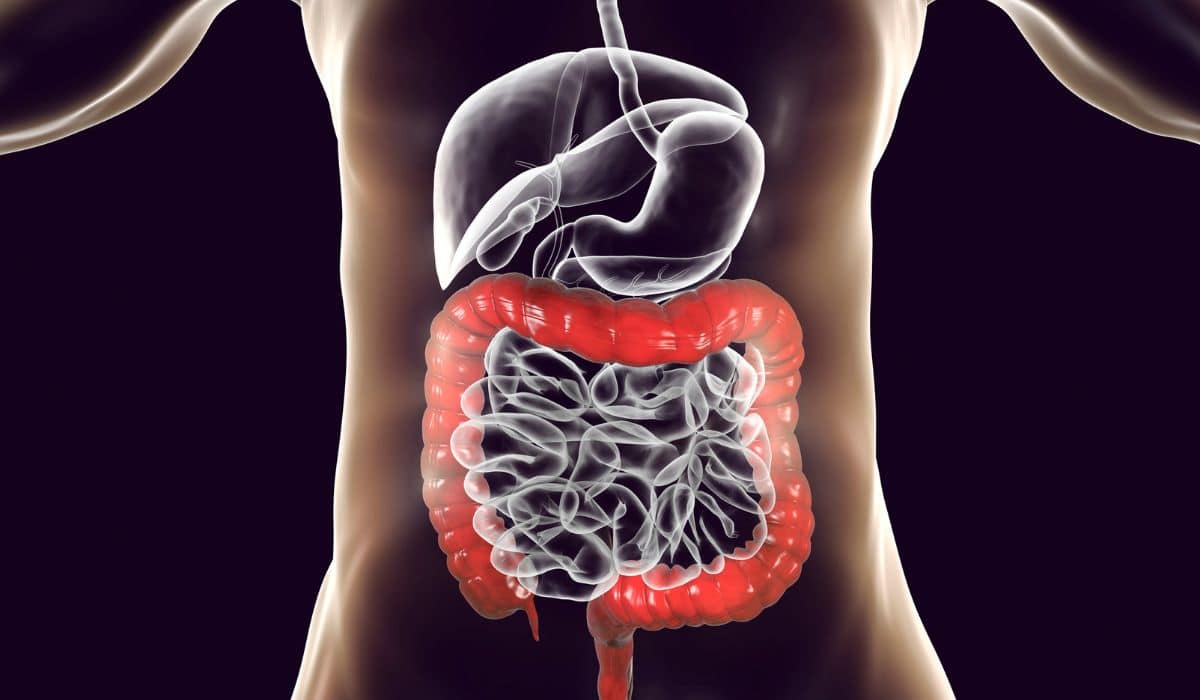
    Baked Salmon Loaf With Dill & Cucumber Salad - by Eat Drink Paleo

    A salmon loaf full of nutrients and veggies.

    Avocado, Apple And Chicken Salad - by Paleo Leap

    Chicken salad, minus the mayo. Great for anyone with an egg sensitivity or following a Paleo autoimmune protocol.

    Filed Under: Paleo Recipe Compilations

    Paleo Foods: Bone Marrow

    September 12, 2016 by Paleo Leaper Leave a Comment

    completed bone marrow

    Bone marrow is a unique, creamy substance found lurking inside long, large bones -- like a tube inside a hard shell of bone. While the nutrition facts for bone marrow have not been thoroughly researched and published, marrow is indeed full of healthy fats. Non-muscle meats like organs and bones are known to be very nutrient dense. In fact, many traditional cultures cherished the marrow and organs of animals, and instead gave the muscle meat to their dogs.

    One of the most popular ways to enjoy bone marrow is to place bones on a baking sheet and roast for 15 minutes at 400 degrees. You can enjoy marrow as an appetizer spread on a Paleo, grain-free cracker or dipping chip. You can also make a nutrient-dense beef broth or beef stew using marrow bones. When the bone broth or stew is finished cooking, remove the bones and scoop the marrow from the bones and spread on a Paleo cracker.

    Nutrition Details

    Macronutrients Macros in Context

    Here's how 1 ounce of bone marrow stacks up in the context of a typical Paleo meal:

    Blue bars show the typical range in grams for a Paleo meal. For example, a Paleo meal usually includes 30-60 grams of fat, but where you personally fall in that range will depend on your preference.

    Orange dots show how 1 ounce of bone marrow fits into the typical nutrient profile of a Paleo meal.

    Buying it Buy It

    • GRASS-FED: Purchase marrow bones from grass-fed animals, when possible. Look for thick, broad bones that contain lots of marrow inside.
    • INEXPENSIVE: Luckily, bones remain fairly inexpensive to purchase. Grass-fed bones may cost a bit more, but it's well worth the few extra dollars or cents.
    • TYPE: Beef bones are the most typical marrow bones, but bones of any large mammal like deer, elk or caribou will have marrow inside.

    Cooking with it Cook It

    ROAST

    Place bones (marrow side up) on a baking sheet and roast for 15 minutes at 400 degrees. Scoop out the marrow and serve on a salad or veggies.

    BROTH

    Use your leftover roasted marrow bones to make bone broth.

    MARROW BUTTER

    Roast bone marrow, scoop out marrow, mix with butter and herbs to create a marrow butter.

    STEW

    Make a beef stew with a mix of marrow bones and bones with a bit of meat on them.

    Recipe ideas Recipe Ideas

    bone marrow

    Roasted Bone Marrow

    bison bulalo main

    Bison Bulalo

    roasted lamb shanks main

    Roasted Lamb Shanks

    Filed Under: Paleo Diet Foods

    21 One-Dish Paleo Dinner Recipes

    August 31, 2016 by Paleo Leaper Leave a Comment

    Create dinner in one dish! If you're tired of dirtying up a bunch of dishes to get dinner on the table, try one of these one-dish recipes and make the task of preparing and cooking dinner a little easier.

    Paleo Pineapple Fried Rice - by Get Inspired Everyday

    A sweet pineapple-filled fried rice dish with crunchy cashews.

    Tex-Mex Turkey Skillet - by Paleo Leap

    Turkey leftovers for people who are sick of turkey leftovers: get excited about them again with this simple skillet dinner.

    Slow Cooker Paleo Pulled Pork - by Anya's Eats

    A simple slow cooker recipe packed with big flavor!

    Crispy Skin Chicken With Honey Garlic Sauce - by Eat Drink Paleo
    Crispy chicken with honey sauce and plenty of veggies.

    Chinese Kung Pao Chicken - by I Heart Umami

    Skip the takeout and enjoy this spicy, smoky kung pao chicken.

    Lemon Chicken Skillet - by Primally Inspired

    An easy weeknight meal full of flavor and made in one skillet.

    My Moroccan Meatballs - by I Heart Umami

    A rich Harissa Sauce over pork meatballs and zucchini noodles.

    Paleo Pizza Chicken - by Jay's Baking Me Crazy

    Love pizza? Enjoy all the flavors of pizza stuffed into a chicken thigh.

    Spicy Chipotle Butternut Squash Turkey Chili - by My Heart Beets

    A smoky, chipotle chili made with squash and turkey.

    Chicken Curry with Zucchini Noodles - by Savory Lotus

    A one-pot dish full of warm, flavorful spices, chicken and veggies.

    Lebanese Lemon Chicken - by A Calculated Whisk

    A fast and flavorful lemon chicken with shallots and fresh herbs.

    Best Ever Chorizo & Vegetable Stew - by Happy Body Formula

    A stew stuffed with chorizo, vegetables and tons of spices!

    One Pan Honey Garlic Chicken - by Real Simple Good

    This dish has it all: vegetables, sweet potatoes and honey chicken.

    Simple Sweet Potato Noodle Pad Thai - by Get Inspired Everyday

    An easy veggie pad Thai with loads of spice and flavor.

    Sloppy Joes - by Jay's Baking Me Crazy

    A quick and easy Sloppy Joes recipe that the whole family will love.

    Potato And Buffalo Chicken Casserole - by Paleo Leap

    A favorite family dinner, made Paleo-friendly without sacrificing convenience or comfort-food value.

    Clean & Green Paleo Chicken Salad - by Grass Fed Salsa

    A quick, creamy chicken salad topped with olives, celery and tomatoes.

    Thai Red Vegetable Curry - by My Heart Beets

    A creamy Thai curry filled with snap peas and water chestnuts and lots of veggies.

    Crispy Shredded Chinese Chicken - by Eat Drink Paleo

    A crispy, colorful shredded chicken dish with plenty of flavors and veggies.

    Crispy Chicken with Fig and Shallot Compote - by A Calculated Whisk

    The fig & shallot compote complete this crispy chicken dish!

    Pumpkin Curry - by Savory Lotus

    A warm and cozy dish made of Indian spices and cubed pumpkin.

    Filed Under: Paleo Recipe Compilations

    Paleo Foods: Pears

    August 29, 2016 by Paleo Leaper Leave a Comment

    completed pear

    Pears have many varieties and come in an array of colors. They're also a great source of phytonutrients and anti-inflammatory antioxidants. Unfortunately, pears often contain pesticide residue and are advised to be purchased from organic growers. Because pears are easy to digest, many give pureed pears to their infants as one of their first foods -- another reason to purchase organic pears when possible.

    Nutrition Details

    Macronutrients Macros in Context

    Here's how a serving of 1 medium pear stacks up in the context of a typical Paleo meal:

    Blue bars show the typical range in grams for a Paleo meal. For example, a Paleo meal usually includes 30-60 grams of fat, but where you personally fall in that range will depend on your preference.

    Orange dots show how 1 medium pear fits into the typical nutrient profile of a Paleo meal.

    Buying it Buy It

    Pears found in the store will often be firm and unripe, and need a few days to ripen. Press on the top of the pear; if it gives to the pressure, then the pear is ready to eat. If the top is too soft, the pear is overripe. Lightly speckled pears are fine, but avoid pears with bruises or dark soft spots.

    • VARIETIES: Pears comes in many different colors and varieties. Common varieties include Bartlett, Bosc and Comice.
    • GROWERS: China is the largest producer of pears. In the US, the state of Washington is the largest grower of pears.
    • KEEP FRESH: Like apples, when pears are cut, they quickly turn brown in color. Squeeze a bit of lemon or lime juice on the pear to keep them from discoloring.

    Cooking with it Cook It

    SNACK

    Slice a pear and wrap each slice with a piece of prosciutto and sprinkle with cinnamon.

    SALAD

    Serve pears, arugula, walnuts and pancetta with a tangy vinaigrette for a delicious salad.

    SKILLET

    Heat butter in a skillet and cook pears cut side down until browned. Add cinnamon, nutmeg and a dollop of coconut cream.

    CARAMELIZE

    Caramelize pears with spices and serve alongside chicken or pork.

    Recipe ideas Recipe Ideas
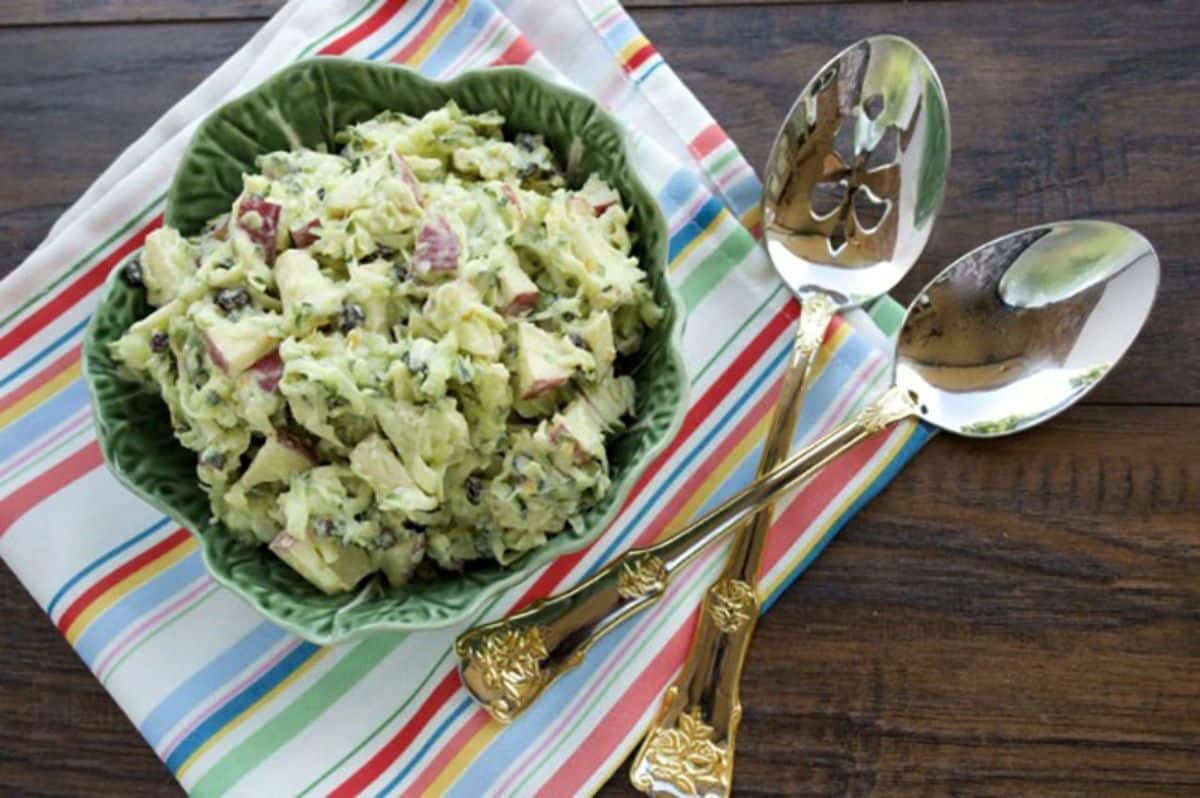
    sausage cranberry stuffed pears main

    Sausage and Cranberry-Stuffed Pears
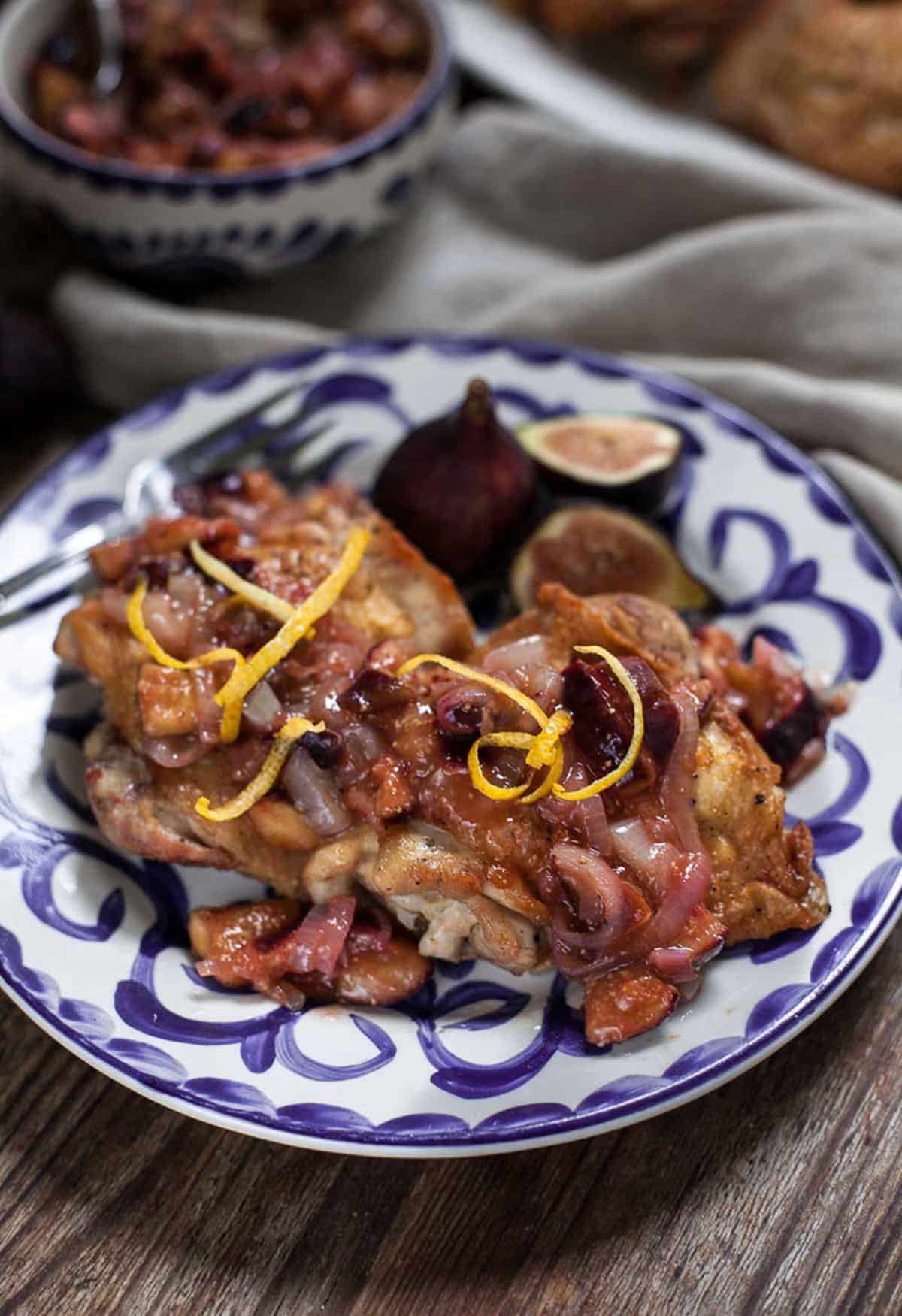
    pork tenderloin warm pear salsa main

    Pork Tenderloin With Warm Pear Salsa

    turnip potato pear soup main

    Turnip, Potato, and Pear Soup

    balsamic pear chicken main

    Chicken With Balsamic Pears

    Filed Under: Paleo Diet Foods

    « Previous Page
    Next Page »
    paleo leap square logo

    Hi, I'm Rick! Paleo Leap is the oldest and biggest resource online, covering everything about the paleo diet. We have over 1500 recipes categorized and plenty of meal plans for you to try.

    More about me →

    Popular

    • Bacon-Wrapped Salmon Featured
      Bacon-Wrapped Salmon Recipe
    • Almond Milk Custard
      Almond Milk Custard Recipe
    • Flourless Banana Pancakes Featured
      Flourless Banana Pancakes Recipe
    • Turban Squash Soup Featured
      Turban Squash Soup Recipe

    Recent Recipes:

    • closeup of a glass of Kale and banana green smoothie with a banana in the background
      Kale and Banana Green Smoothie
    • closeup of a glass of Almond banana cinnamon smoothie on a wood table
      Almond Banana Cinnamon Smoothie
    • glass of Peach and chocolate green smoothie on a wood table with peaches in the background
      Peach and Chocolate Green Smoothie
    • closeup of two glasses of cinnamon and Coconut vanilla milkshake
      Coconut Vanilla Milkshake

    Footer

    ↑ back to top

    About

    • Privacy Policy
    • Disclaimer
    • Cookie Policy

    Newsletter

    • Sign Up! for emails and updates

    Contact

    • Contact

    As an Amazon Associate, I earn from qualifying purchases.

    For your information only. The statements on this website are merely opinions. Paleo Leap does not provide medical or nutritional advice, treatment, or diagnosis. Read the full disclaimer.

    Copyright © 2023 Paleo Leap